

🪨 Gravel Calculator: How Much Gravel Do I Need?
Calculate volume, weight & cost — Rectangle · Circle · Triangle
You can explore more tools like this in our construction calculator collection for better project planning.
This gravel calculator gives you volume, weight, and cost in seconds. Enter your area dimensions, choose a depth, and pick your gravel type. Results appear instantly — no math required.
It works for rectangles, circles, and triangles. Switch between Imperial and Metric with one click. Results show cubic yards, cubic meters, tons, tonnes, kilograms, and the number of 50 lb bags you need.
How Much Gravel Do I Need?
The answer depends on three things: area, depth, and gravel type.
Here is the formula used to calculate gravel volume:
Volume (ft³) = Length × Width × Depth
Then convert to cubic yards by dividing by 27.
Quick Reference: Cubic Yards Per 1,000 Square Feet
| Depth | Cubic Yards Needed |
|---|---|
| 1 inch | 3.1 yd³ |
| 2 inches | 6.2 yd³ |
| 3 inches | 9.3 yd³ |
| 4 inches | 12.4 yd³ |
| 6 inches | 18.5 yd³ |
One cubic yard of standard gravel weighs roughly 1.4 short tons (2,800 pounds). Heavier materials like decomposed granite run closer to 1.6 tons per cubic yard.
Recommended Depth By Project Type
Depth is the most common mistake people make. Too shallow and gravel shifts. Too deep and you waste money.
Driveway: 4 to 6 inches Vehicles need a stable base. A 4-inch layer handles light passenger cars. Add another 2 inches for trucks or regular heavy loads. Most contractors use a 4-inch compacted gravel base topped with 2 inches of smaller stone.
Walkway or path: 2 to 3 inches Foot traffic needs far less material. Two inches is the minimum to prevent soil exposure. Three inches keeps the path stable and weed growth minimal.
Patio or garden bed: 2 to 3 inches Decorative coverage does not need depth. A 2-inch layer looks full and keeps weeds down. Going deeper wastes material without adding value.
Base layer under pavers or slabs: 4 to 6 inches This is structural, not decorative. The base supports weight and prevents settling. Compact each layer as you go.
How to Use the Gravel Calculator
Step 1 — Choose your shape. Pick Rectangle, Circle, or Triangle at the top. Most projects are rectangular. Use Circle for round garden beds or pond surrounds. Use Triangle for corner areas or wedge-shaped driveways.
Step 2 — Enter dimensions. Length and width go in the first two fields. Depth goes in the third. Use the quick-select preset buttons (1″ path, 2″ walkway, etc.) to fill depth automatically.
Step 3 — Select gravel type. Each type has a different density. Pea gravel is light. Decomposed granite is heavy. Choosing the right type gives accurate weight results.
Step 4 — Add a price (optional). Enter the price per ton your supplier charges. The tool estimates your total material cost.
Step 5 — Read results. Volume in ft³, yd³, and m³. Weight in lbs, tons, tonnes, and kg. Number of 50 lb bags. Estimated cost.
Gravel Types: Which One to Use
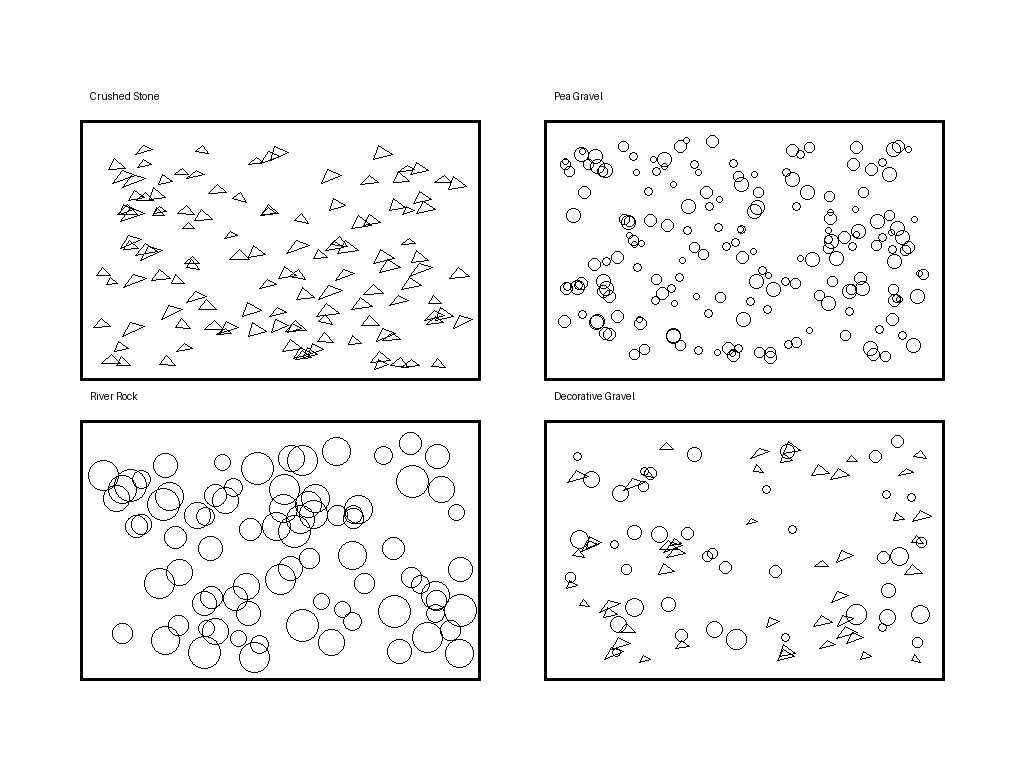
Pea Gravel
Small, smooth, and rounded. Density around 105 lb/ft³. Best for walkways, playgrounds, and decorative beds. It shifts under foot traffic, so edge restraints help. Not recommended for driveways without a stabilizer grid.
Crushed Stone
Angular and compactable. Density around 100 lb/ft³. Locks together when compacted. The best choice for driveway bases, under slabs, and drainage layers. #57 crushed stone (3/4 inch) is the most common size for driveways.
Decomposed Granite
Compacts very hard. Density around 120 lb/ft³. Used for pathways, patios, and desert landscaping. Stabilizes well and resists erosion. Popular in dry climates.
Limestone
Dense and durable. Density around 110 lb/ft³. Good for driveways and base layers. Slightly more expensive than generic crushed stone but longer lasting.
Sand and Gravel Mix
A blend of fine and coarse material. Density around 120 lb/ft³. Good for general fill, drainage improvement, and under concrete slabs.
Weight of Gravel Per Cubic Yard
| Gravel Type | Density (lb/ft³) | Weight Per Cubic Yard |
|---|---|---|
| Pea Gravel | 105 | ~1.42 tons |
| Crushed Stone | 100 | ~1.35 tons |
| Regular Gravel | 105 | ~1.42 tons |
| Decomposed Granite | 120 | ~1.62 tons |
| Limestone | 110 | ~1.49 tons |
| Sand & Gravel Mix | 120 | ~1.62 tons |
| Quartzite | 109 | ~1.47 tons |
Use these numbers to double-check supplier estimates. If a supplier quotes weight per ton, multiply cubic yards by the relevant value above.
Bags vs. Bulk: Which Should You Buy?
Bags cost more per ton but make small projects easier. Bulk delivery saves money on large projects.
Buy bags when:
- The project is under 0.5 cubic yards (roughly 14 bags of 50 lb)
- You have no way to handle bulk delivery
- You need to carry material to a hard-to-reach area
Buy bulk when:
- The project is 0.5 cubic yards or more
- You have a dump site with good access
- You want to save 30–50% on material cost
One cubic yard of gravel equals about 54 bags of 50 lb. The tool shows both options in results so you can compare costs before ordering.
Gravel Coverage Per Ton
How far does a ton of gravel go? It depends on depth. Use these numbers to estimate the gravel needed before contacting a supplier.
| Depth | Coverage Per Ton |
|---|---|
| 1 inch | ~240 sq ft |
| 2 inches | ~120 sq ft |
| 3 inches | ~80 sq ft |
| 4 inches | ~60 sq ft |
These are approximate values for standard gravel at 105 lb/ft³. Heavier types like decomposed granite cover slightly less per ton.
Common Mistakes When Calculating Gravel
Not measuring depth consistently. A 3-inch average across a sloped area is different from 3 inches everywhere. Measure at multiple points if the ground is uneven.
Forgetting compaction. Loose gravel compacts 15–20% after settling and traffic. Add 15% to your order to account for this.
Using one material for every layer. Driveways work better with a dense base layer (crushed stone) topped with a finer finish layer (pea gravel or limestone chips). The calculator handles each layer separately.
Measuring the wrong dimensions. Always measure the area the gravel will actually cover. A common error is calculating how much gravel is needed based on total property area rather than the specific zone being filled.
Frequently Asked Questions
Related Calculators
- Concrete Calculator — Estimate concrete volume for slabs and footings
- Cubic Yard Calculator — Calculate cubic yards for any material
- Asphalt Calculator — Estimate asphalt tonnage for paving projects
Conclusion
Getting the right amount of material before ordering saves time, money, and multiple trips to the supplier. This gravel calculator handles the volume, weight, and cost estimate for all three common shapes — rectangle, circle, and triangle.
Add 10–15% to your calculated amount to cover compaction and uneven ground. Choose your gravel type based on the project, not just price. And always measure depth at multiple points if the surface is not perfectly level.