
Board Foot Calculator, Calculate Lumber Volume and Estimate Wood Needs

Calculate total board feet for lumber using thickness, width, length, and quantity.

Enter thickness in inches
Enter width in inches
Enter length in feet
Number of identical boards

For more helpful tools, visit our construction calculator online page and simplify your estimates.

A board foot calculator helps you measure lumber volume fast and correctly. It uses thickness, width, length, and quantity to give accurate results. This makes it easier to plan projects, estimate cost, and avoid buying extra wood.

Whether you are working with hardwood, softwood, or construction lumber, knowing board feet is important. It helps compare wood sizes, understand pricing, and plan material needs without confusion.

Instead of doing manual calculations, this tool simplifies everything. You enter basic dimensions, and it instantly shows total board feet. This saves time and reduces errors, especially in large projects.

What Is a Board Foot and Why It Matters in Lumber Buying

A board foot is a standard unit used to measure lumber volume. It represents a piece of wood that is:

  • 1 inch thick
  • 12 inches wide
  • 12 inches long

This equals 144 cubic inches of wood.

Lumber yards use this unit because wood comes in different sizes. Measuring only length or area is not enough. Volume gives a more accurate way to price and compare boards.

Common terms used in the lumber industry include:

  • BF, BDFT, FBM
  • Thousand board feet, also called MBF
  • Hardwood and softwood classifications

Using board feet helps you:

  • Compare different board sizes easily
  • Understand pricing based on volume
  • Estimate total material needed for projects

Without this system, buying lumber would be confusing and inconsistent.

Board Foot Calculator, How It Works Step by Step

The tool works using simple inputs and a clear formula. You only need basic measurements of your lumber.

Enter these values:

  • Thickness in inches
  • Width in inches
  • Length in feet
  • Quantity of boards

Once you enter the values, the calculation runs instantly. The result shows total board feet for all pieces combined.

Here is how the process works:

  • Thickness and width define the cross section of the board
  • Length adds depth to calculate total volume
  • Quantity multiplies the result for multiple boards

The output is easy to read and helps with quick decisions.

Why this method works well:

  • It uses standard lumber measurement units
  • It matches how suppliers price wood
  • It avoids manual errors in calculations

For larger projects, this approach saves time and keeps estimates accurate.

Board Foot Formula in Simple Terms

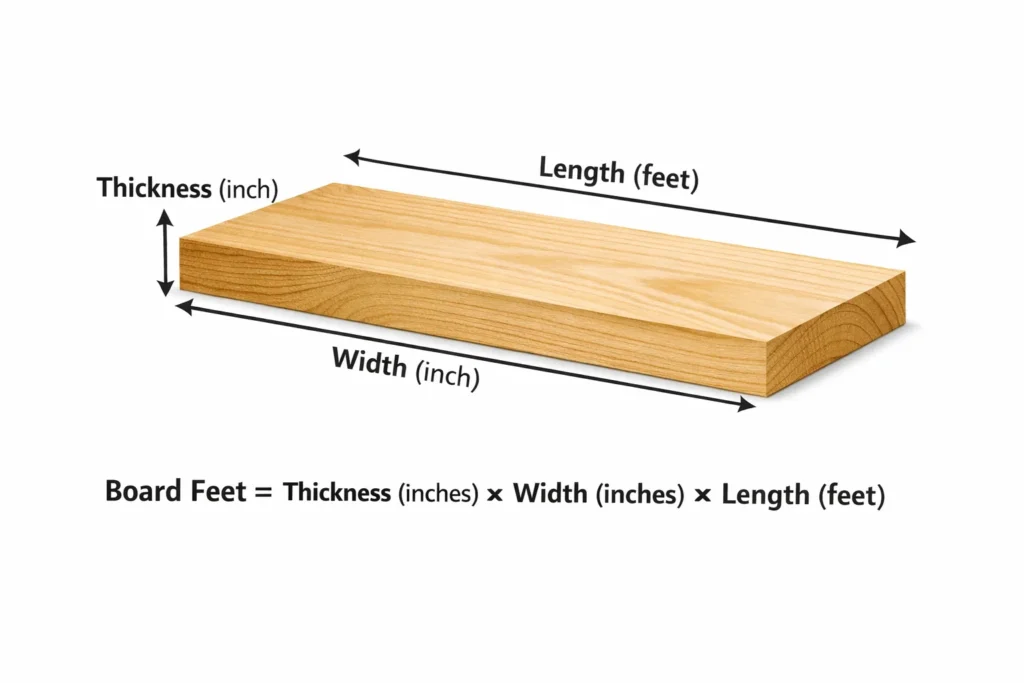
The formula used to calculate board feet is simple and practical. Board feet equals thickness multiplied by width multiplied by length, divided by twelve.

board foot formula diagram showing thickness width length of lumber with measurement labels

Each part of the formula has a clear role:

  • Thickness is measured in inches
  • Width is measured in inches
  • Length is measured in feet

Dividing by twelve converts the total into board feet correctly.

There is another way to understand the same calculation:

  • Multiply thickness, width, and length in inches
  • Divide the result by 144

Both methods give the same answer. The first version is easier for most users.

Why the formula works:

  • It converts dimensions into volume
  • It standardizes different board sizes into one unit
  • It helps compare lumber consistently

Once you understand this formula, you can quickly estimate board feet even without a tool.

Example Calculations to Understand Board Foot Quickly

Simple examples help you understand how board foot works in real situations.

Example 1: Single board calculation

A board is 2 inches thick, 6 inches wide, and 8 feet long.

  • Multiply 2 × 6 × 8
  • Divide by 12

Result:

  • 8 board feet for one board 

Example 2: Multiple boards

You have 10 boards with the same dimensions.

  • One board = 8 board feet
  • Multiply 8 × 10

Result:

  • 80 board feet total

Example 3: Hardwood thickness notation

A 4/4 board means 1 inch thickness.

A board is:

  • 4/4 thick
  • 8 inches wide
  • 10 feet long

Calculation:

  • 1 × 8 × 10 ÷ 12

Result:

  • 6.67 board feet 

Example 4: Larger board

A board is 3 inches thick, 10 inches wide, and 12 feet long.

  • 3 × 10 × 12 ÷ 12

Result:

  • 30 board feet

These examples show how thickness, width, and length affect total volume.
You can use similar steps for any lumber size.

Standard Lumber Sizes and Their Board Foot Values

Lumber often comes in common sizes. Knowing these helps you estimate quickly. Here are typical board sizes and their approximate board foot values.

common lumber sizes 2x4 2x6 2x8 with board foot values and actual dimensions comparison

2x4 lumber

  • 8 ft length = about 5.33 board feet
  • 10 ft length = about 6.67 board feet
  • 12 ft length = about 8 board feet

2x6 lumber

  • 8 ft length = about 8 board feet
  • 10 ft length = about 10 board feet
  • 12 ft length = about 12 board feet

2x8 lumber

  • 8 ft length = about 10.67 board feet
  • 10 ft length = about 13.33 board feet
  • 12 ft length = about 16 board feet

2x10 lumber

  • 8 ft length = about 13.33 board feet
  • 10 ft length = about 16.67 board feet
  • 12 ft length = about 20 board feet

Lumber sizes are labeled using nominal dimensions. Actual sizes are usually smaller.

For example:

  • A 2x4 is actually about 1.5 × 3.5 inches
  • A 2x6 is about 1.5 × 5.5 inches

This difference happens due to drying and finishing processes.

Why this matters

  • Using actual dimensions gives more accurate volume results
  • Nominal sizes are useful for quick estimation only
  • Builders often rely on experience to adjust values

Knowing these sizes helps you estimate faster, even before using any tool.

Board Foot vs Square Foot vs Linear Foot

These three units measure different things. Mixing them causes mistakes in lumber estimates.

difference between board foot square foot and linear foot with visual comparison of volume area and length

Board foot measures volume

  • Includes thickness, width, and length
  • Used for solid lumber like hardwood boards
  • Helps calculate how much wood you actually get

Square foot measures area

  • Uses only length and width
  • Common for flooring, plywood, and panels
  • Does not include thickness

Linear foot measures length

  • Only measures the length of material
  • Used for trim, molding, and framing pieces
  • Ignores width and thickness 

Quick comparison

  • Board foot = volume of wood
  • Square foot = surface area
  • Linear foot = length only 

When to use each

  • Use board foot for lumber buying and cost calculation
  • Use square foot for sheet materials like plywood
  • Use linear foot for long pieces like beams or trim

Common mistake to avoid

Many people try to convert square foot directly into board foot.
This only works when thickness is known.

For example:

  • 1 square foot with 1 inch thickness = 1 board foot
  • Different thickness gives different results

Understanding these differences helps avoid incorrect estimates and wasted money.

Convert Board Foot to Other Units Easily

Sometimes you need to switch between units when planning or buying lumber. These conversions help you work with different systems.

Board foot to cubic feet

One board foot equals one twelfth of a cubic foot.

  • 12 board feet = 1 cubic foot
  • Divide total board feet by 12 to get cubic feet

Example:

  • 60 board feet ÷ 12 = 5 cubic feet

Board foot to cubic meters

For international use, cubic meters are common.

  • 1 board foot ≈ 0.00236 cubic meters

Example:

  • 100 board feet ≈ 0.236 cubic meters

Square foot to board foot

You need thickness to convert correctly.

Formula idea:

  • Square feet × thickness in inches ÷ 12

Example:

  • 50 square feet with 2 inch thickness
  • 50 × 2 ÷ 12 = 8.33 board feet

Linear foot to board foot

Linear feet require width and thickness.

Example:

  • 10 feet length
  • 6 inches width
  • 2 inches thickness

Calculation:

  • 2 × 6 × 10 ÷ 12 = 10 board feet

Why conversions matter

  • Helps compare materials across different measurement systems
  • Useful when working with suppliers using different units
  • Important for international projects and exports

Learning these conversions makes planning more flexible and accurate.

Board Foot Calculator for Logs and Tree Measurements

Lumber from logs is measured differently than finished boards. Logs use estimation methods based on diameter and length.

How log measurement works

  • Measure diameter inside bark at the small end
  • Measure log length in feet
  • Apply a log scale to estimate usable lumber

Common log scales used:

  • Doyle scale
  • Scribner scale
  • International 1/4 scale

Each method gives slightly different results. The Doyle scale is widely used but can underestimate small logs.

Why log calculations are different

  • Logs include bark, taper, and waste
  • Not all wood becomes usable boards
  • Sawmill cuts affect final yield

Because of this, log board foot values are estimates, not exact numbers.

Key factors that affect results

  • Log diameter
  • Log length
  • Wood species
  • Sawing method
  • Defects like knots or cracks

When to use log estimation

  • Buying standing trees
  • Planning sawmill output
  • Estimating raw timber value

For finished boards, always use standard board foot calculation instead of log estimates.

How to Calculate Board Feet for Multiple Boards

Projects often include boards of different sizes. You need a simple method to handle them together.

Basic approach

  • Calculate board feet for one board first
  • Repeat for each board size
  • Add all results to get total volume 

Example with mixed boards

You have:

  • 5 boards of 2 × 6 × 8
  • 3 boards of 2 × 8 × 10

Steps:

  • First group = 2 × 6 × 8 ÷ 12 = 8 board feet
  • Total for first group = 8 × 5 = 40
  • Second group = 2 × 8 × 10 ÷ 12 = 13.33
  • Total for second group = 13.33 × 3 = 40

Final result:

  • 40 + 40 = 80 board feet total

Tips for faster calculation

  • Group boards by same size
  • Calculate once, then multiply by quantity
  • Round values only at the final step

Why this method helps

  • Saves time on large projects
  • Reduces calculation mistakes
  • Keeps estimates organized and easy to check

Using this approach makes it easier to plan materials for furniture, decks, or construction work.

Price per Board Foot, How Lumber Cost Is Calculated

Lumber is usually sold by board foot, not by piece. This makes pricing consistent across different sizes.

How pricing works

Each wood type has a price per board foot. You multiply this rate by total volume.

Simple method:

  • Total board feet × price per board foot = total cost 

Example calculation

You need 80 board feet of oak.

  • Price = 6 dollars per board foot
  • 80 × 6 = 480 total cost

Factors that affect price

  • Wood species like oak, walnut, or pine
  • Grade and quality of lumber
  • Moisture condition, kiln dried or green
  • Thickness and width availability
  • Market demand and location 

Why board foot pricing is used

  • Works for all board sizes
  • Keeps pricing fair across different dimensions
  • Helps buyers compare wood types easily

Tips for better cost planning

  • Always confirm price per board foot before buying
  • Add extra budget for waste and defects
  • Compare multiple suppliers for better rates

Understanding pricing helps you stay within budget and avoid surprises at the lumber yard.

Average Price per Board Foot by Wood Type

Prices change by location and availability, but general ranges help with planning.

Common wood types and typical price ranges

  • Pine
    • Around 2 to 4 dollars per board foot
    • Budget friendly and widely available
  • Oak
    • Around 5 to 8 dollars per board foot
    • Strong and commonly used in furniture
  • Maple
    • Around 6 to 10 dollars per board foot
    • Smooth grain and durable
  • Walnut
    • Around 10 to 15 dollars per board foot
    • Premium hardwood with rich color
  • Cedar
    • Around 4 to 7 dollars per board foot
    • Good for outdoor projects due to resistance
  • Teak
    • Around 20 dollars or more per board foot
    • High-end wood with strong durability 

Why prices vary

  • Hardwood costs more than softwood
  • Rare species have higher demand
  • Drying method affects final price
  • Local supply changes availability 

How to use this information

  • Estimate project budget before buying
  • Choose wood based on both cost and purpose
  • Adjust plan if material exceeds budget

These price ranges give a quick idea, but always check with local suppliers for exact rates.

Real-World Use Cases for Board Foot Calculation

Board foot measurement is used in many practical situations. It helps plan material, control cost, and avoid waste.

Deck building

  • Estimate total lumber needed for framing and surface boards
  • Compare different board sizes for strength and cost
  • Plan material before starting outdoor construction

Furniture making

  • Calculate wood needed for tables, cabinets, and shelves
  • Choose between hardwood types based on budget
  • Reduce waste by planning exact board sizes 

Woodworking projects

  • Useful for DIY tasks like shelves or small builds
  • Helps manage leftover pieces and scrap wood
  • Keeps material planning simple and organized

Construction and renovation

  • Contractors use board feet for framing and structural work
  • Helps estimate cost before ordering materials
  • Supports accurate planning for large projects 

Sawmill and lumber yard work

  • Used to measure raw timber output
  • Helps price bulk wood orders
  • Ensures consistent measurement across different board sizes

Why it matters in real projects

  • Prevents overbuying or underbuying wood
  • Helps control project budget
  • Improves planning accuracy from start to finish

Using board foot correctly makes every wood project more efficient and predictable.

Waste Factor and Extra Material Planning

Real projects always need extra wood. Cuts, defects, and adjustments reduce usable material.

Why waste happens

  • Cutting boards to required sizes
  • Trimming edges for clean finishes
  • Defects like knots, cracks, or warping
  • Measurement adjustments during installation

How much extra to add

A simple rule works well for most projects:

  • Add 10 percent for small projects
  • Add 15 to 20 percent for larger or complex builds

Example

If your project needs 100 board feet:

  • Add 10 percent = 110 board feet total
  • Add 20 percent = 120 board feet total

This ensures you do not run short during work.

Tips to reduce waste

  • Plan cuts before starting
  • Group similar board sizes together
  • Use leftover pieces for smaller parts
  • Check wood quality before buying

Why planning extra matters

  • Saves time by avoiding repeat trips to suppliers
  • Keeps workflow smooth without interruptions
  • Helps maintain consistent material quality

Adding a small buffer improves accuracy and avoids costly delays.

Hardwood Thickness Notation Explained for Beginners

Hardwood is often labeled using a quarter system. This shows thickness before surfacing.

What the notation means

Each number represents quarters of an inch.

  • 4/4 means 1 inch thick
  • 5/4 means 1.25 inches thick
  • 6/4 means 1.5 inches thick
  • 8/4 means 2 inches thick

Why this system is used

  • Hardwood is sold rough, not fully finished
  • Thickness may change after planing and drying
  • This system gives a standard reference across suppliers

Rough vs surfaced lumber

  • Rough lumber is cut but not smoothed
  • Surfaced lumber is planed to a cleaner finish
  • Final thickness becomes slightly smaller after surfacing

Example:

  • 4/4 rough lumber may finish near 0.75 inches

Why this matters in calculation

  • Using rough thickness gives more accurate volume estimates
  • Using finished size may reduce calculated board feet
  • Always confirm whether dimensions are rough or surfaced

Quick tip

When buying hardwood, ask for actual thickness after surfacing.
This helps avoid errors in planning and ensures better material use.

Moisture Content and Its Impact on Board Foot Measurement

Wood changes size based on moisture levels. This affects how accurate your measurements are.

How moisture affects wood

  • Wet wood expands slightly
  • Dry wood shrinks over time
  • Dimensions change after drying

Types of lumber based on moisture

  • Green lumber has high moisture content
  • Kiln-dried lumber is dried to stable levels

Why this matters

  • Board size may reduce after drying
  • Final volume can be slightly different from initial calculation
  • Moisture affects weight and strength of wood

Tips for better accuracy

  • Use kiln-dried lumber for precise projects
  • Measure wood after drying when possible
  • Avoid mixing wet and dry wood in the same calculation

Understanding moisture helps prevent sizing issues and improves project quality.

Common Mistakes When Calculating Board Feet

Small errors can lead to wrong estimates and extra cost.

Common mistakes

  • Mixing inches and feet in the same calculation
  • Forgetting to divide by twelve in the formula
  • Ignoring quantity when calculating total volume
  • Using nominal sizes instead of actual dimensions
  • Rounding values too early

How to avoid these mistakes

  • Keep all units consistent
  • Double-check inputs before calculating
  • Use actual measurements for accuracy
  • Round only at the final result

Avoiding these mistakes improves accuracy and saves money.

How to Measure Lumber Correctly Before Calculation

Accurate measurement is the first step in correct calculation.

Steps to measure lumber

  • Measure thickness using a ruler or caliper
  • Measure width across the widest part of the board
  • Measure length in feet using a tape measure
  • Check for irregular edges or bends

Important tips

  • Always use actual dimensions, not labeled sizes
  • Measure each board if sizes vary
  • Keep units consistent across all inputs

Proper measurement ensures reliable results and better planning.

Board Foot Quick Reference Chart for Fast Estimation

Quick reference charts help estimate without doing full calculations.

Common estimates

  • 2 × 4 × 8 = about 5.33 board feet
  • 2 × 6 × 8 = about 8 board feet
  • 2 × 8 × 10 = about 13.33 board feet
  • 2 × 10 × 12 = about 20 board feet

Why use a chart

  • Saves time during quick decisions
  • Useful at lumber yards
  • Helps compare sizes instantly

When to use calculator instead

  • When working with different board sizes
  • When accuracy is important
  • When calculating total project volume

Charts are helpful, but detailed calculations give better accuracy.

FAQs About Board Foot Calculation and Lumber Measurement

One board foot equals a piece of wood that is one inch thick, one foot wide, and one foot long.

Multiply thickness, width, and length, then divide by twelve for quick results.

It depends on thickness. One inch thickness equals one board foot per square foot.

Because lumber has thickness, volume measurement gives more accurate results.

No, sheet materials are measured in square feet, not board feet.

When to Use a Board Foot Calculator Instead of Manual Calculation

Manual calculation works for small tasks, but tools are better for larger projects.

When a tool is useful

  • Working with many boards
  • Handling different sizes together
  • Estimating cost and material quickly
  • Avoiding calculation mistakes

Benefits of using a calculator

  • Faster results
  • Better accuracy
  • Easy to use for beginners
  • Useful for planning large projects

Using a tool improves efficiency and reduces errors.

Final Thoughts on Using a Board Foot Calculator Efficiently

A board foot calculator helps you measure lumber volume with accuracy and speed. It simplifies planning, reduces mistakes, and improves cost estimation.

By understanding the formula, measurements, and common mistakes, you can make better decisions when buying wood. Always measure carefully, account for waste, and choose the right wood type for your project.

Using this method ensures smooth project execution and better results every time.