

Exponent Calculator
Exponent Calculator, Solve Powers, Fractions, and Negative Exponents
An exponent calculator helps you solve powers, fractions, and negative exponents quickly. It removes guesswork when dealing with repeated multiplication or complex expressions.
You often see exponents in algebra, science, and daily calculations. Understanding how they work makes problem solving much easier and faster.
Most problems follow simple patterns once you know the rules. This guide explains those patterns using real examples and clear steps.
If you also work with roots, check this square root calculator for related problems. Both concepts connect when dealing with fractional exponents.
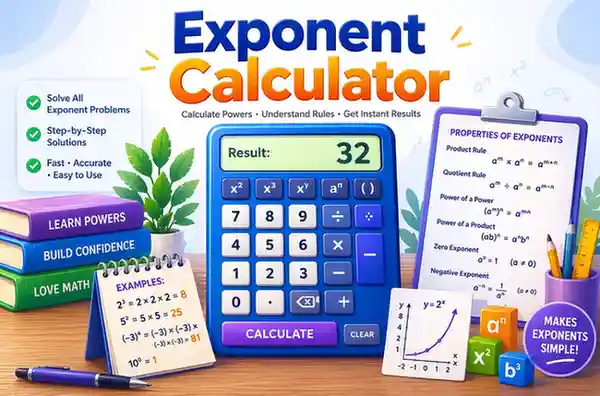
What is an exponent and how exponent notation works
An exponent shows how many times a number multiplies itself. It has two parts, the base and the exponent.
In the expression 2³, the base is 2. The exponent is 3, which means multiply 2 three times.
So, 2³ equals 2 × 2 × 2, which gives 8. This process is called exponentiation.
Exponents use superscript notation to keep expressions compact. Instead of writing long multiplication, you write a short power form.
You will often see this in formulas and equations. It helps simplify complex calculations.
Understanding this format is the first step before solving any exponent problem.
Once clear, you can move to formulas and rules easily.
Basic formula to calculate exponents step by step
You can solve most exponent problems using simple repeated multiplication. This method works well for small numbers and clear expressions.
The basic formula is:an=a×a×a…(n times)
Here, a is the base and n is the exponent.
For example, 3⁴ means:
- 3 × 3 × 3 × 3
- Result equals 81
This approach is easy but not practical for large values. That is where a calculator with exponents becomes useful.
Step-by-step method
Follow these steps for manual calculation:
- Identify the base and exponent
- Expand the expression into repeated multiplication
- Multiply step by step
- Write the final result
Example:
- 5³ = 5 × 5 × 5
- 5 × 5 = 25
- 25 × 5 = 125
Using powers with multiple operations
When expressions include more than one operation, follow order of operations:
- Solve exponents first
- Then multiplication or division
- Then addition or subtraction
Example:
- 2 + 3² × 2
- First solve 3² = 9
- Then 9 × 2 = 18
- Final result = 20
When to avoid manual calculation
Manual steps become slow in some cases:
- Large exponent values like 10⁸
- Decimal or fractional exponents
- Long expressions with variables
In these cases, use a power calculator or scientific tool. It saves time and reduces errors. You can also explore a scientific calculator for advanced expressions. It handles powers, roots, and complex calculations in one place.
Laws of exponents you must understand before calculation
Exponent rules help you simplify expressions without long multiplication. They save time and reduce mistakes in complex problems.
You should learn these rules before using any exponent calculator. They apply to numbers, variables, and mixed expressions.
Product and quotient rules
When multiplying powers with the same base, add the exponents.
- a^m × a^n = a^(m+n)
Example:
- 2³ × 2² = 2⁵ = 32
For division, subtract the exponents.
- a^m ÷ a^n = a^(m−n)
Example:
- 5⁴ ÷ 5² = 5² = 25
These rules only work when the base is the same.
Power of a power rule
When raising a power to another power, multiply the exponents.
- (a^m)^n = a^(m×n)
Example:
- (2³)² = 2⁶ = 64
This rule helps simplify nested exponent expressions quickly.
Zero exponent rule
Any non-zero number raised to zero equals one.
- a⁰ = 1
Example:
- 7⁰ = 1
This rule is often used in algebra simplification.
Negative exponent rule
A negative exponent means take the reciprocal of the base power.
- a^−n = 1 / a^n
Example:
- 2^−3 = 1 / 8
This converts negative powers into positive form for easier solving.
These rules form the foundation for solving most exponent problems. You will use them in fractions, variables, and advanced calculations.
How to calculate negative exponents with real examples
Negative exponents look tricky, but the process is simple.
You just convert the expression into a reciprocal form first.
Use this rule:a−n=an1
This means the base moves to the denominator.
Step-by-step method
Follow these steps:
- Change the negative exponent to positive
- Move the base to the denominator
- Calculate the power normally
Example:
- 4^-2 becomes 1 / 4²
- 4² = 16
- Final answer = 1 / 16
Example with variables
Negative exponents also apply to variables.
- x^-3 = 1 / x³
If you see a fraction already, reverse it:
- (1/5)^-2 becomes 5²
- Final answer = 25
Common mistakes to avoid
- Do not make the result negative
- Negative exponent does not mean negative value
- Always apply the reciprocal rule first
Quick real-world use
Negative exponents appear in:
- Scientific notation with very small numbers
- Physics formulas with inverse relationships
- Unit conversions in advanced calculations
If you work with fractions and roots, check this fraction calculator with exponents. It helps simplify mixed expressions faster.
How to calculate fractional exponents and rational exponents
Fractional exponents represent roots combined with powers. They help convert complex expressions into simpler forms.
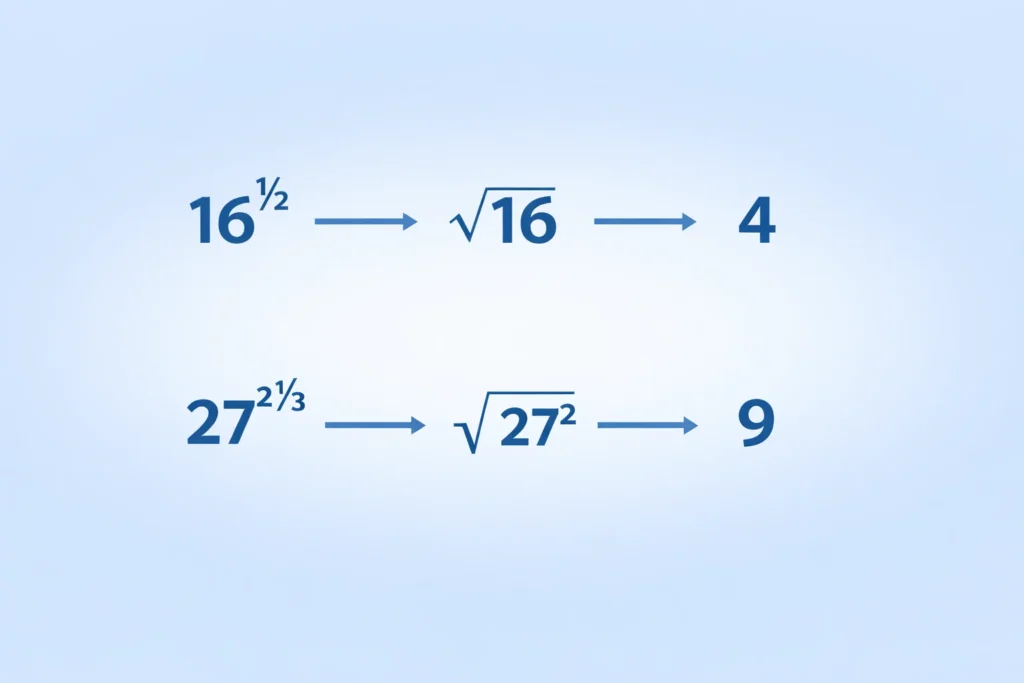
Use this rule:am/n=nam
The numerator is the power. The denominator is the root.
Step-by-step method
Follow these steps:
- Identify numerator and denominator of the exponent
- Apply the root based on denominator
- Apply the power based on numerator
Example:
- 16^(1/2) becomes √16
- Result equals 4
Another example:
- 27^(2/3) becomes cube root of 27²
- 27² = 729
- Cube root of 729 = 9
Converting between forms
You can switch between exponent and radical forms easily.
- 8^(1/3) equals cube root of 8
- 32^(2/5) equals fifth root of 32²
This makes calculations clearer in many problems.
When to use this method
Fractional exponents appear in:
- Algebra expressions with roots
- Geometry formulas involving area and volume
- Scientific calculations with scaling factors
Common mistakes to avoid
- Do not divide the base by the fraction
- Always apply root first when needed
- Handle negative bases carefully with roots
Fractional exponents connect closely with roots and radicals.
How to simplify exponents using rules and patterns
Simplifying exponents helps reduce expressions into a clean final form. It saves time and avoids long calculations.
Start by checking if bases are the same. Then apply the correct exponent rules step by step.
Step-by-step simplification approach
Follow this method:
- Combine like bases using product or quotient rules
- Multiply exponents when powers are nested
- Convert negative exponents into positive form
- Reduce fractional exponents into roots when needed
Example:
- 2³ × 2² becomes 2⁵
- Final result = 32
Another example:
- (x² × x³) ÷ x⁴ becomes x¹
- Final result = x
Simplifying expressions with fractions
Work carefully when fractions are involved.
Example:
- (4² × 4⁻¹) becomes 4¹
- Final result = 4
Always convert negative exponents before final simplification.
Simplifying rational exponents
Convert into radical form if it helps clarity.
Example:
- 9^(1/2) equals √9
- Final result = 3
This method is useful for large or complex numbers.
Pattern recognition tips
You can speed up calculations by spotting patterns:
- Powers of 2, 3, and 10 appear often
- Repeated values simplify quickly using rules
- Large expressions break into smaller parts easily
Common simplification mistakes
- Mixing different bases in one rule
- Forgetting order of operations
- Ignoring parentheses in expressions
Simplifying exponents is easier once you apply rules correctly. It also prepares you for solving larger algebra expressions.
Solving exponent expressions with variables
Variables follow the same rules as numbers in exponent problems. You just apply the laws carefully without mixing different bases.
Start by identifying like terms. Then combine or simplify step by step.
Working with same base variables
When bases match, apply standard rules.
- x² × x³ becomes x⁵
- x⁷ ÷ x² becomes x⁵
Always keep the base unchanged.
Power of a power with variables
Multiply exponents when expressions are nested.
- (x³)² becomes x⁶
- (a²b³)² becomes a⁴b⁶
Distribute the exponent across each term.
Expressions with different bases
Do not combine exponents if bases differ.
- x² × y³ stays as it is
- You cannot merge x and y powers
Keep expressions separate unless bases match.
Variables with negative exponents
Convert negative powers into fractions.
- x⁻² becomes 1 / x²
- (a⁻¹b²) becomes b² / a
This keeps the expression in standard form.
Example with full simplification
Solve:
- (x² × x³) ÷ x⁴
Steps:
- x² × x³ = x⁵
- x⁵ ÷ x⁴ = x¹
Final answer = x
Where this is used
You will see variable exponents in:
- Algebra problems
- Polynomial simplification
- Scientific formulas
How to calculate large exponents without errors
Large exponents are hard to solve with manual multiplication. A small mistake can change the final result completely. You need a structured approach for accuracy and speed.
Break the expression into smaller parts
Instead of solving everything at once, simplify in steps.
- 2¹⁰ can be written as (2⁵)²
- 2⁵ = 32, then 32² = 1024
This reduces calculation errors.
Use powers of 10 for quick estimation
Powers of 10 are easier to handle mentally.
- 10³ = 1000
- 10⁶ = 1,000,000
This helps when estimating large values quickly.
Work with patterns
Some numbers follow clear patterns.
- 2¹, 2², 2³, 2⁴ grow in a predictable way
- Recognizing patterns speeds up calculation
Use logarithmic thinking for very large values
For extremely large exponents, direct calculation is not practical. Use logs or scientific tools to estimate results.
Common mistakes with large exponents
- Skipping steps during multiplication
- Misplacing digits in large numbers
- Ignoring exponent rules for simplification
Large exponent problems are common in science and finance. Use smart shortcuts instead of long manual calculations.
Examples where exponent calculation is used
Exponents appear in many daily and professional situations.
They help model repeated growth and scaling patterns.
Understanding these examples makes concepts easier to apply.
Growth and doubling patterns
Exponents describe repeated growth over time.
- Bacteria doubling every hour follows exponential growth
- Population models often use powers to show increase
Example:
- Start with 2 bacteria
- After 3 hours → 2³ = 8
This pattern appears in biology and data analysis.
Scientific notation and large numbers
Exponents help represent very large or very small values.
- 1,000,000 becomes 10⁶
- 0.0001 becomes 10⁻⁴
This is common in physics and chemistry calculations.
Finance and compound growth basics
Money growth often uses exponent formulas.
- Compound interest depends on repeated multiplication
- Example formula: A = P(1 + r)ⁿ
Here:
- P is principal
- r is rate
- n is time period
Technology and computing
Exponents are used in:
- Data storage units like kilobytes and gigabytes
- Algorithms with exponential complexity
Example:
- 2¹⁰ = 1024 bytes in computing
Common mistakes when working with exponents
Small mistakes can change the entire result in exponent problems. Most errors come from misunderstanding basic rules. Fix these issues early to avoid repeated confusion.
Ignoring parentheses in negative base expressions
Parentheses change the meaning of the expression.
- -4² equals -(4²) = -16
- (-4)² equals 16
Always check how the base is written.
Mixing exponent rules incorrectly
Rules only apply when bases are the same.
- 2² × 3² cannot be combined
- Keep different bases separate
Confusing multiplication with exponentiation
Exponentiation is repeated multiplication, not simple multiplication.
- 2³ is not 2 × 3
- It is 2 × 2 × 2
Misusing negative exponents
Negative exponents do not make the answer negative.
- 3⁻² equals 1 / 9
- Not -9
Errors with fractional exponents
Many users divide instead of applying roots.
- 16^(1/2) means square root, not division
- Always convert to radical form first
Skipping order of operations
Exponents must be solved before multiplication or addition.
- 2 + 3² = 11
- Not 25
dge cases you should understand before solving
Some exponent cases do not follow simple patterns. You need to handle them carefully to avoid wrong results.
Zero as a base
Zero behaves differently depending on the exponent.
- 0⁵ = 0
- Any positive exponent keeps the result zero
But:
- 0⁰ is undefined in most contexts
- Avoid using it without clear rules
Zero as an exponent
Any non-zero number raised to zero equals one.
- 8⁰ = 1
- This rule always applies
Negative base with even and odd exponents
The result depends on the exponent type.
- (-2)² = 4
- (-2)³ = -8
Even powers give positive results. Odd powers keep the negative sign.
Negative base with fractional exponents
This is where problems get tricky.
- (-8)^(1/3) = -2
- Works because cube root of negative is valid
But:
- (-16)^(1/2) is not a real number
- Square root of negative gives complex values
Decimal exponents
Decimal exponents behave like fractional ones.
- 9^0.5 equals √9
- Result = 3
Always convert decimals into fractions for clarity.
Very large or very small values
Extreme values need careful handling.
- Large exponents grow quickly
- Negative exponents shrink values toward zero
Understanding these edge cases prevents confusion. It also helps when using any exponent calculator correctly.
Advanced exponent operations and combinations
Some problems combine multiple exponent rules in one expression. You need a clear order to solve them correctly. Work step by step and avoid rushing through operations.
Multiplying and dividing exponents
Apply product and quotient rules carefully.
- x² × x³ = x⁵
- x⁶ ÷ x² = x⁴
Only combine when bases are the same. Keep different bases separate.
Order of operations with exponents
Exponents are solved before multiplication and division.
Follow this order:
- Solve powers first
- Then multiplication or division
- Then addition or subtraction
Example:
- 2 + 4² × 3
- 4² = 16
- 16 × 3 = 48
- Final answer = 50
Converting between exponent and radical form
This helps simplify complex expressions.
- 25^(1/2) becomes √25
- 64^(2/3) becomes cube root of 64²
Use this method when fractional exponents appear.
Combining multiple rules in one problem
Break the expression into parts.
Example:
- (x² × x³)² ÷ x⁴
Steps:
- x² × x³ = x⁵
- (x⁵)² = x¹⁰
- x¹⁰ ÷ x⁴ = x⁶
Final answer = x⁶
Using an exponent calculator for faster results
An exponent calculator helps when values get large or complex. It reduces manual work and improves accuracy in seconds.
Use it for negative exponents, fractions, and long expressions. It is useful in algebra, science, and daily calculations.
When you should use it
Use a tool in these situations:
- Large exponent values like 10⁸ or higher
- Fractional or rational exponents
- Expressions with variables or multiple steps
- Quick verification of manual results
How to use it correctly
Follow a simple input method:
- Enter the base value
- Enter the exponent value
- Use the power or exponent key if needed
- Read the result carefully
For example:
- Enter 2 and 5
- Result shows 32
Handling special cases in tools
Most tools support advanced inputs:
- Negative exponents convert into fractions automatically
- Fractional exponents return root-based results
- Decimal exponents are calculated precisely
Always check if parentheses are needed for negative bases.
Frequently asked questions about exponent calculation
Conclusion
An exponent calculator makes solving powers faster and more reliable. It handles large numbers, fractions, and negative exponents without confusion.
Once you understand the rules, calculations become simple and predictable. You can solve problems manually or verify results using a tool.
Keep practicing with different examples to build confidence. Small steps lead to better accuracy in every calculation.