

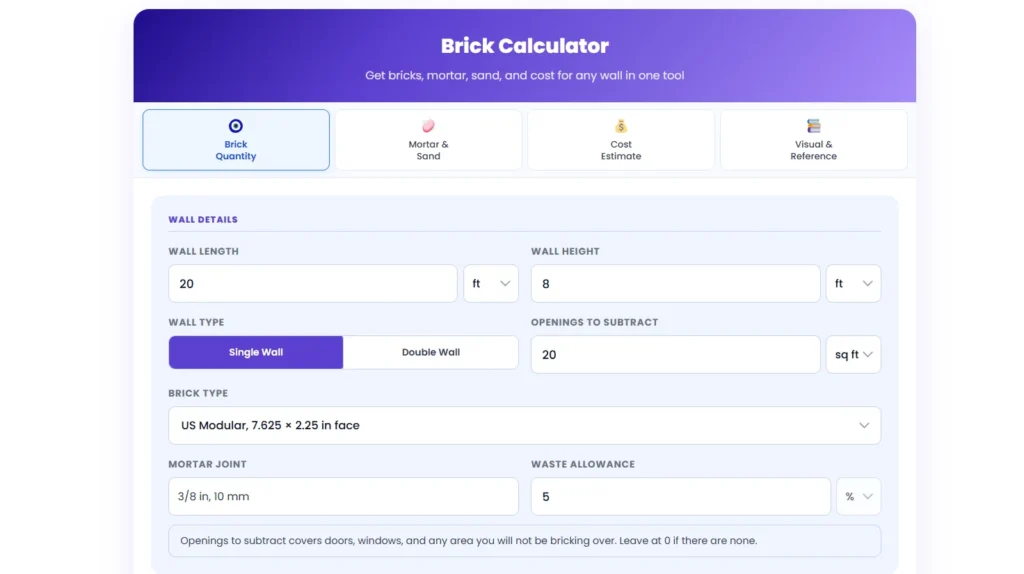
Brick Calculator, Build an Accurate Order for Any Wall
Get bricks, mortar, sand, and cost for any wall in one tool
| Brick Type | Face Size | Approx. Bricks / Sq Ft |
|---|---|---|
| US Modular | 7.625 × 2.25 in | ~6.9 |
| Queen Size | 7.625 × 2.75 in | ~5.8 |
| Engineer | 7.625 × 2.813 in | ~5.6 |
| Norman (long) | 11.625 × 2.25 in | ~4.6 |
| UK Standard | 215 × 65 mm | ~4.6 |
Related Calculators
Ordering bricks without knowing mortar, sand, or true cost is how a simple wall project turns into two trips to the supplier. A brick calculator should answer more than just how many bricks you need. It needs to cover mortar, sand, and total cost together, since those four numbers make up a real order.
Most people start with a brick count and stop there. Then mortar runs short mid project, or the final bill comes in higher than expected because sand and delivery were never part of the plan.
This guide builds toward one goal, a complete order ready to hand to a supplier. Start with brick sizes and wall measurements, then move through mortar, waste, and cost, ending with a checklist that ties every number together.
What a Brick Calculator Order Actually Needs
Most people jump straight to a brick count and figure the rest will sort itself out on site. That approach is exactly why mortar runs short and final bills come in higher than expected.
Four Numbers You Actually Need
A real order needs bricks, mortar, sand, and total cost, not just one figure. Missing any single one of these causes a delay or a second trip to the supplier.
Why Most Brick Calculators Stop Too Early
Many tools online give a brick count and nothing else. A real order needs mortar and sand quantities worked out too, since bricks alone cannot hold a wall together.
Checklist: Your Order Needs These 4 Numbers
- Bricks, the total count for your wall
- Mortar, in bags ready to buy
- Sand, in tons for the mix
- Total cost, bricks plus mortar plus delivery
Understanding Brick Sizes Before You Calculate
Brick size sits underneath every other number in this guide. Get it wrong and the brick count, mortar volume, and cost all shift with it.
Common Brick Sizes by Region
US Modular brick is the standard for most American residential walls. UK Standard brick uses metric sizing and is common outside the United States. Regional brick sizes vary enough on their own to change your final count.
Brick Types Beyond the Standard Size
Queen size, Engineer, and Norman bricks all use different face dimensions. Larger bricks mean fewer pieces are needed to cover the same wall area.
Why Confirming Brick Size First Saves Rework
A wrong size assumption throws off every number that follows it. Always confirm actual brick dimensions with your supplier before running any calculation.
Brick Type Comparison
| Brick Type | Face Size | Approx. Bricks per Sq Ft |
|---|---|---|
| US Modular | 7.625 x 2.25 in | ~6.9 |
| Queen Size | 7.625 x 2.75 in | ~5.8 |
| Engineer | 7.625 x 2.813 in | ~5.6 |
| Norman (long) | 11.625 x 2.25 in | ~4.6 |
| UK Standard | 215 x 65 mm | ~4.6 |
Measuring Your Wall the Right Way
Every number in a brick order traces back to one measurement, the wall itself. A small error here carries through to bricks, mortar, and cost.
Getting Length and Height Right
Measure wall length end to end at working height. Measure height from the base up to the top edge of the wall.
Working in Square Feet or Square Meters
Multiply length by height to get total wall area. Keep every measurement in the same unit throughout the entire calculation.
Subtracting Doors, Windows, and Openings
Measure each door and window opening separately before subtracting it. Skipping this step is one of the most common reasons people overestimate.
Single Wall or Double Wall, What Changes
Wall type is a simple choice with a big impact on your final brick count. Get this wrong and every other number in your order is off too.
What Single and Double Wall Actually Mean
Single wall uses one layer of brick thickness across the wall. Double wall uses two layers stacked together for added strength.
How Wall Type Changes Your Final Count
Double wall nearly doubles the total brick quantity needed for the same wall. Never double the wall length by mistake instead of doubling the brick count itself.
Choosing the Right Type for Your Project
Boundary and garden walls often use single wall construction. Structural and load bearing walls usually call for double wall instead.
The Role of Mortar Joints in Brick Calculation
Mortar joints look small on paper but shift the final brick count more than people expect. Skipping this detail is one of the fastest ways to end up short.
Why Mortar Joints Change Your Brick Count
Joints add space between bricks across the entire wall surface. Ignoring joint size overestimates how many bricks actually fit into that space.
Standard Mortar Joint Sizes
3/8 inch or 10 millimeters is the most common joint size used. Wider joints slightly reduce the total number of bricks needed.
Picking a Joint Size for Your Project
Match your joint size to the local building standard in your area. Confirm with your mason directly if you are ever unsure.
Calculating Bricks, Mortar, and Sand Together
This is where the four numbers from the intro actually come together. Each step below feeds directly into the next one.
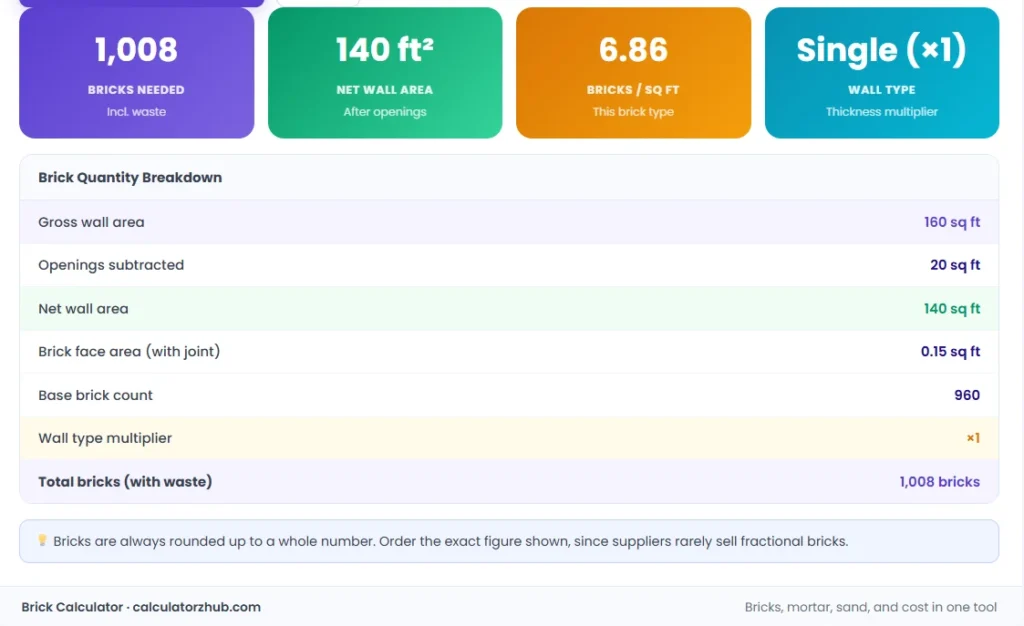
Step One, Find Your Net Wall Area
Start with the gross wall area, length multiplied by height. Then subtract any door and window openings from that total.
Step Two, Find Your Brick Count
Divide net area by brick face area, including the mortar joint. Multiply that result by two if you are building a double wall.
Step Three, Estimate Mortar Volume
Subtract total brick volume from total wall volume. The space left over is the volume filled by mortar.
Step Four, Convert Mortar Into Bags and Sand
Divide mortar volume by bag yield to get your bag count. Estimate sand separately, based on that same mortar volume figure.
The Four Step Flow
- Area, net wall area after subtracting openings
- Bricks, net area divided by brick face area
- Mortar, wall volume minus total brick volume
- Bags and sand, mortar volume converted into buyable units
Adding Waste to Your Brick and Mortar Order
A calculated number is not the same as an order number. Real job sites lose material in ways a formula alone cannot predict.
Why Zero Waste Almost Never Works
Bricks break during transport, handling, and on site cutting. A raw calculation rarely survives contact with an actual job site.
Typical Waste Percentages by Project
5 percent covers straightforward, simple wall runs without much cutting. 10 to 15 percent fits corners, pillars, or softer brick that breaks more easily.
Estimating Total Brick Project Cost
Bricks and mortar answer what to order. Cost answers what to budget, and it comes from a few separate pieces added together.
Pricing Bricks by Type and Quality
Standard brick sits at a mid range price for most residential jobs. Premium and reclaimed brick cost noticeably more per piece.
Pricing Mortar and Delivery Separately
Mortar bags add a smaller but very real cost on top of bricks. Delivery fees shift with distance from the supplier and total order size.
Material Cost Versus Total Project Cost
Material cost only covers bricks, mortar, and delivery. Labor, equipment, and site preparation all sit outside this estimate.
Cost Breakdown Example
| Item | Example Cost |
|---|---|
| Bricks | 970 x $0.60 = $582 |
| Mortar bags | 17 x $8 = $136 |
| Delivery | $75 flat fee |
| Total estimate | $793 |
Brick Calculators for Patios, Pavers, and Walkways
Some people land on a brick calculator looking for something slightly different. It helps to be upfront about where this tool fits and where it does not.
Why Patio and Paver Math Works Differently
Flat brick coverage uses area divided by paver footprint, not wall math. No mortar joint or wall thickness factor applies the same way here.
When to Use a Wall Calculator Instead
Any vertical brick structure needs the wall based method covered in this guide. Flat surfaces like patios, walkways, and fire pits do not follow the same formula.
Common Mistakes in Brick Quantity Estimation
Most bad estimates trace back to one of a handful of repeat mistakes. Catching these early saves both money and a second trip to the supplier.
Ignoring the Mortar Joint Entirely
Skipping the joint size overestimates how many bricks actually fit on the wall. This is one of the most common errors in a manual calculation.
Using the Wrong Brick Size
A brick calculation is only as accurate as the size entered into it. Always confirm real dimensions instead of assuming a standard size applies.
Forgetting to Subtract Openings
Doors and windows take up real wall area that does not need bricks. Skipping this step leads to ordering far more than necessary.
Skipping the Waste Allowance
A calculation with no waste buffer almost always leaves a project short. Breakage and cutting both eat into that raw calculated number.
Doubling the Wrong Measurement for a Double Wall
Double the brick count for a double wall, never the wall length. Doubling the wrong number leads to a wildly inflated final order.
Manual Calculation Versus Using a Calculator
Both approaches get you to a final number, just through different amounts of effort. The right choice depends on the size and complexity of your project.
When Manual Math Makes Sense
Small projects with simple, single wall sections work fine by hand. Manual math also helps you understand the process before trusting a tool fully.
When a Calculator Is Worth Using
Larger walls with openings, waste, and mortar all at once benefit from a calculator. Repeated calculations across multiple wall sections add up to real time saved.
Worked Examples for Wall Projects
Numbers make more sense next to a project than inside a formula alone. These four examples cover different wall types and scales.
Example, Small Garden Wall
A 15 by 3 foot single wall using US Modular brick needs 324 bricks. That figure already includes a 5 percent waste allowance for a simple, straightforward run.
Example, House Boundary Wall
A 40 by 6 foot wall with two window openings totaling 24 square feet needs 1,556 bricks. That number reflects the net area after subtracting both openings, plus 5 percent waste.
Example, Structural Double Wall
A 10 by 4 foot double wall needs 604 bricks. Even though the footprint is smaller than the garden wall, doubling the layer plus a 10 percent waste allowance for corners pushes the count higher.
Example, Full Order With Mortar and Cost
Carrying the boundary wall example through, 1,556 bricks need 23 mortar bags and about 0.4 tons of sand. At $0.60 per brick and $8 per bag, that wall runs close to $1,193 in materials before delivery.
Your Final Order Checklist
Everything in this leads back to one goal, a complete order you can hand to a supplier with confidence. Run through this list before you buy anything.
Final Order Checklist
- Confirm exact brick size and type with your supplier
- Confirm net wall area after subtracting openings
- Confirm single or double wall thickness
- Confirm mortar joint size used in the calculation
- Add a waste allowance before finalizing brick count
- Convert mortar volume into bags and sand separately
- Price bricks, mortar, and delivery for a full cost total
If every item on this list has a number next to it, your order is ready.
FAQs
How many bricks do I need for my wall
It depends on net wall area, brick size, mortar joint, and wall type. A calculator combines all four into one final number.
How many bricks are in one square foot
Standard US Modular brick runs close to 6.9 bricks per square foot. Larger brick types like Norman run closer to 4.6 per square foot.
Does mortar joint size really change the brick count
Yes, joints add space between every brick across the wall. A wider joint slightly lowers the total brick count needed.
What is the difference between single and double wall
Single wall uses one layer of brick thickness. Double wall uses two layers and nearly doubles the brick count.
How much sand and cement do I need per 1000 bricks
This varies with mortar joint size and mix ratio used. A rough guide is close to 0.6 cubic meters of mortar per 1,000 bricks.
Can I use this for a patio or walkway instead
No, patios and walkways use flat coverage math, not wall based math. A different formula applies since there is no vertical wall thickness involved.
How much waste should I add to a brick order
5 percent covers most simple, straightforward wall runs. 10 to 15 percent fits corners, pillars, or softer brick.
Why This Brick Calculator Works Better
Most tools online stop at a brick count and leave mortar, sand, and cost for you to figure out separately. This one keeps all four numbers connected in a single place.
- Covers bricks, mortar, sand, and cost in one connected tool
- Seven brick type presets instead of two or three
- Subtracts openings directly instead of leaving that step manual
- Shows a to-scale single versus double wall thickness preview
Conclusion
A brick calculator should give you more than a single number to write down. Bricks, mortar, sand, and total cost all belong in the same calculation, not four separate guesses pieced together later.
Confirm your brick size, subtract your openings, and add a waste allowance before you finalize anything. Run through the final order checklist one last time, then take those numbers straight to your supplier.