

🪵 Board Foot Calculator: How to Calculate Board Feet & Lumber Cost
Single board · Multiple boards · Lumber species reference
| Qty | Thickness (in) | Width (in) | Length (ft) | BF each | BF total | |
|---|---|---|---|---|---|---|
| — | — | |||||
| — | — | |||||
| Grand Total Board Feet | — | |||||
| Species | Common Use | Avg Price / BF | Notes |
|---|---|---|---|
| Hard Maple | Furniture, floors, cutting boards | $4.50–$7.00 | Very hard, takes stain well |
| Red Oak | Furniture, cabinets, flooring | $3.50–$5.50 | Most common US hardwood |
| White Oak | Barrels, outdoor furniture | $4.00–$6.50 | Water resistant |
| Black Walnut | Fine furniture, gunstocks | $8.00–$14.00 | Premium, high demand |
| Cherry | Cabinets, furniture | $6.00–$10.00 | Darkens beautifully with age |
| White Ash | Tool handles, sports equipment | $4.00–$6.00 | Flexible and strong |
| Poplar | Paint-grade projects, trim | $2.50–$4.00 | Budget-friendly hardwood |
| Mahogany | Boatbuilding, fine furniture | $7.00–$12.00 | Classic, stable wood |
| Hickory | Tool handles, flooring | $4.50–$7.00 | Hardest US domestic wood |
| Species | Common Use | Avg Price / BF | Notes |
|---|---|---|---|
| Douglas Fir | Framing, structural beams | $1.50–$3.00 | Strong, widely available |
| Eastern White Pine | Paneling, shelving, trim | $2.00–$3.50 | Easy to work with |
| Western Red Cedar | Outdoor, decking, fencing | $3.00–$5.00 | Naturally rot resistant |
| Redwood | Outdoor furniture, decking | $4.00–$7.00 | Premium outdoor softwood |
| Sitka Spruce | Instrument tops, aviation | $5.00–$9.00 | High strength-to-weight ratio |
| Southern Yellow Pine | Framing, treated lumber | $1.00–$2.50 | Common framing lumber |
For more helpful tools, visit our construction calculator online page and simplify your estimates.
Enter thickness, width, length, and quantity above. The board foot calculator returns total volume, weight, cubic feet, and estimated cost instantly. Tab 2 handles multiple boards with live per-row results. Tab 3 shows species pricing for hardwoods and softwoods.
What Is a Board Foot?
A board foot is the standard unit lumber yards use to measure and price wood by volume. One board foot equals a piece of lumber that is 1 inch thick, 12 inches wide, and 1 foot long.
In numbers: 1 board foot = 144 cubic inches = 1/12 of a cubic foot
This matters because lumber comes in dozens of different thicknesses and widths. Using only length or area gives an incomplete picture. Volume tells you exactly how much wood you are buying regardless of the shape.
You will see board feet abbreviated as BF, bd ft, or FBM (foot board measure) on supplier invoices. Large orders are quoted in MBF — one thousand board feet.
Board Foot Formula
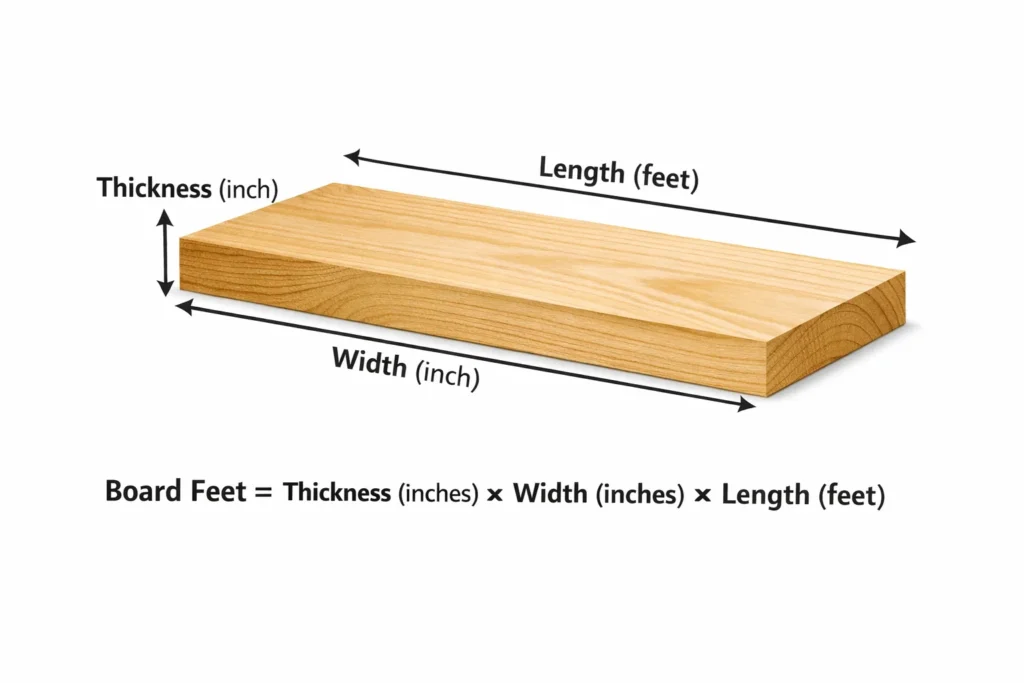
How to Calculate Board Feet
The formula has two versions depending on how you measure:
Version 1 — Length in feet: Board Feet = Thickness (in) × Width (in) × Length (ft) ÷ 12
Version 2 — All dimensions in inches: Board Feet = Thickness (in) × Width (in) × Length (in) ÷ 144
Both give the same result. Most woodworkers use Version 1 because length is usually measured in feet.
Step-by-Step Example
A board is 1 inch thick, 6 inches wide, and 8 feet long.
- Thickness × Width × Length: 1 × 6 × 8 = 48
- Divide by 12: 48 ÷ 12 = 4 board feet
Example With Multiple Boards
You need 15 boards at the same dimensions.
- One board = 4 board feet
- 4 × 15 = 60 board feet total
Example With Thicker Lumber
A timber beam is 3 inches thick, 8 inches wide, and 12 feet long.
- 3 × 8 × 12 = 288
- 288 ÷ 12 = 24 board feet
Common Lumber Sizes: Board Feet Per Piece
| Nominal Size | Actual Size | 8 ft length | 10 ft length | 12 ft length |
|---|---|---|---|---|
| 1×4 | 0.75″ × 3.5″ | 2.00 BF | 2.50 BF | 3.00 BF |
| 1×6 | 0.75″ × 5.5″ | 3.00 BF | 3.75 BF | 4.50 BF |
| 1×8 | 0.75″ × 7.25″ | 4.00 BF | 5.00 BF | 6.00 BF |
| 1×12 | 0.75″ × 11.25″ | 6.00 BF | 7.50 BF | 9.00 BF |
| 2×4 | 1.5″ × 3.5″ | 5.33 BF | 6.67 BF | 8.00 BF |
| 2×6 | 1.5″ × 5.5″ | 8.00 BF | 10.00 BF | 12.00 BF |
| 2×8 | 1.5″ × 7.25″ | 10.67 BF | 13.33 BF | 16.00 BF |
| 4×4 | 3.5″ × 3.5″ | 9.33 BF | 11.67 BF | 14.00 BF |
Important: These calculations use nominal dimensions (the stated size), not actual dimensions. A 2×4 is actually 1.5″ × 3.5″. When calculating board feet for lumber you have already purchased, always use the actual measured size for accurate results.
Nominal vs. Actual Lumber Size
Every piece of dimensional lumber has two sizes: nominal and actual. The nominal size is what it is called. The actual size is smaller because of surfacing and drying.
| Nominal | Actual |
|---|---|
| 1″ thick | 0.75″ |
| 2″ thick | 1.5″ |
| 4″ thick | 3.5″ |
| 6″ thick | 5.5″ |
| 8″ thick | 7.25″ |
| 10″ thick | 9.25″ |
| 12″ thick | 11.25″ |
Hardwood dealers often sell rough-sawn lumber at full nominal thickness. A 4/4 board (pronounced “four-quarter”) means 1 inch nominal, and rough-sawn hardwood is typically close to that actual size. Always clarify with your supplier whether the price is based on nominal or actual dimensions.
Hardwood Thickness Notation: Quarter System
Hardwood lumber uses a quarter-inch system for thickness.
| Notation | Thickness |
|---|---|
| 4/4 | 1 inch |
| 5/4 | 1.25 inches |
| 6/4 | 1.5 inches |
| 8/4 | 2 inches |
| 10/4 | 2.5 inches |
| 12/4 | 3 inches |
When you enter dimensions into the calculator for hardwoods, convert the quarter notation to decimal inches first. A 6/4 board is 1.5 inches thick.
Waste Factor: Why You Should Order More
Raw board feet tells you the minimum amount of wood your project requires. It does not account for cutting losses, defects, or grain matching.
Always add a waste factor before ordering:
| Project Type | Recommended Waste |
|---|---|
| Simple shelving, paint-grade | 5–10% |
| Furniture with clear lumber | 10–15% |
| Figured or exotic hardwood | 15–20% |
| Complex joinery, grain matching | 20–25% |
The calculator includes a waste factor selector. Set it to 10% for most projects. Set it to 15–20% when working with hardwood that has natural character, knots, or color variation you need to work around.
Kerf loss (the material removed by the saw blade) adds roughly 1/8 inch per cut. On a project requiring many rip cuts, this accumulates. Add it to your waste estimate.
How to Calculate Board Feet in a Log
Calculating board feet from a standing tree or raw log uses a different approach. The most common method is the Doyle Log Scale.
Doyle Formula: Board Feet = (Diameter in inches − 4)² × Log Length in feet ÷ 16
Log Board Foot Example
A log is 16 inches in diameter and 12 feet long.
- Diameter minus 4: 16 − 4 = 12
- Square it: 12² = 144
- Multiply by length: 144 × 12 = 1,728
- Divide by 16: 1,728 ÷ 16 = 108 board feet
The Doyle scale is used most widely in the eastern United States. It tends to underestimate yield on small logs and overestimate on large ones. The International 1/4-inch scale and Scribner scale are used in other regions.
Lumber Prices Per Board Foot
Lumber pricing varies by species, grade, moisture content, and region. The species pricing tab in the tool above shows average retail estimates. Here is a summary of typical price ranges:
Budget Hardwoods ($2.50–$5.50/BF): Poplar, Red Oak, White Ash — good choices for painted furniture, shop cabinets, and beginner projects.
Mid-Range Hardwoods ($4.00–$8.00/BF): Hard Maple, White Oak, Cherry — suited to furniture, cabinetry, and flooring.
Premium Hardwoods ($8.00–$14.00/BF): Black Walnut, Mahogany — fine furniture, heirloom pieces, and specialty work.
Softwoods ($1.00–$5.00/BF): Southern Yellow Pine and Douglas Fir start under $2/BF. Western Red Cedar and Redwood run $3–$7/BF for outdoor and finish-grade material.
Prices above reflect rough-sawn or S4S (Surfaced Four Sides) retail pricing. Wholesale orders (10+ MBF) price significantly lower.
Board Foot vs. Linear Foot
These two units measure different things and are not interchangeable.
Linear foot measures only length. A 10-foot board equals 10 linear feet regardless of thickness or width.
Board foot measures volume. The same 10-foot board measures differently depending on thickness and width.
A 1×6 at 10 feet = 5 board feet. A 2×6 at 10 feet = 10 board feet.
Both are 10 linear feet. But the 2×6 has twice the wood by volume.
Framing lumber is often priced by linear foot. Hardwood flooring and cabinet-grade lumber is almost always priced by board foot. Confirm the pricing unit with your supplier before comparing quotes.
Frequently Asked Questions
Related Calculators
- Concrete Calculator — Estimate concrete volume for slabs and footings
- Gravel Calculator — Calculate gravel volume, weight, and cost by shape
- Asphalt Calculator — Estimate asphalt tonnage for paving projects
Conclusion
Knowing how to calculate board feet prevents over-ordering, under-ordering, and supplier pricing confusion. Enter your actual dimensions, not nominal sizes. Add a waste factor before placing your order. Use the species pricing tab to sanity-check supplier quotes before committing.
This board foot calculator handles single boards, full project lists, and log calculations in one place.