

🏗️ Concrete Calculator: Estimate Volume, Bags, Cement & Cost Instantly
Estimate concrete volume, bags, coverage, cost, weight, posts, sonotubes, stairs, mix materials, cement bags, and basic conversions in one tool.
Volume Calculator
Bag Calculator
Coverage Calculator
Cost Estimator
Post Hole Calculator
Sonotube Calculator
Stairs Calculator
Weight Calculator
Mix Ratio Calculator
Cement Calculator
Unit Converter
Multi Pour Calculator
Planning concrete work without proper numbers usually leads to waste or shortage. A good concrete calculator helps you estimate volume, bags, and cost before starting. It also reduces guesswork when working with slabs, footings, or posts.
In this guide, you will learn how to calculate concrete, cement, and materials step by step. You will also see real examples, formulas, and practical use cases used on sites.
What Concrete and Cement Mean in Real Construction Work
Many people mix up cement and concrete, but they are not the same. Cement is a binding powder, while concrete is a mix of cement, sand, and aggregate.
Concrete forms the structure, while cement holds everything together. Mortar is similar but used for brickwork and plaster.
Search intent often overlaps, so users looking for cement calculations usually need full concrete estimates. That is why one page should cover both.
Key Units Used in Concrete and Cement Calculations
Understanding units is critical before calculating any volume or material.
You will mostly work with:
- cubic yards, cubic feet, cubic meters for volume
- square feet or meters for area
- inches or centimeters for thickness
Even small unit mistakes can double your material estimate.
Quick Unit Conversion Reference for Builders
Use these quick conversions during calculations:
- 1 cubic yard = 27 cubic feet
- 1 cubic meter = 35.31 cubic feet
- 4 inches = 0.33 feet
Always convert thickness into feet when using volume formulas.
Basic Concrete Volume Formula with Examples
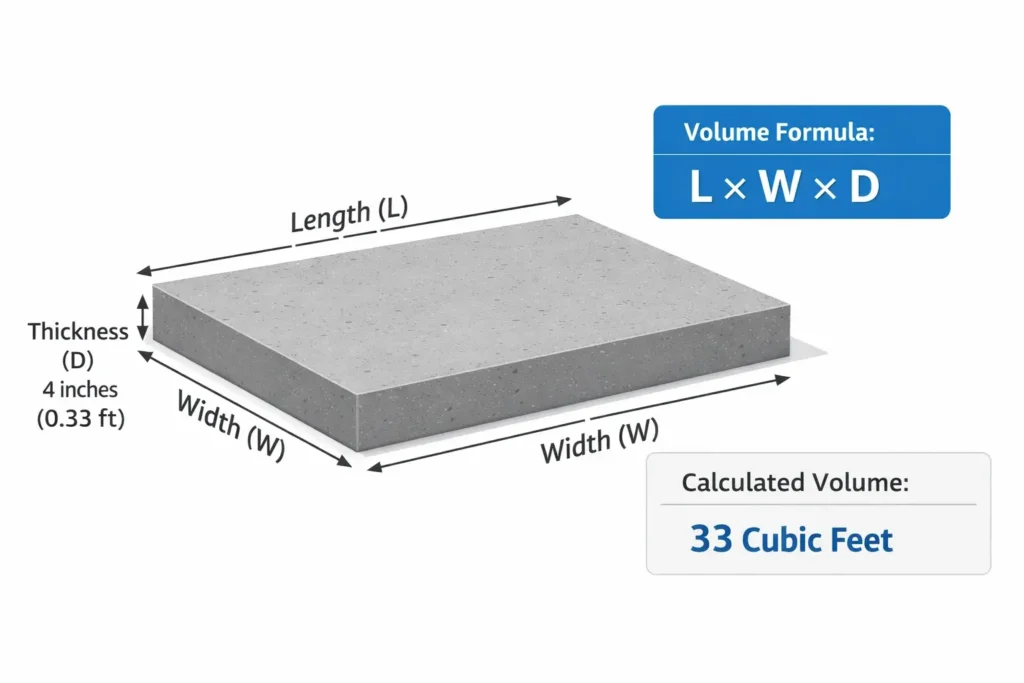
The standard formula is simple:
Volume = Length × Width × Depth
All values must be in the same unit before calculation.
For example, a slab 10 ft long, 10 ft wide, and 4 inches thick:
- Convert thickness, 4 inches = 0.33 ft
- Volume = 10 × 10 × 0.33
- Result = 33 cubic feet
Now convert into cubic yards:
- 33 ÷ 27 = 1.22 cubic yards
This is your base estimate before adding waste.
Example Slab Calculation Step by Step
Let’s take a real case:
- Length = 12 ft
- Width = 12 ft
- Thickness = 4 inches
Steps:
- Convert thickness to feet, 0.33 ft
- Multiply all values
- Volume = 12 × 12 × 0.33 = 47.52 cubic feet
- Convert to yards, 47.52 ÷ 27 = 1.76 cubic yards
Add 10 percent waste:
- Final volume = 1.93 cubic yards
This is closer to real site usage.
How to Calculate Concrete for Different Shapes
Different structures need different formulas. Using the wrong shape gives incorrect volume. Always match the formula with the actual structure on site.
Slab and Pad Concrete Calculation
Slabs are the most common use case in construction.
Use this formula:
- Volume = length × width × thickness
Example:
- 20 × 15 slab with 5 inch thickness
- Convert thickness, 5 inches = 0.42 ft
- Volume = 20 × 15 × 0.42 = 126 cubic feet
Common uses include patios, driveways, and floors.
Footing and Foundation Concrete Calculation
Footings support load-bearing structures like walls and columns.
Use:
- Volume = length × width × depth
Example:
- 30 ft long footing, 2 ft wide, 1 ft deep
- Volume = 30 × 2 × 1 = 60 cubic feet
Always check depth carefully, as small changes increase volume quickly.
Wall Concrete Volume Calculation
Walls use a similar approach but include height.
Formula:
- Volume = length × height × thickness
Example:
- 15 ft wall, 8 ft height, 6 inch thickness
- Convert thickness, 0.5 ft
- Volume = 15 × 8 × 0.5 = 60 cubic feet
Used for retaining walls and vertical structures.
Column and Circular Concrete Calculation
Columns are cylindrical, so use a different formula.
Formula:
- Volume = π × radius² × height
Example:
- Diameter = 1 ft, radius = 0.5 ft
- Height = 10 ft
- Volume = 3.14 × 0.5² × 10 = 7.85 cubic feet
Multiply by number of columns for total.
Tube and Sonotube Concrete Calculation
Used in deck footings and round foundations.
Formula:
- Volume = π × radius² × height
If inner and outer diameter exist:
- Subtract inner volume from outer volume
This avoids overestimating hollow structures.
Stairs Concrete Calculation
Stairs are not simple rectangles. Use a triangular approximation.
Formula:
- Volume = 0.5 × run × rise × steps × width
Example:
- Run = 10 ft, rise = 3 ft, steps = 10, width = 4 ft
- Volume = 0.5 × 10 × 3 × 10 × 4 = 600 cubic feet
Always add waste because stairs have uneven surfaces.
Concrete Bags Calculation Based on Volume
After volume, the next step is converting into bags. Each bag covers a fixed cubic volume depending on size.
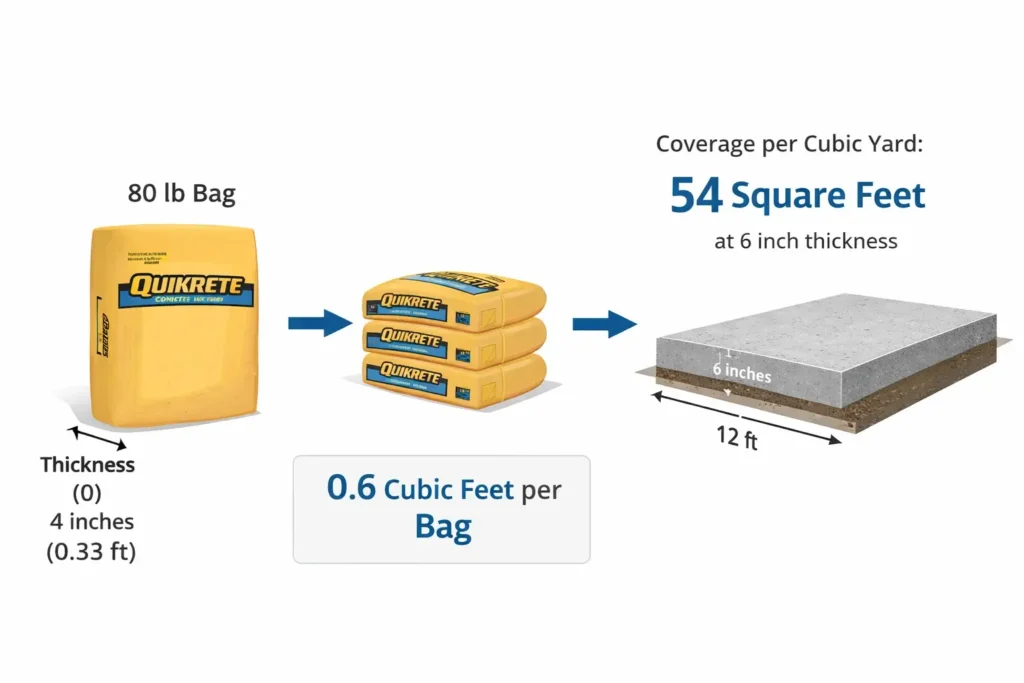
Common yields:
- 80 lb bag = 0.6 cubic feet
- 60 lb bag = 0.45 cubic feet
- 40 lb bag = 0.3 cubic feet
Bag Yield Reference for Common Sizes
Example calculation:
- Total volume = 60 cubic feet
- Using 80 lb bags
- Bags needed = 60 ÷ 0.6 = 100 bags
Add 10 percent extra:
- Final = 110 bags
For deeper calculations, you can also compare with a cubic yard calculator to cross-check volume before converting into bags.
Concrete Coverage Based on Area and Thickness
Coverage depends on both area and thickness. Thicker slabs need more concrete for the same area.
Formula:
- Volume = area × thickness
Example:
- Area = 200 sq ft
- Thickness = 4 inches = 0.33 ft
- Volume = 200 × 0.33 = 66 cubic feet
Coverage Example with Thickness Variation
- 1 cubic yard covers about 81 sq ft at 4 inches
- At 6 inches, it covers only 54 sq ft
This is why thickness matters more than area in many cases.
Concrete Cost Estimation with Real Pricing Factors
Cost depends on how you buy concrete. Some projects use ready mix, others use bags.
You can calculate cost using two methods:
- price per cubic yard
- price per bag
Example using yard pricing:
- Volume = 2 cubic yards
- Price = $150 per yard
- Total cost = 2 × 150 = $300
Example using bags:
- 100 bags needed
- Price = $6 per bag
- Total cost = $600
Always include:
- 5 to 10 percent waste
- delivery charges
- labor costs
Small projects often cost more per unit than bulk orders.
Example Cost Calculation for a Slab
Let’s estimate a driveway slab.
- Size = 20 × 10 ft
- Thickness = 4 inches
- Volume ≈ 2.47 cubic yards
If price is $140 per yard:
- Total = 2.47 × 140 = $345.8
After adding 10 percent waste:
- Final ≈ $380
Using bags for the same job will usually cost more.
Cement Quantity Calculation from Concrete Mix Ratio
Concrete mix ratios define how much cement, sand, and aggregate you need.
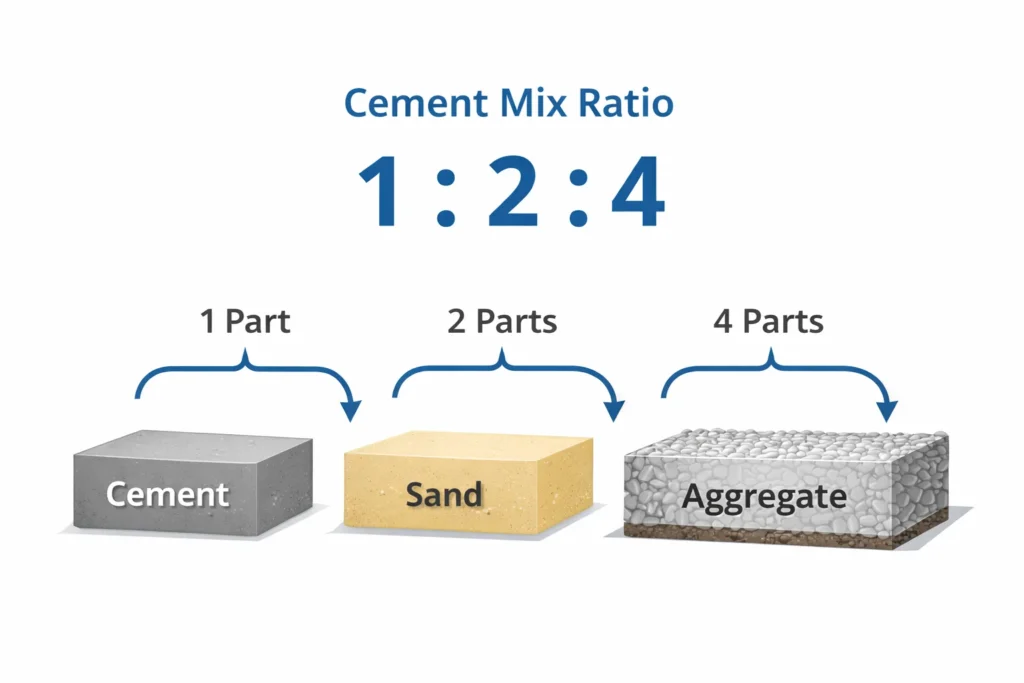
Common ratios:
- 1:2:4
- 1:1.5:3
These numbers represent parts of each material.
Dry Volume Adjustment
Wet concrete volume is not enough for material calculation.
Use this formula:
- Dry volume = wet volume × 1.54
This accounts for voids and compaction losses.
Cement Bags Calculation from Mix Ratio
Example:
- Wet volume = 1 cubic meter
- Dry volume = 1 × 1.54 = 1.54 m³
For ratio 1:2:4:
- Total parts = 7
- Cement = 1.54 × (1 ÷ 7) = 0.22 m³
Convert to kg:
- 0.22 × 1440 = 316.8 kg
If using 50 kg bags:
- Bags = 316.8 ÷ 50 ≈ 7 bags
Always round up to avoid shortage.
Cement Calculation for Slab, Plaster, and Mortar
Cement calculation changes depending on application. Concrete uses full mix ratios, while plaster and mortar use lean mixes.
Cement for Slab Calculation
Use full concrete volume with mix ratio.
Example:
- Volume = 2 m³
- Ratio = 1:2:4
- Cement bags ≈ 14
This includes dry volume adjustment.
Cement for Plaster Work
Plaster uses surface area and thickness.
Formula:
- Volume = area × thickness
Example:
- Wall = 200 sq ft
- Thickness = 0.5 inch
- Convert to feet and calculate volume
Then apply ratio like 1:4.
Cement for Mortar Volume
Mortar is used in brickwork and joints.
Example:
- Volume = 0.5 m³
- Ratio = 1:5
Follow same steps:
- apply dry factor
- calculate cement portion
- convert into bags
For related calculations, you can also compare results with a square footage calculator when working with wall areas.
Post Hole and Fence Concrete Calculation
Post holes are circular, so volume uses a cylinder formula.
Formula:
- Volume = π × radius² × depth
Example:
- Diameter = 12 inches = 1 ft
- Radius = 0.5 ft
- Depth = 2 ft
Calculation:
- Volume = 3.14 × 0.5² × 2 = 1.57 cubic feet
If you have 10 holes:
- Total = 1.57 × 10 = 15.7 cubic feet
Convert to bags:
- 15.7 ÷ 0.6 ≈ 26 bags
Always add extra for uneven digging and soil loss.
Multi Section Concrete Estimation for Complex Projects
Some projects include multiple shapes and sections. Instead of guessing, calculate each part separately, then combine.
Example:
- Slab section = 1.5 cubic yards
- Footing section = 0.8 cubic yards
- Total = 2.3 cubic yards
Add waste after combining:
- Final = 2.53 cubic yards
This method works well for irregular layouts and mixed structures.
Concrete Weight Estimation for Transport and Load Planning
Weight matters when transporting or planning structural loads.
Standard concrete weighs:
- 150 lb per cubic foot
- 2400 kg per cubic meter
Example:
- Volume = 2 cubic yards
- Convert to cubic feet = 54
Weight:
- 54 × 150 = 8100 lb
For lighter mixes, weight decreases but volume stays same.
Common Mistakes in Concrete and Cement Calculations
These mistakes lead to wrong estimates and extra cost.
- Not converting inches into feet before calculation
- Ignoring waste percentage completely
- Using wrong mix ratio for the job
- Confusing cement quantity with concrete volume
- Forgetting to multiply by number of sections
Always double check units before final calculation.
Practical Use Cases for Concrete Calculator
You can use these calculations in many real projects.
- driveway slabs and patio floors
- house foundations and footings
- retaining walls and columns
- fence posts and deck supports
- plaster and brick mortar work
If you work with multiple shapes, combine results carefully.
You can also cross-check calculations using a construction calculator hub for related tools and estimates.
Tips to Improve Accuracy in Concrete Estimation
Small adjustments can improve your estimate a lot.
- always add 5 to 10 percent waste
- round up material quantities
- measure dimensions twice before calculating
- use consistent units across all inputs
- plan for uneven surfaces and ground variation
These steps reduce material shortage during pouring.
When to Use Concrete vs Cement Calculations
Use concrete calculation when estimating total structure volume. Use cement calculation when planning materials inside the mix. Both are connected but serve different purposes.
Concrete tells you how much volume you need. Cement tells you how much material you must buy.
Final Thoughts on Accurate Concrete and Cement Estimation
Accurate planning saves both time and money on site. A reliable concrete calculator helps you avoid underestimation and waste. Use correct formulas, convert units carefully, and always include waste. Simple checks before pouring can prevent costly mistakes later.