Fraction Calculator, Solve, Simplify, Convert Fractions Fast
Solve fractions, mixed numbers, decimals, percent conversions, comparisons, and inch precision in one clean tool.
Basic Fraction Calculator
Add, subtract, multiply, or divide two fractions.
Show steps
Fractions are just one part of basic math. You can explore more related tools inside this math calculators collection.
Fractions show how parts relate to a whole in daily life. A fraction calculator helps check answers fast, but understanding the logic matters more.
You will see how to add, subtract, multiply, and divide fractions clearly. This guide also covers mixed numbers, decimals, and real-world uses like measurements.
Instead of memorizing rules, focus on simple steps that work every time. Each section uses practical examples you can apply without confusion.
What a Fraction Means in Simple Terms
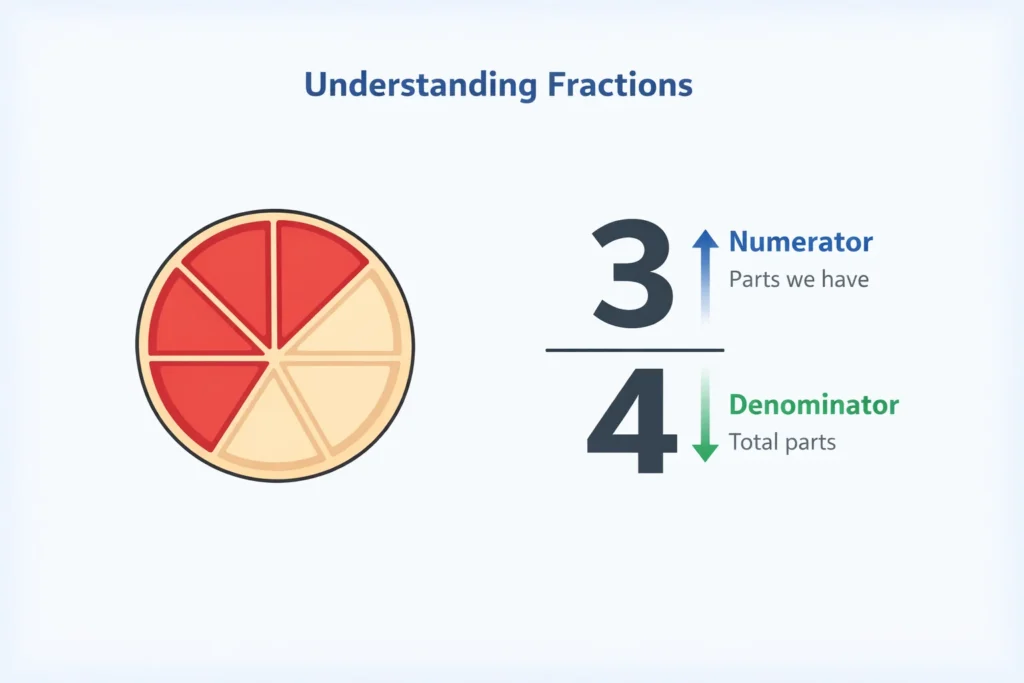
A fraction represents equal parts taken from one whole value. It helps measure, compare, and divide things in real situations.
Think of slicing a pizza into equal pieces. Each slice shows how fractions describe parts clearly.
Fractions appear in cooking, construction, and school problems daily. Understanding them saves time and reduces calculation errors.
Numerator and Denominator
The numerator shows how many parts you have selected.
The denominator shows how many equal parts exist in total.
For example, in 3/4:
- 3 is the numerator, selected parts
- 4 is the denominator, total parts
This simple structure drives every fraction calculation you perform.
Proper, Improper, and Mixed Fractions
A proper fraction has a smaller numerator than denominator.
Example, 2/5 is less than one whole.
An improper fraction has a larger numerator than denominator.
Example, 7/3 is more than one whole.
A mixed number combines a whole number with a fraction.
Example, 2 1/3 represents more than two full parts.
Core Fraction Rules You Need Before Calculating
Every fraction operation follows a clear pattern. Once you know the rules, calculations become predictable and fast.
These rules apply across all fraction types, including mixed numbers. Focus on steps instead of memorizing random shortcuts.
How to Add Fractions with Like Denominators
When denominators match, the process is simple.
- Add the numerators
- Keep the denominator unchanged
Example:
1/5 + 2/5 = 3/5
No conversion is needed in this case.
How to Add Fractions with Unlike Denominators
Different denominators require a common base first.
- Find the least common denominator
- Convert both fractions into equivalent fractions
- Add the new numerators
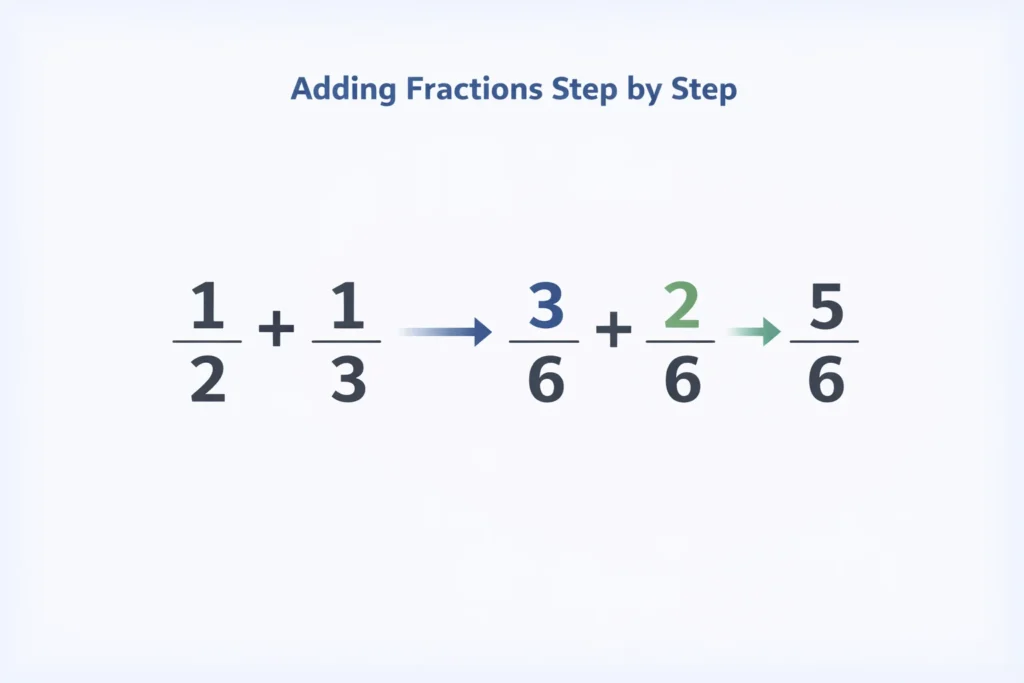
Example:
1/2 + 1/3 → 3/6 + 2/6 = 5/6
This method avoids incorrect results.
How to Subtract Fractions Correctly
Subtraction follows the same structure as addition.
- Match denominators first
- Subtract numerators
- Keep the denominator unchanged
Example:
3/4 − 1/4 = 2/4 → simplify to 1/2
Always simplify the result at the end.
How to Multiply Fractions
Multiplication is the easiest fraction operation.
- Multiply numerator by numerator
- Multiply denominator by denominator
Example:
2/3 × 3/5 = 6/15 → simplify to 2/5
You can cancel common factors before multiplying.
How to Divide Fractions
Division requires one key step.
- Flip the second fraction
- Multiply instead of dividing
Example:
2/3 ÷ 4/5 = 2/3 × 5/4 = 10/12 → 5/6
This method works every time.
Simplify Fractions and Reduce to Lowest Terms
Simplifying fractions keeps answers clean and easy to understand.
It removes extra factors without changing the actual value.
A fraction is in lowest terms when no common factor remains.
This step is often missed, but it is always required.
How to Find the Greatest Common Factor
The greatest common factor helps reduce both numbers quickly.
- List factors of numerator and denominator
- Find the largest number dividing both
- Divide both values by that number
Example:
12/18 → GCF is 6
12 ÷ 6 = 2, 18 ÷ 6 = 3 → result is 2/3
This method works for all fraction sizes.
When a Fraction Is Already Simplified
Some fractions cannot be reduced further.
- If GCF equals 1, the fraction is already simplified
- Example: 5/7 cannot be reduced
Always check before moving to the next step.
Skipping this check leads to unnecessary calculations.
Simplified results are easier to compare and convert later.
They also reduce errors in multi-step problems.
Mixed Numbers and Improper Fraction Conversion
Mixed numbers and improper fractions represent the same value.
You can switch between them based on the problem type.
This conversion is common in cooking, measurements, and exams.
Convert Mixed Numbers to Improper Fractions
Use a simple formula to convert mixed numbers.
- Multiply whole number by denominator
- Add the numerator
- Keep the same denominator
Example:
2 1/3 → (2 × 3) + 1 = 7 → result is 7/3
This form is easier for calculations.
Convert Improper Fractions to Mixed Numbers
This step helps present answers clearly.
- Divide numerator by denominator
- The quotient becomes the whole number
- The remainder becomes the numerator
Example:
7/3 → 2 remainder 1 → result is 2 1/3
Use this format for final answers when needed.
Fraction to Decimal and Decimal to Fraction Conversion
Converting between fractions and decimals helps in quick comparisons. It is useful in pricing, measurements, and percentage calculations. You can move between both forms using simple steps and logic.
If you are converting fractions into decimal values, you may also need a percentage calculator for quick percent conversions in real use cases.
How to Convert a Fraction to a Decimal
This process uses basic division.
- Divide the numerator by the denominator
- Continue division for more precision
Example:
3/4 = 3 ÷ 4 = 0.75
Some results repeat, like 1/3 = 0.333…
Round only when the situation allows it.
How to Convert a Decimal to a Fraction
Use place value to convert decimals into fractions.
- Write the decimal over its place value
- Simplify the fraction fully
Example:
0.75 = 75/100 → simplify to 3/4
This method works for most decimal values.
Common Decimal to Fraction Examples
These examples appear often in daily calculations:
- 0.5 = 1/2
- 0.25 = 1/4
- 0.75 = 3/4
- 0.125 = 1/8
- 1.5 = 3/2
- 2.25 = 9/4
Knowing these saves time during quick calculations.
Fraction to Percent and Percent to Fraction Basics
Percent values connect fractions with real-world comparisons. They are common in discounts, grades, and financial calculations.
When you start working with fractions, it also helps to understand square roots for more advanced math problems. You can explore this using a square root calculator.
Convert a Fraction to Percent
Follow a simple two-step process.
- Convert fraction into decimal
- Multiply the result by 100
Example:
1/4 → 0.25 → 25%
This method works for all fractions.
Convert a Percent to a Fraction
Reverse the process for percent conversion.
- Write percent over 100
- Simplify the fraction
Example:
50% = 50/100 → 1/2
This helps when comparing ratios or values quickly.
Comparing Fractions Without Guessing
Comparing fractions helps you pick larger or smaller values quickly.
It is useful in pricing, measurements, and decision making.
Instead of guessing, use simple methods that give exact answers.
Compare Fractions with the Same Denominator
This is the fastest comparison method.
- The fraction with the larger numerator is greater
- Denominator stays the same
Example:
3/8 > 1/8
No conversion is needed here.
Compare Fractions with Different Denominators
Use one of these two reliable methods.
- Convert to a common denominator
- Or use cross multiplication
Example using cross multiplication:
2/3 and 3/5
2 × 5 = 10, 3 × 3 = 9 → 2/3 is greater
This avoids extra steps in many cases.
Use Equivalent Fractions to Check Equality
Equivalent fractions represent the same value in different forms.
- Multiply numerator and denominator by the same number
- Check if both fractions match
Example:
1/2 = 2/4 = 4/8
This helps verify equality without converting to decimals.
Fractions with Whole Numbers in Real Calculations
Whole numbers often appear with fractions in real problems. Handling them correctly avoids common mistakes. You can treat a whole number as a fraction over one.
Add and Subtract Whole Numbers and Fractions
Convert the whole number before solving.
- Whole number → fraction over one
- Match denominators
- Add or subtract normally
Example:
3 + 1/2 = 3/1 + 1/2 = 6/2 + 1/2 = 7/2 → 3 1/2
This keeps the process consistent.
Multiply Whole Numbers by Fractions
Multiplication becomes straightforward.
- Convert whole number to fraction
- Multiply both parts
Example:
4 × 2/3 = 4/1 × 2/3 = 8/3 → 2 2/3
Simplify after multiplying.
Divide Whole Numbers by Fractions
Division follows the reciprocal rule.
- Convert whole number to fraction
- Multiply by flipped second fraction
Example:
5 ÷ 2/3 = 5/1 × 3/2 = 15/2 → 7 1/2
This method works in all cases.
Negative Fractions, Complex Fractions, and Edge Cases
Some fraction problems include negatives or unusual formats. Handling these correctly prevents wrong answers in simple calculations. These cases appear often in exams and real calculations.
How Negative Fractions Should Be Written
A negative fraction should carry one clear sign.
- -1/2 and 1/-2 both mean negative values
- -1/-2 becomes positive
Keep the negative sign in one place only.
This avoids confusion during simplification.
How to Simplify Complex Fractions
A complex fraction has another fraction inside it.
- Simplify the top part first
- Simplify the bottom part
- Divide both results
Example:
(1/2) ÷ (3/4) = 1/2 × 4/3 = 4/6 → 2/3
Treat each step separately to avoid mistakes.
What to Do with Zero in Fraction Problems
Zero changes how fractions behave.
- 0 numerator means the result is zero
- 0 denominator is undefined
Example:
0/5 = 0
5/0 is not allowed
Always check the denominator before solving.
Fraction Formulas Worth Remembering
Knowing key formulas helps solve problems faster.
You do not need many, just the important ones.
Formula for Adding and Subtracting Fractions
Use a common denominator formula.
- a/b + c/d = (ad + bc) / bd
- a/b − c/d = (ad − bc) / bd
This works when denominators are different.
Formula for Multiplying and Dividing Fractions
Multiplication and division follow simple rules.
- a/b × c/d = ac / bd
- a/b ÷ c/d = ad / bc
Remember to flip the second fraction in division.
Formula for Decimal and Mixed Number Conversion
These formulas help in quick conversions.
- Decimal to fraction uses place value
- Mixed number → (whole × denominator + numerator) / denominator
Use these formulas for consistent results.
Fraction Number Line, Fraction Bars, and Visual Learning
Visual tools make fractions easier to understand quickly. They help compare values without heavy calculations.
Using a Fraction Number Line
A number line places fractions between whole numbers.
- 1/2 sits between 0 and 1
- 3/2 sits between 1 and 2
This helps compare size and position clearly.
Using Fraction Bars for Quick Understanding
Fraction bars divide a whole into equal parts visually.
- Each segment represents equal value
- Easy to see equivalent fractions
Example:
1/2 looks the same as 2/4 on a bar model
These visuals improve understanding without complex steps.
Tape Measure and Inch Fraction Conversions
Fractions are widely used in construction and measurement tasks. Tape measures rely on standard fractional divisions instead of decimals. This makes quick fraction understanding very useful in real work.
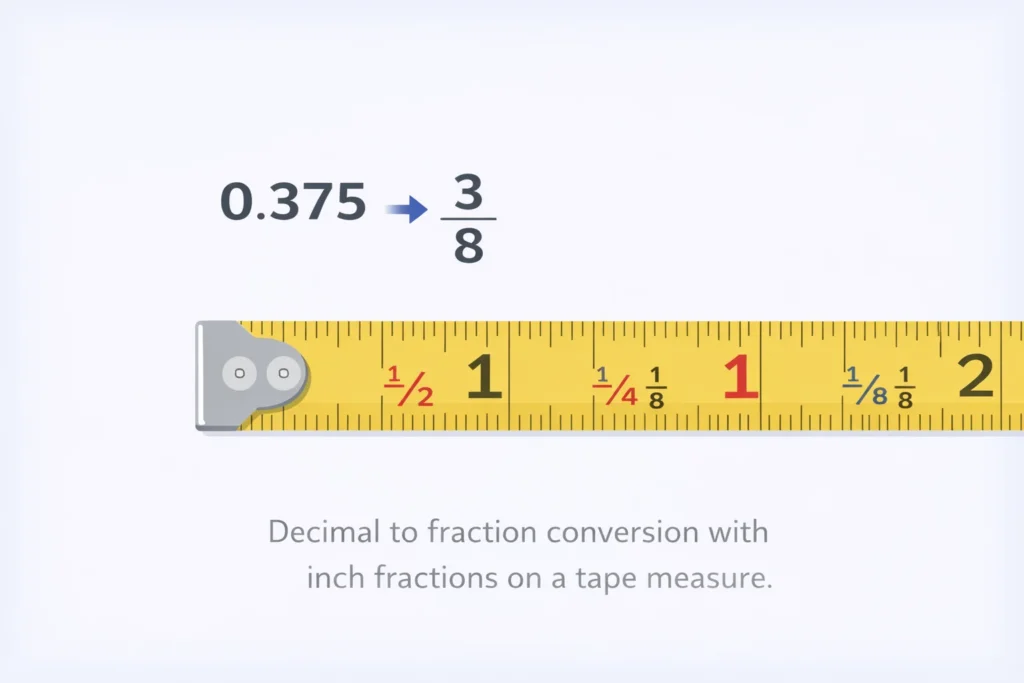
Common Inch Fractions on a Tape Measure
Tape measures divide inches into equal fractional parts.
- 1/2 inch
- 1/4 inch
- 1/8 inch
- 1/16 inch
- 1/32 inch
- 1/64 inch
These marks help measure lengths precisely without decimals.
Decimal Inches to Fraction Inches
Decimals often need conversion into standard fraction format.
Example:
2.375 inches = 2 + 0.375
0.375 = 3/8 → final result is 2 3/8 inches
Another example:
5.625 = 5 5/8 inches
This is useful for cutting materials accurately.
Metric and Imperial Fraction Use Cases
Different systems require conversion between units.
- mm to inches fraction helps in machine work
- inch fractions are common in carpentry
Rounding to the nearest fraction improves practical accuracy. This is important when exact decimals are not needed.
Everyday Examples Where Fraction Math Matters
Fractions are not limited to classroom problems. They appear in daily activities and practical decisions. Understanding them reduces errors and saves time.
Cooking and Recipe Adjustments
Recipes often require scaling ingredients.
- Double 1/2 cup becomes 1 cup
- Half of 3/4 becomes 3/8
Fractions help adjust portions without guessing.
Carpentry, Flooring, and Cutting Measurements
Construction work depends on precise fraction values.
- Cutting wood at 2 1/4 inches
- Measuring tiles or panels accurately
Small errors can affect the entire project outcome.
School Homework and Test Practice
Students use fractions in many subjects.
- Simplifying fractions
- Comparing values
- Converting to decimals
You can also check answers using a fraction calculator when needed.
Common Fraction Mistakes and How to Avoid Them
Many errors happen due to skipping basic steps. Fixing these mistakes improves accuracy quickly.
Forgetting Common Denominators
Adding fractions directly without matching denominators gives wrong results.
Example mistake:
1/2 + 1/3 = 2/5, which is incorrect
Always convert before adding.
Not Simplifying the Final Answer
Some answers are correct but not complete.
Example:
4/8 should be simplified to 1/2
Always reduce to lowest terms.
Flipping the Wrong Fraction During Division
Only the second fraction should be flipped.
Example:
a/b ÷ c/d = a/b × d/c
Flipping both fractions leads to incorrect answers.
Mixing Decimal and Fraction Formats Midway
Switching formats during calculation creates confusion. Convert everything to one format before solving. Then convert the final answer if needed.
Quick Fraction Reference Examples by Type
These examples cover common fraction problems in real situations. Use them as quick references when solving similar questions.
Basic Operation Examples
- 1/2 + 1/3 = 5/6
- 3/4 − 1/8 = 5/8
- 2/5 × 3/7 = 6/35
- 5/6 ÷ 2/3 = 5/4
Mixed Number Examples
- 2 1/3 + 1 1/6 = 3 1/2
- 4 1/2 − 2 3/4 = 1 3/4
- 1 2/5 × 3 = 4 1/5
Conversion Examples
- 3/8 = 0.375
- 0.625 = 5/8
- 3/4 = 75%
- 125% = 5/4
When Manual Fraction Math Is Better Than Fast Estimation
Some situations require exact answers, not rounded values. Choosing the right method depends on the task.
Cases Where Exact Fractions Matter
- Baking precise recipes
- Cutting materials accurately
- Solving exam problems
Exact values prevent errors in critical situations.
Cases Where Rounded Decimals Are Fine
- Quick budgeting estimates
- Rough measurements
- Fast comparisons
Use decimals when precision is not critical.
Frequently Asked Questions
Closing Words, Fraction Skills That Save Time Every Day
Fractions appear in cooking, measurements, and daily decisions. Knowing how to simplify, convert, and compare them saves effort. You now understand core rules, edge cases, and real examples. Use these steps confidently instead of guessing answers. When needed, a fraction calculator can help verify results quickly.