

Understanding how to find common factors saves time in many math problems. A greatest common factor calculator helps you get quick answers, but knowing the steps makes you faster and more accurate.
You will often need GCF when simplifying fractions, factoring expressions, or solving ratios. This guide focuses on clear steps, real examples, and practical use. It also shows how different methods work so you can choose the fastest one.
What is the Greatest Common Factor in Math
The greatest common factor, also called GCF or GCD, is the largest number that divides two or more numbers evenly.
A factor divides a number without leaving any remainder. When two numbers share factors, the largest one is the GCF.
This concept is used in:
- Simplifying fractions
- Factoring algebra expressions
- Solving ratio problems
GCF Meaning with Simple Example
Take 12 and 18.
Factors of 12: 1, 2, 3, 4, 6, 12
Factors of 18: 1, 2, 3, 6, 9, 18
Common factors are 1, 2, 3, and 6. The greatest common factor is 6.
How to Find the Greatest Common Factor Step by Step
There are three common methods used in school and calculators. Each works well depending on the numbers.
Prime Factorization Method
Break each number into prime factors.
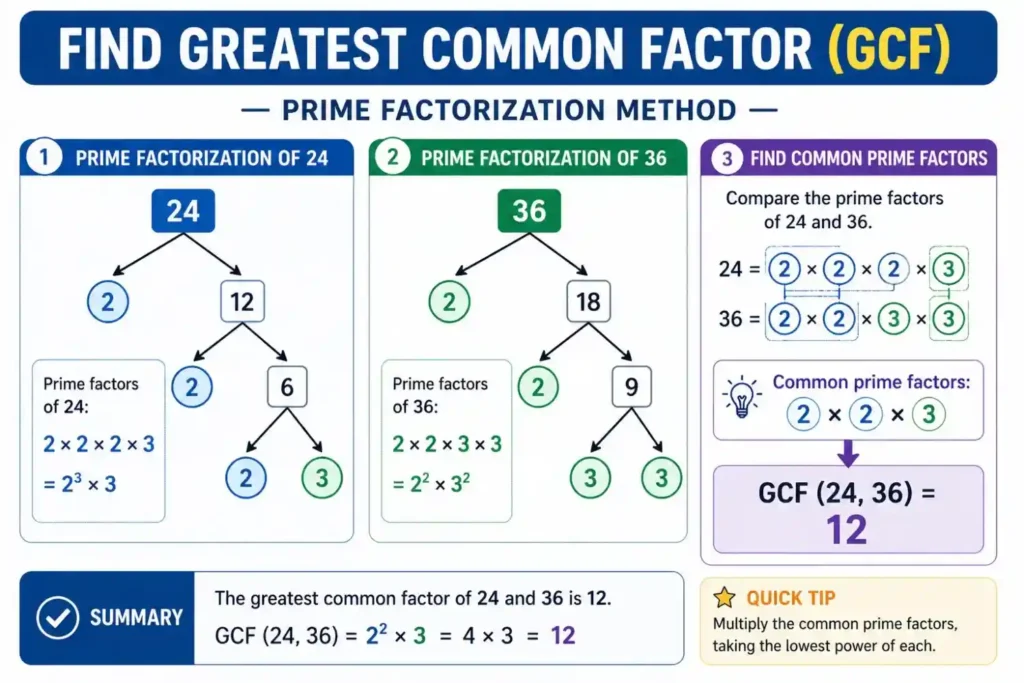
Example with 12 and 18:
- 12 = 2 × 2 × 3
- 18 = 2 × 3 × 3
Common primes are 2 and 3.
Multiply them: 2 × 3 = 6
This method works best for small to medium numbers.
List of Factors Method
List all factors for each number, then compare.
Example:
- Factors of 16: 1, 2, 4, 8, 16
- Factors of 24: 1, 2, 3, 4, 6, 8, 12, 24
Common factors: 1, 2, 4, 8
GCF = 8
This method is simple but slow for large numbers.
Euclidean Algorithm Method
This method uses division and remainders.
Example with 48 and 18:
- 48 ÷ 18 = remainder 12
- 18 ÷ 12 = remainder 6
- 12 ÷ 6 = remainder 0
The last non-zero remainder is 6, which is the GCF. This method is fast and works well for large numbers.
Calculating GCF of Two or More Numbers
You can find GCF for more than two numbers using the same methods. Start with two numbers, then include the next one.
Example with Three Numbers
Find GCF of 24, 36, and 60.
Prime factors:
- 24 = 2³ × 3
- 36 = 2² × 3²
- 60 = 2² × 3 × 5
Common factors are 2² and 3.
GCF = 4 × 3 = 12
Greatest Common Factor Calculator with Steps
A greatest common factor calculator uses these same methods behind the scenes. It finds factors, compares them, and shows the final result.
Some tools also show:
- Prime factorization steps
- Division method steps
- Factor lists
If you work with large values, try a big number calculator to handle heavy calculations smoothly.
GCF and LCM Relationship
GCF and LCM are closely connected in many math problems. GCF finds shared factors, while LCM finds the smallest shared multiple.
You often use both when working with fractions or ratios.
Formula Connecting GCF and LCM
For two numbers, this formula always works:
GCF × LCM = Number 1 × Number 2
Example with 12 and 18:
- GCF = 6
- LCM = 36
Check:
6 × 36 = 216
12 × 18 = 216
Both sides match, so the result is correct.
Greatest Common Factor for Fractions
GCF helps reduce fractions to their simplest form. You find the GCF of the numerator and denominator, then divide both.
Example for Fraction Simplification
Simplify 18/24.
- GCF of 18 and 24 = 6
- Divide both by 6
18 ÷ 6 = 3
24 ÷ 6 = 4
Final answer: 3/4
This method saves time when simplifying large fractions. You can also combine it with a fraction calculator for faster results.
GCF with Variables and Exponents
GCF also applies to algebra terms with variables and powers. You find the common number and the common variables.
Pick the smallest exponent for each shared variable.
GCF of Monomials
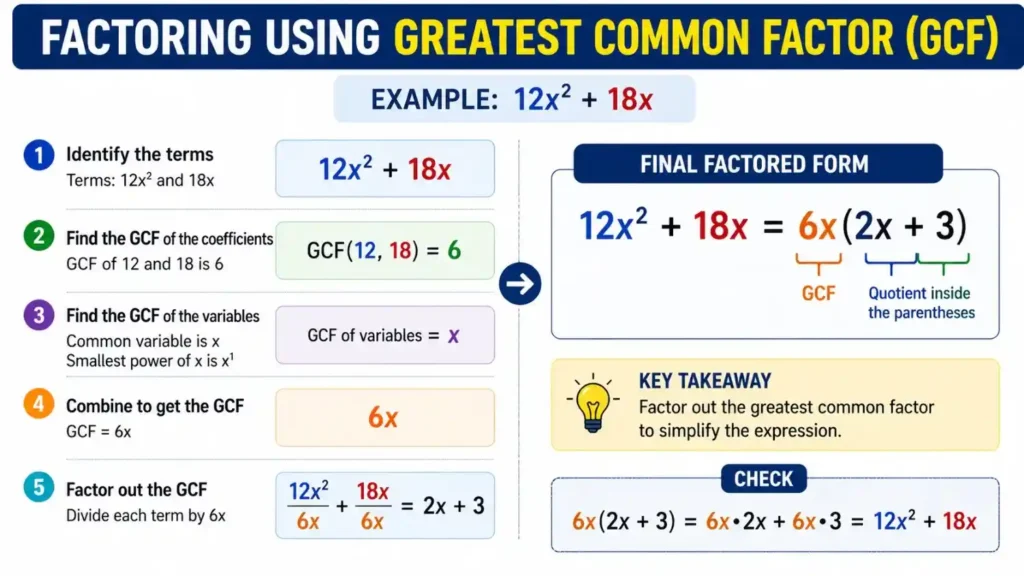
Example: 12x² and 18x
- Numbers: GCF of 12 and 18 is 6
- Variable: x appears in both
- Lowest exponent of x is 1
GCF = 6x
This method works for any pair of monomials.
GCF of Polynomials
Example: 12x² + 18x
- First term: 12x²
- Second term: 18x
Common factor is 6x.
Factor the expression:
12x² + 18x = 6x(2x + 3)
This step is used in algebra and exam problems. If you handle powers often, an exponent calculator can help verify results.
Factoring Using Greatest Common Factor
Factoring by GCF simplifies expressions before solving equations. It helps reduce complex terms into smaller parts.
Factoring Example with Variables
Factor: 20x³ + 10x²
- GCF of 20 and 10 is 10
- Lowest power of x is x²
Factor out 10x²:
20x³ + 10x² = 10x²(2x + 1)
This makes equations easier to solve and reduces mistakes.
Special Cases in GCF Calculations
Some cases do not follow the usual pattern. Knowing them avoids errors.
GCF of Zero and Any Number
GCF of a number and 0 is the number itself.
Example:
GCF(8, 0) = 8
Because any number divides zero evenly.
When GCF is 1
If numbers share no common factor except 1, the GCF is 1.
Example:
GCF(8, 15) = 1
These are called relatively prime numbers.
Ladder Method and Factor Tree Method
These methods are common in classrooms and easy to follow.
Ladder Method for GCF
Divide both numbers at the same time using common divisors.
Example with 18 and 24:
- Divide by 2 → 9 and 12
- Divide by 3 → 3 and 4
Multiply divisors: 2 × 3 = 6
Factor Tree Method
Break numbers into prime factors using trees.
Example with 20:
- 20 → 2 × 10
- 10 → 2 × 5
So, 20 = 2 × 2 × 5
Repeat for the second number and compare primes.
Common GCF Examples Students Search
These examples appear often in homework and tests.
GCF of 12 and 18
- 12 = 2 × 2 × 3
- 18 = 2 × 3 × 3
Common primes: 2 and 3
GCF = 6
GCF of 24 and 36
- 24 = 2³ × 3
- 36 = 2² × 3²
Common: 2² × 3
GCF = 12
GCF of 8 and 12
- 8 = 2³
- 12 = 2² × 3
Common: 2²
GCF = 4
How to Find GCF on a Calculator
Most basic calculators do not have a direct GCF button. You can still find it using simple steps.
Use the division method or list of factors approach manually.
Scientific and Graphing Calculator Tips
On a scientific calculator:
- Divide the larger number by the smaller one
- Note the remainder
- Repeat using the smaller number and remainder
Continue until the remainder becomes zero. The last non-zero value is the answer.
On a graphing calculator like TI-84:
- Use the same division steps manually
- Or use built-in programming if available
This method works even when numbers are large.
Real Life Uses of Greatest Common Factor
GCF is not limited to school problems. It appears in many daily situations.
- Splitting items into equal groups
- Simplifying recipes and measurements
- Reducing fractions in finance calculations
- Planning layouts in construction work
For example, dividing 24 tiles and 36 tiles into equal rows uses GCF.
Common Mistakes When Finding GCF
Many errors happen due to small oversights.
- Missing a common factor between numbers
- Picking the highest exponent instead of the lowest
- Confusing GCF with LCM
- Ignoring variables in algebra expressions
Double-check each step to avoid wrong results.
Key Takeaways for Fast GCF Calculation
Use the right method based on the problem size.
- Prime factorization works well for clarity
- Euclidean method is faster for large numbers
- Always pick the lowest exponent for variables
- Check if numbers are relatively prime
A greatest common factor calculator helps confirm answers quickly. Use it when working with large values or complex expressions.
For more related tools, explore the math calculators collection.
FAQs
Final Words
Finding common factors becomes easy once you know the right method. Practice with small numbers first, then move to larger values and expressions.
Use prime factorization for clarity and the division method for speed. Always check your steps, especially with variables and exponents.
A greatest common factor calculator can help verify answers and save time when needed. Use it as support, not a replacement for understanding.