

Pythagorean Theorem Calculator
Solve a right triangle with a live diagram and full steps
| To Find | Formula |
|---|---|
| Hypotenuse c | c = √(a² + b²) |
| Side a | a = √(c² − b²) |
| Side b | b = √(c² − a²) |
| Area | A = (a × b) ÷ 2 |
| Angle α | arctan(a ÷ b) |
| Triple | Scaled Example |
|---|---|
| 3, 4, 5 | 6, 8, 10 |
| 5, 12, 13 | 10, 24, 26 |
| 8, 15, 17 | 16, 30, 34 |
| 7, 24, 25 | 14, 48, 50 |
Related Calculators
A pythagorean theorem calculator helps solve right triangle problems quickly and accurately. It removes manual steps and reduces calculation errors. You can use it to find the hypotenuse or a missing side in seconds.
This method is widely used in geometry, construction, and measurement tasks. Understanding the formula first makes results more reliable when using any calculator.
What Is the Pythagorean Theorem and Why It Matters
The Pythagorean theorem explains the relationship between the three sides of a right triangle. It works only when one angle is exactly ninety degrees.
In every right triangle:
- Two shorter sides meet at the right angle
- The longest side is called the hypotenuse
- The square of the hypotenuse equals the sum of the other squares
This simple rule helps solve many real measurement problems. It is useful in geometry, construction work, and layout planning. Without this formula, finding diagonal distances would take more time and effort.
Understanding Hypotenuse in a Right Triangle
The hypotenuse is the longest side in any right triangle. It sits opposite the right angle and connects the two shorter sides.
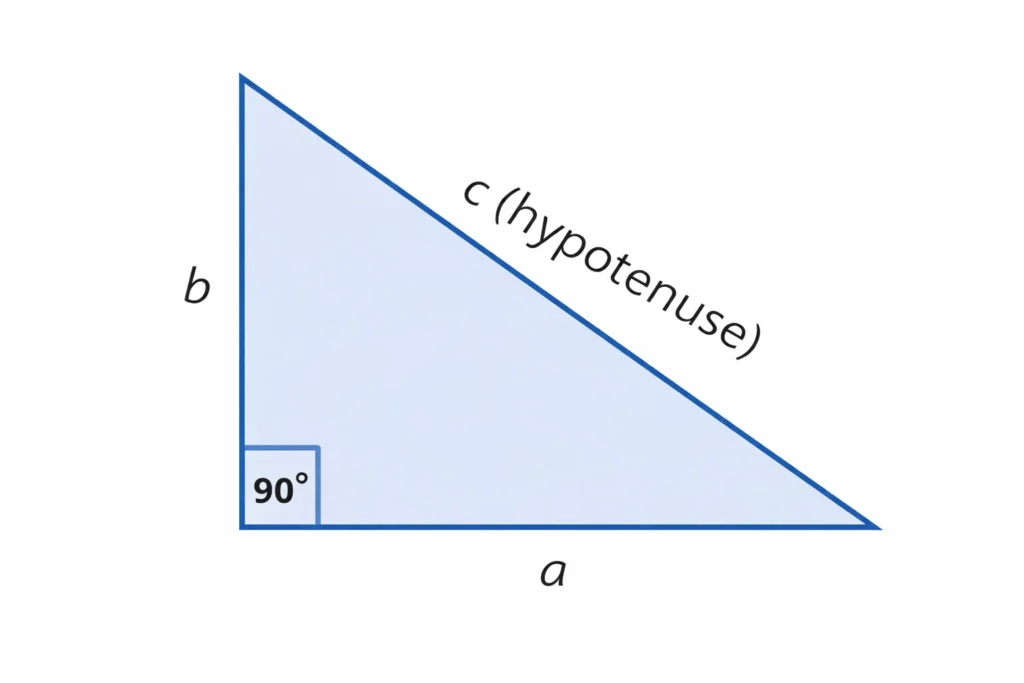
You can recognize it quickly by its position and length. It never forms the right angle itself and always has the highest value.
Keep these points in mind:
- It is opposite the ninety degree angle
- It is always longer than the other two sides
- It controls the overall triangle size
A common mistake is confusing it with adjacent or opposite sides. This leads to incorrect calculations, especially when solving for missing values.
Understanding the hypotenuse clearly makes every step of the calculation easier.
Pythagorean Theorem Formula
Standard Formula
The core formula is:
a² + b² = c²
Here, a and b are the two shorter sides. The value c represents the hypotenuse.
This means the square of the longest side equals the sum of the squares of the other two sides.
Rearranged Formulas
You can adjust the formula based on what you need to find.
- To find hypotenuse
c = √(a² + b²) - To find side a
a = √(c² − b²) - To find side b
b = √(c² − a²)
These forms help solve different triangle problems without changing the base concept. Once you understand these variations, solving any right triangle becomes straightforward.
How to Calculate Hypotenuse Step by Step
Start with the two known sides of a right triangle. These sides form the right angle.
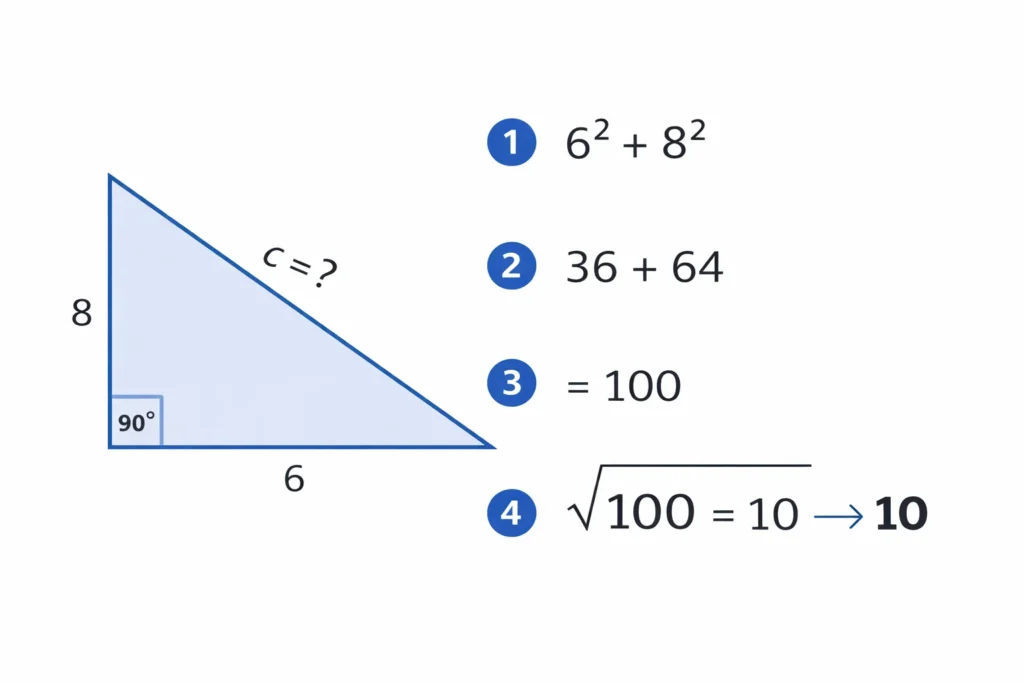
Follow these steps:
- Square the first side value
- Square the second side value
- Add both squared values
- Take the square root of the result
Example:
If a = 6 and b = 8:
- 6² = 36
- 8² = 64
- 36 + 64 = 100
- √100 = 10
So, the hypotenuse equals 10.
Keep units consistent during calculation. Mixing feet and meters leads to wrong results.
How to Find Missing Side of a Right Triangle
Sometimes the hypotenuse and one side are already known. You can still find the missing side using the same formula.
Follow these steps carefully:
- Square the hypotenuse value
- Square the known side
- Subtract the smaller value from the larger one
- Take the square root of the result
Example:
If c = 10 and a = 6:
- 10² = 100
- 6² = 36
- 100 − 36 = 64
- √64 = 8
So, the missing side equals 8. Always check that the hypotenuse is the largest value. If not, the setup is incorrect.
For more complex cases with angles or different triangle types, try a triangle calculator to get accurate results quickly.
How to Calculate Hypotenuse Using Angles and Sides
Sometimes one side and an angle are known instead of two sides. In this case, basic trigonometry helps find the hypotenuse.
Use these relationships:
- sin(angle) = opposite ÷ hypotenuse
- cos(angle) = adjacent ÷ hypotenuse
Rearrange them to find the hypotenuse:
- hypotenuse = opposite ÷ sin(angle)
- hypotenuse = adjacent ÷ cos(angle)
Example:
If the opposite side is 5 and angle is 30 degrees:
- sin(30°) = 0.5
- hypotenuse = 5 ÷ 0.5 = 10
This method is useful in design, surveying, and slope calculations. It works when direct side values are not available.
Distance Between Two Points Using Pythagorean Theorem
The same rule helps find distance on a coordinate plane. Two points create a right triangle using horizontal and vertical differences.
Follow these steps:
- Subtract x values to get horizontal distance
- Subtract y values to get vertical distance
- Treat both as sides of a right triangle
- Apply the formula to find total distance
Example:
Points (2, 3) and (8, 11):
- Horizontal difference = 8 − 2 = 6
- Vertical difference = 11 − 3 = 8
- Distance = √(6² + 8²)
- Distance = √(36 + 64) = √100 = 10
This method works for maps, graphs, and layout planning. For quick calculations, you can use a distance calculator to handle coordinate inputs easily.
Examples of Pythagorean Theorem
Construction and Measurement
Builders often use this rule for quick and accurate measurements. It helps when direct measurement is difficult.
- Checking wall height using a ladder and ground distance
- Measuring diagonal length for flooring or tile placement
- Setting right angles during layout work
These tasks rely on right triangle relationships in real settings.
Navigation and Mapping
Distance calculation becomes easier using triangle methods. It works well on grid-based layouts.
- Finding shortest path between two mapped points
- Measuring straight-line distance on coordinate grids
- Planning routes in navigation systems
This approach is common in mapping tools and location planning.
Engineering and Design
Design work often needs precise diagonal measurements. The formula helps maintain accuracy.
- Calculating slope lengths in structures
- Designing support beams and frames
- Ensuring proper alignment in layouts
These uses show how simple math supports complex designs.
Pythagorean Triples and Their Practical Use
Pythagorean triples are sets of three numbers that satisfy the formula exactly. They make calculations faster because no square root is needed.
Common triples include:
- 3, 4, 5
- 5, 12, 13
- 8, 15, 17
These values follow the same rule where the squares add up perfectly.
Builders and engineers use these triples for quick checks on site. They help confirm right angles without complex tools.
You can also scale these triples to larger sizes. For example, 6, 8, 10 works the same as 3, 4, 5. Using triples saves time and reduces calculation errors in practical work.
Common Mistakes When Using Pythagorean Theorem
Small errors can lead to wrong results, even with simple numbers. Most issues come from incorrect setup or missing steps.
Watch for these common mistakes:
- Using the formula on triangles without a right angle
- Treating the hypotenuse as a shorter side
- Forgetting to square values before adding or subtracting
- Mixing units like feet and meters in one calculation
Another mistake is rounding too early during intermediate steps. This can change the final answer slightly. Always check your triangle setup before calculating. A quick review prevents most errors.\
Edge Cases and Special Situations
Some problems need extra care to keep results accurate. Small details can change the final value.
- Decimal inputs may require careful rounding at the end
- Large numbers can increase calculation errors if handled manually
- Radical results may be better left in square root form
Keep units consistent across all inputs. Switching between feet and inches can break the calculation. In some cases, simplifying square roots improves clarity. For example, √50 can be written as 5√2. If calculations involve roots, a square root calculator can help simplify values correctly.
Advanced Applications of the Pythagorean Theorem
This rule extends beyond simple triangle problems. It supports many real calculations in different fields.
- In 3D space, it helps find distance between points
- In physics, it measures vector magnitude and motion paths
- In coordinate geometry, it supports graph distance calculations
Engineers use it to design stable structures and measure diagonal supports. It also helps in layout planning where precision matters.
In computer graphics, it is used to calculate pixel distances and object spacing. This keeps visuals aligned and proportional.
These applications show how a simple formula solves complex real problems.
When You Should Use the Pythagorean Theorem
Use this method only when the triangle has a right angle. Without a ninety degree angle, the formula will not work.
Keep these conditions in mind:
- The triangle must be right angled
- At least two sides must be known
- The hypotenuse must be the longest side
This method works well for finding diagonal distances and missing sides. It is also useful in layout, measurement, and coordinate problems.
Avoid using it for non right triangles. In such cases, other formulas are required for accurate results.
Using a Pythagorean Theorem Calculator for Fast Results
A pythagorean theorem calculator gives quick answers without manual steps. It is useful when working with decimals, large numbers, or repeated calculations.
It helps you:
- Find hypotenuse instantly from two known sides
- Calculate missing side when hypotenuse is given
- Solve distance problems on coordinate planes
- Reduce calculation errors during complex work
This tool is helpful for students, builders, and anyone handling measurements. It saves time while keeping results accurate. You can also explore more tools in the math calculators for similar problems.
Frequently Asked Questions
Conclusion
The pythagorean theorem calculator makes triangle calculations simple and accurate. It helps find hypotenuse, missing sides, and distances without confusion.
Understanding the formula improves accuracy, while using a tool saves time. Combining both methods gives reliable results in real situations.