

Roofing Calculator
Calculate roof area, pitch, materials, cost, replacement, load, rafter length, ventilation, and truss estimates in one clean tool.
Your results
Review the most important outputs below.
Getting an accurate estimate starts with the right method, not guesswork. A roofing calculator helps you plan roof area, materials, and cost quickly. Many people use floor size instead of real roof surface area. That mistake leads to wrong material counts and higher project costs.
This guide focuses on practical steps you can use on real projects. You will learn formulas, examples, and common mistakes to avoid. By the end, you can estimate roofing squares, shingles, and total cost confidently. You can also cross-check results using tools like a square footage calculator when needed.
What a roofing calculator should help you estimate
A good roofing calculator should solve real planning problems, not just basic math. It should help you move from size to materials and then to cost.
Here are the key things you should estimate:
- Roof area after adjusting for pitch and overhang
- Roofing squares used by contractors for pricing
- Shingle bundles or metal panels needed
- Underlayment, fasteners, and extra materials
- Total project cost including labor and waste
Many tools stop at area only. That is not enough for real work. You need a full estimate that connects size, materials, and cost. Roof pitch plays a big role in all calculations. Steeper roofs increase surface area and change material requirements.
Also understand the difference between footprint and roof surface. A 2000 sq ft house rarely has a 2000 sq ft roof. Use a roofing calculator as a starting point, not the final answer. Always adjust results based on roof shape, material type, and complexity.
How to calculate roof area before pricing materials
Start with area first, then move to materials and cost. Wrong area means every next calculation becomes inaccurate.
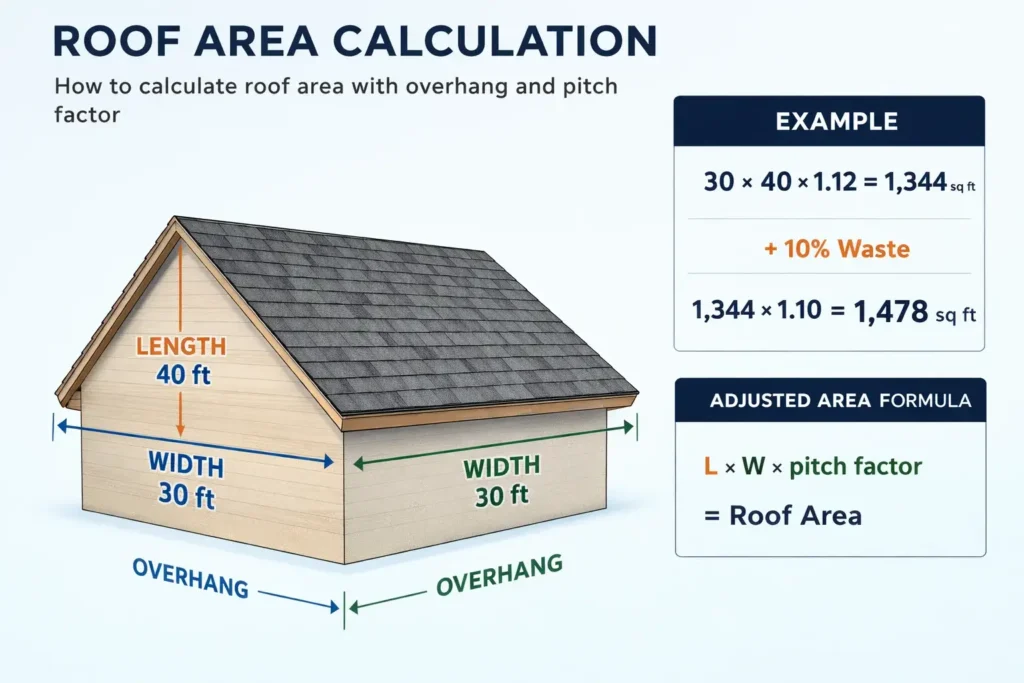
If you work on multiple building estimates, you can also use other construction-related calculators.
You need four basic inputs:
- Roof length
- Roof width
- Roof pitch
- Overhang
Add waste later, not during base area calculation. Keep steps clean to avoid confusion.
Flat roof area formula
Flat roofs use the simplest formula.
You only need length and width.
Formula:
Roof area = length × width
Example:
Length = 40 ft, width = 30 ft
Area = 40 × 30 = 1200 sq ft
This works only for flat or very low slope roofs. Do not use this for pitched roofs.
Pitched roof area formula
Most homes have pitched roofs, not flat surfaces. You must adjust area using a pitch factor.
Formula:
Roof area = footprint area × pitch factor
Pitch factor comes from rise and run.
It increases area based on roof slope.
Example:
Footprint = 1200 sq ft
Pitch = 6/12
Pitch factor ≈ 1.12
Adjusted area = 1200 × 1.12 = 1344 sq ft
This step is where most people go wrong. They skip pitch and underestimate materials.
How overhang changes roof measurements
Overhang extends beyond the wall edges.
It increases total roof surface area.
To adjust correctly:
- Add overhang to both sides of length
- Add overhang to both sides of width
Example:
Overhang = 1 ft
New length = 40 + 2 = 42 ft
New width = 30 + 2 = 32 ft
Now calculate area using updated dimensions.
Ignoring overhang leads to missing materials during installation. Even small overhangs can change total square footage.
How to calculate roofing squares
Roofing work uses squares, not just square feet.
One square equals 100 sq ft.
Formula:
Roofing squares = total roof area ÷ 100
Example:
Total area = 1344 sq ft
Squares = 1344 ÷ 100 = 13.44
Round up when ordering materials.
Contractors always account for waste and cuts.
You can verify area calculations with tools like a square yard calculator when converting units.
Roof pitch, slope, and angle
Roof pitch controls how steep your roof is. It directly affects area, drainage, and material usage. Pitch is written as rise over run. For example, 6/12 means 6 inches rise for 12 inches run.
Higher pitch means more surface area and more materials. It also changes how water and snow move across the roof.
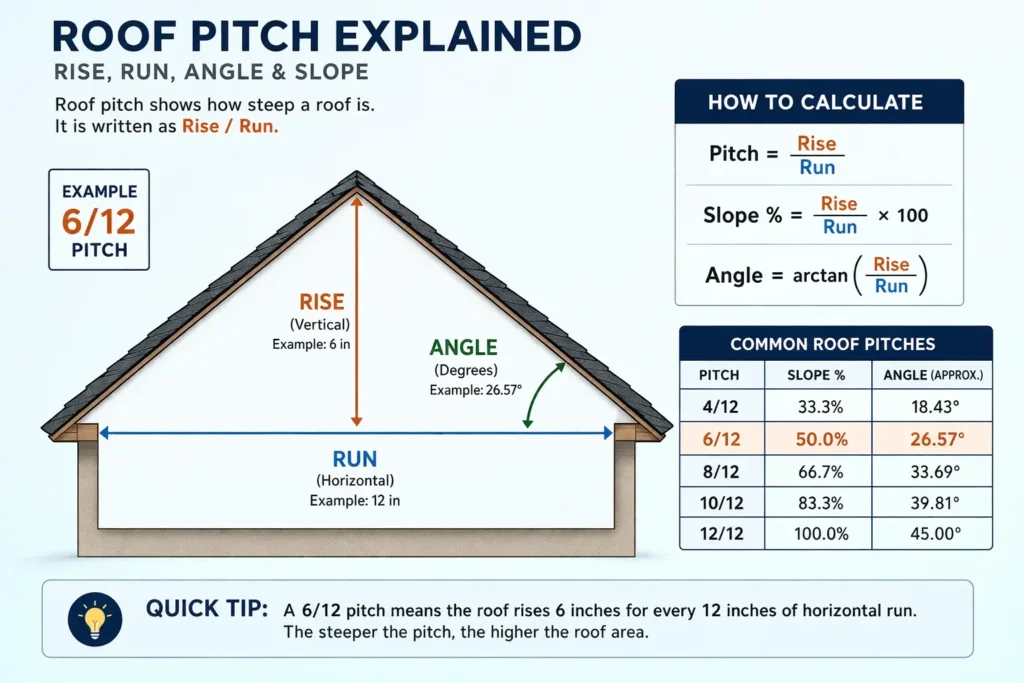
Roof pitch formula
You calculate pitch using rise and run values.
Formula:
Pitch = rise ÷ run
Example:
Rise = 6, run = 12
Pitch = 6 ÷ 12 = 0.5
This is written as 6/12 in roofing terms. It is one of the most common residential roof pitches.
Convert roof pitch to degrees and slope percent
Pitch can also be shown in degrees and percentage. This helps with design, layout, and material planning.
Formulas:
Slope percent = (rise ÷ run) × 100
Angle (degrees) = arctan(rise ÷ run)
Example:
Pitch = 6/12
Slope = 50%
Angle ≈ 26.57 degrees
These values help when working with drawings or advanced planning.
Roof pitch factor table for quick estimates
Pitch factor adjusts flat area into real roof surface. You can use common values instead of calculating each time.
Common pitch factors:
- 3/12 → 1.03
- 4/12 → 1.05
- 6/12 → 1.12
- 8/12 → 1.20
- 12/12 → 1.41
Use these multipliers with your footprint area. This gives a quick and reliable roof area estimate.
How to measure a roof for shingles and roofing materials
Accurate measuring saves money and avoids material shortages. You do not always need to climb the roof to get useful numbers. Start with simple methods, then refine if needed. Focus on usable measurements, not perfect precision.
Measuring from the ground, plans, or satellite tools
You can measure roof size in several practical ways.
- Use a tape measure for small structures like sheds
- Use building plans if available for accurate dimensions
- Use satellite tools for quick estimates on larger homes
Satellite tools help when access is difficult. They give rough roof area based on aerial images.
Use them as a starting point, not final measurement. Always adjust for pitch and overhang after that.
Measuring simple roofs versus complex roof shapes
Simple roofs are easy to calculate in one step. Complex roofs need to be broken into smaller sections.
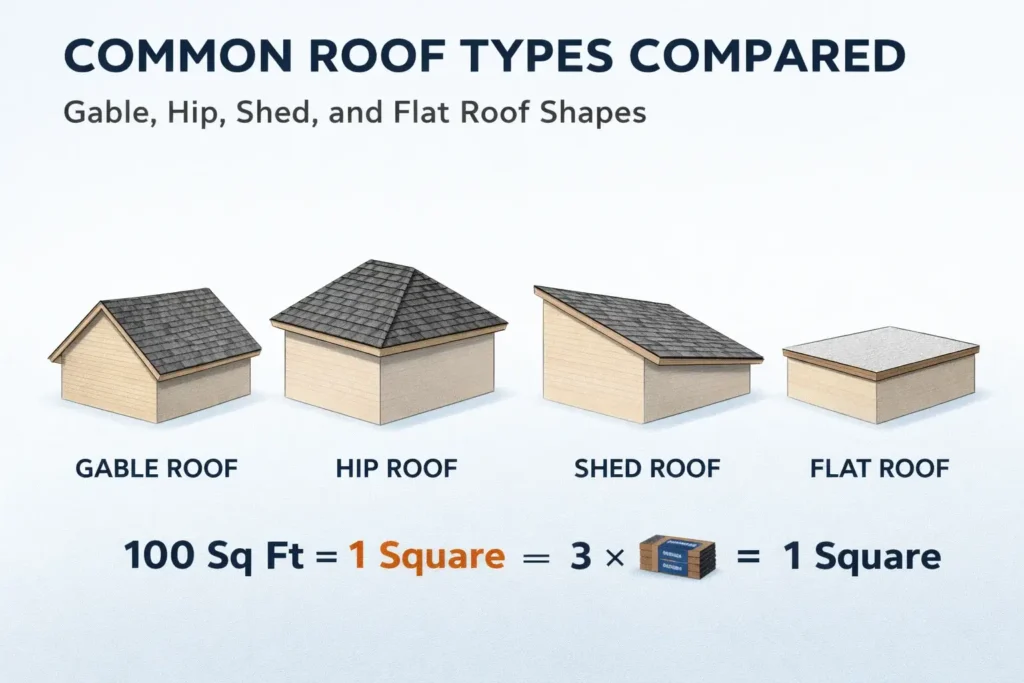
Common roof types include:
- Gable roof, two equal sloping sides
- Hip roof, slopes on all four sides
- Shed roof, single slope surface
- Flat roof, minimal slope
For complex layouts:
- Divide roof into rectangles or triangles
- Calculate each section separately
- Add all sections together
This method improves accuracy for real projects.
It also reduces mistakes in material planning.
Common measuring mistakes that change the estimate
Small errors can create large cost differences later. Avoid these common issues during measurement.
- Using floor area instead of roof surface area
- Ignoring roof pitch in calculations
- Forgetting overhang extensions
- Skipping waste allowance
- Rounding numbers too early
Another common mistake is mixing units. Keep all values in the same unit before calculating.
Roofing materials calculator, what to estimate beyond area
Area alone does not complete a roofing estimate. You also need material counts, coverage, and supporting components. Different materials follow different coverage rules. Always match calculations with the material you plan to use.
Shingle bundles and roofing squares
Asphalt shingles are sold in bundles, not square feet. Three bundles usually cover one roofing square.
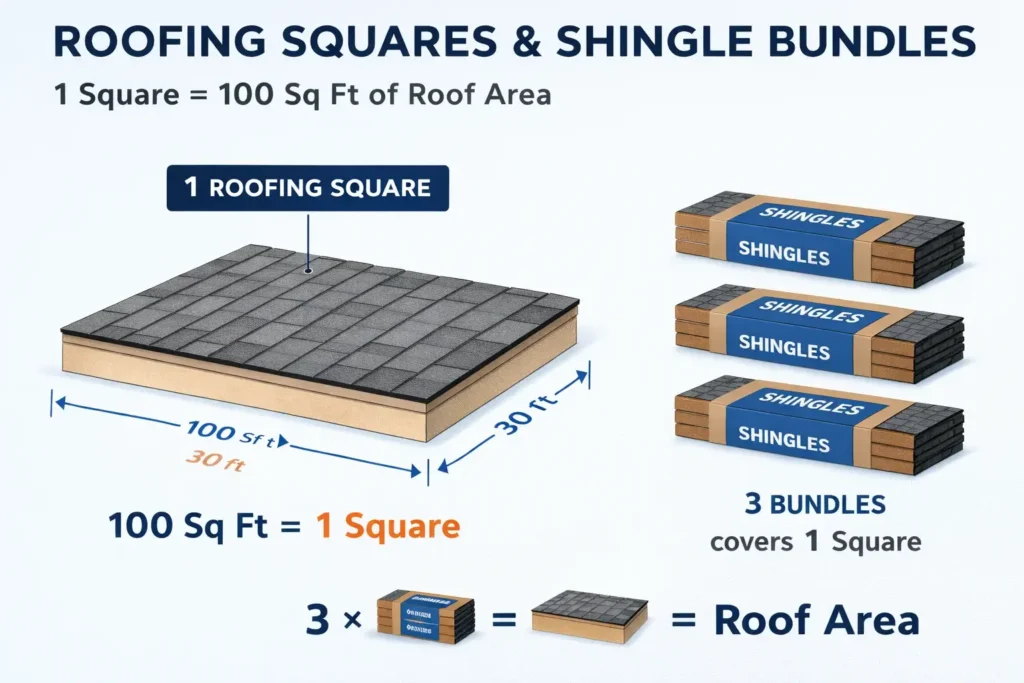
Formula:
Bundles = roofing squares × 3
Example:
Roof area = 1500 sq ft
Squares = 15
Bundles = 15 × 3 = 45 bundles
Always add waste to your final bundle count. Complex roofs may require extra bundles for cuts.
Metal roofing panels and sheet coverage
Metal roofing uses panels or sheets with fixed coverage. Overlap reduces the usable width of each panel.
To estimate panels:
- Calculate total roof area
- Divide by effective panel coverage
- Add extra for overlap and waste
Panel length also matters for installation. Long panels reduce seams but increase handling difficulty.
Roof tile estimates
Tile roofs require counting individual tiles or tile packs. Coverage depends on tile size and exposure spacing.
Steps to estimate tiles:
- Calculate total roof area
- Divide by tile coverage per unit
- Add extra for breakage and cuts
Tile roofs often need higher waste allowance. Breakage during transport and installation is common.
Underlayment, felt, membrane, and accessories
Roofing projects include more than top material. You also need supporting layers and accessories.
Key components include:
- Underlayment rolls or felt
- Flashing around edges and valleys
- Ridge cap shingles or trim pieces
- Nails, screws, and fasteners
Underlayment coverage varies by product type. Check manufacturer details before final ordering. Many people forget these items during planning. That leads to delays and extra store visits.
Roofing cost calculator, estimate material and labor clearly
Cost estimation comes after area and materials are clear. Do not jump to pricing before confirming your roof size. Break the total into simple parts. This keeps your estimate realistic and easy to adjust.
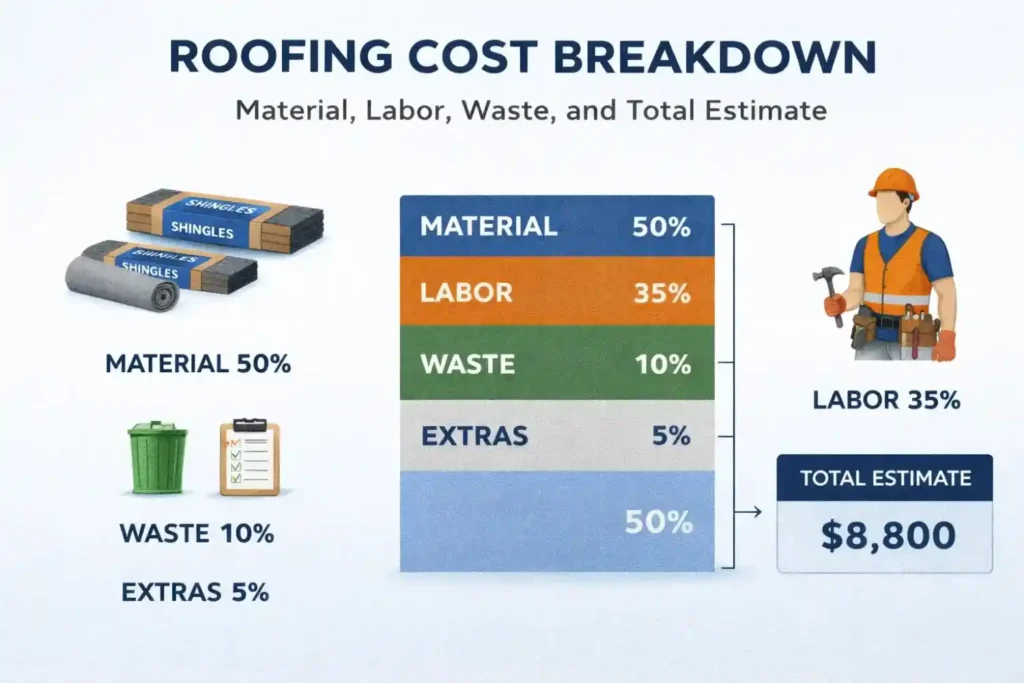
Material cost per square foot or square meter
Material cost depends on type and quality. Asphalt shingles cost less than metal or tile roofing.
Formula:
Material cost = roof area × price per unit
Example:
Area = 1500 sq ft
Cost = $4 per sq ft
Total = 1500 × 4 = $6000
Always apply waste before calculating final cost. Material cost increases with higher waste percentages.
Labor cost, tear-off, disposal, and permit costs
Labor is often a large part of total cost. It depends on roof pitch, height, and complexity.
Typical cost elements include:
- Labor cost per square foot
- Tear-off cost for old roofing
- Disposal or dumpster fees
- Permit and inspection costs
Steeper roofs usually increase labor charges. Complex shapes also require more time and effort.
Roof replacement cost formula
Replacement includes both removal and installation costs. It is higher than installing a new roof on bare structure.
Formula:
Total cost = new roof cost + tear-off + disposal + extras
Example:
New roof = $6000
Tear-off = $1500
Disposal = $500
Total = $8000
Add small extra costs for safety and tools if needed. These often get ignored during early estimates.
Cost per roofing square
Contractors often price jobs per roofing square. This makes comparison easier across different quotes.
Formula:
Cost per square = total cost ÷ number of squares
Example:
Total cost = $8000
Squares = 16
Cost per square = $500
Use this method to compare multiple contractor quotes. It helps you spot overpricing quickly.
Waste factor, how much extra roofing material to add
Waste is not optional, it is part of every roofing estimate. Cuts, overlaps, and errors always increase material usage. Add waste after calculating total roof area. Do not mix it with base measurements.
Standard waste percentages for simple and complex roofs
Waste depends on roof shape and design complexity. Simple roofs need less extra material than complex layouts.
Typical waste ranges:
- 5% for simple flat or shed roofs
- 8% to 10% for standard gable roofs
- 12% to 15% for hip or complex roofs
Valleys, dormers, and angles increase cutting. More cuts always mean higher waste.
Waste factor example with shingles and metal panels
Use waste percentage directly in your calculations. Apply it before ordering materials or pricing.
Example with shingles:
Area = 1500 sq ft
Waste = 10%
Total = 1500 × 1.10 = 1650 sq ft
Squares = 1650 ÷ 100 = 16.5
Order at least 17 squares for safety.
Example with metal panels:
Area = 1500 sq ft
Waste = 8%
Total = 1500 × 1.08 = 1620 sq ft
Panel count should match usable coverage, not full size. Always account for overlap and trimming.
Roof framing and structure calculations that affect estimates
Framing details can change your final material and cost numbers. You do not need full engineering, but basic understanding helps planning.
Focus on span, slope, and load when estimating. These factors affect material choice and installation effort.
Rafter length formula
Rafter length depends on rise and run of the roof. It helps estimate wood, spacing, and cutting angles.
Formula:
Rafter length = √(run² + rise²)
Example:
Run = 12 ft, rise = 6 ft
Length = √(144 + 36) = √180 ≈ 13.42 ft
Add overhang length if needed. This gives the full rafter size required.
Roof truss and framing estimate basics
Trusses replace individual rafters in many modern builds. They simplify installation but still depend on span and slope.
Key points to consider:
- Larger spans require stronger truss systems
- Steeper roofs increase material and labor
- Lean-to and shed roofs use simpler framing
Always match framing with roof type and load. Wrong assumptions can affect total project cost.
Roof load basics for planning
Roof load includes all weight acting on the structure. It affects material selection and safety.
Main load types:
- Dead load, permanent weight of materials
- Live load, temporary weight like workers
- Snow load, climate-based weight on roof
Heavier materials like tile increase total load. Always consider load before switching roofing type.
Roof ventilation and drainage calculations homeowners often miss
Many estimates ignore airflow and water movement. These details affect roof life and long term performance. Ventilation keeps attic space dry and balanced. Drainage prevents water buildup and structural damage.
Roof ventilation calculator basics
Ventilation depends on attic floor area and airflow balance. Most homes follow a simple ratio rule.
Common rule:
1 square foot vent area per 300 sq ft attic area
Steps to estimate:
- Measure attic floor area
- Divide by 300 to get required vent area
- Split evenly between intake and exhaust
Example:
Attic = 1800 sq ft
Vent area = 1800 ÷ 300 = 6 sq ft
Balanced airflow improves insulation performance. It also reduces moisture and mold risk.
Roof drainage and drain sizing basics
Drainage depends on roof area and slope. Flat roofs need more careful planning than pitched roofs.
Key factors:
- Total roof area
- Rainfall intensity in your region
- Number and size of drains or gutters
Larger roofs need wider or more drains. Poor drainage leads to water pooling and leaks. For flat roofs, even small slope changes matter. Always ensure water flows toward drains or edges.
Material-specific roofing estimates by roof type
Different materials need different estimating methods. Do not apply one formula to every roofing type. Each material changes coverage, waste, and installation approach. Choose the right method before ordering anything.
Asphalt shingle roof estimate
Shingles are the most common roofing material. They are sold in bundles and measured in squares.
Steps:
- Calculate total roof area
- Convert to roofing squares
- Multiply by 3 for bundles
Example:
Area = 1800 sq ft
Squares = 18
Bundles = 18 × 3 = 54 bundles
Add 10% waste for standard roofs. Increase waste for hips, valleys, or complex layouts.
Metal roof estimate
Metal roofing uses panels instead of bundles. Each panel has effective coverage after overlap.
Steps:
- Calculate total roof area
- Divide by panel coverage
- Add extra for overlap and waste
Panel length affects installation speed. Longer panels reduce seams but are harder to handle.
Tile roof estimate
Tile roofs need more careful planning than shingles. Each tile covers a smaller fixed area.
Steps:
- Calculate roof area
- Divide by tile coverage
- Add extra for breakage
Tile projects often need higher waste percentages.
Breakage during installation is common.
Flat roof and membrane estimate
Flat roofs use rolls or sheets instead of individual pieces. Coverage depends on roll width and overlap.
Steps:
- Calculate flat roof area
- Add overlap percentage
- Divide by roll coverage
Drainage design is critical for flat roofs. Poor slope can lead to water pooling and damage.
Roof shape examples for more accurate estimates
Roof shape changes both area and material needs. Always match your calculation method to the actual roof design. Simple roofs are easier to estimate in one step. Complex roofs require section-by-section calculation.
Gable roof calculation example
A gable roof has two equal sloping sides. It is one of the easiest roof types to estimate.
Example:
Length = 40 ft, width = 30 ft
Pitch = 6/12
Footprint = 40 × 30 = 1200 sq ft
Adjusted area = 1200 × 1.12 = 1344 sq ft
Convert to squares for material planning. Add waste before final ordering.
Hip roof calculation example
A hip roof slopes on all four sides. It increases both area and material waste.
Example:
Footprint = 1200 sq ft
Pitch factor = 1.12
Base area = 1344 sq ft
Add extra 3% to 5% for hips and cuts
Final area ≈ 1400 sq ft
Hip roofs require more cutting and fitting. Always increase waste for this design.
Shed and lean-to roof example
Shed roofs have a single slope surface.
They are common for extensions and small structures.
Example:
Length = 20 ft, width = 12 ft
Pitch = 4/12
Area = 240 × 1.05 = 252 sq ft
These roofs have low waste compared to complex shapes.
They are easier to measure and install.
Complex roof, how to split sections correctly
Complex roofs include multiple slopes and intersections. You cannot calculate them as one single surface.
Steps:
- Divide roof into rectangles and triangles
- Calculate each section separately
- Add all areas together
This method improves accuracy significantly. It also reduces material shortages during installation.
Roofing formulas that matter most in one place
Keep formulas simple and easy to reuse on real projects. These formulas cover most roofing calculations you will need.
Roof area formulas
Use the correct formula based on roof type.
- Flat roof area = length × width
- Pitched roof area = footprint × pitch factor
Always adjust dimensions for overhang before calculation. This ensures your base area is accurate.
Roofing square and bundle formulas
These formulas help convert area into material units.
- Roofing squares = total area ÷ 100
- Shingle bundles = squares × 3
Round up final numbers to avoid shortages. Never order exact quantities without extra margin.
Pitch and slope formulas
These formulas convert roof slope into usable values.
- Pitch = rise ÷ run
- Slope percent = (rise ÷ run) × 100
- Angle = arctan(rise ÷ run)
Use these values for design, layout, and safety planning.
Cost formulas
These formulas connect area with total project cost.
- Material cost = area × price per unit
- Total cost = material + labor + extras
- Waste-adjusted area = area × (1 + waste %)
Always calculate cost after applying waste factor. This avoids underestimating the final budget.
Practical roofing estimate examples
Real examples help you apply formulas without confusion. Use these cases to check your own numbers quickly.
Example 1, shingle estimate for a gable roof
This is a common residential roofing scenario. It uses standard pitch and asphalt shingles.
Details:
Length = 40 ft, width = 30 ft
Pitch = 6/12
Footprint = 1200 sq ft
Adjusted area = 1200 × 1.12 = 1344 sq ft
Add 10% waste:
1344 × 1.10 = 1478 sq ft
Squares = 1478 ÷ 100 = 14.78
Bundles = 14.78 × 3 ≈ 45 bundles
Round up to 46 bundles for safety.
This avoids running short during installation.
Example 2, metal roof estimate with cost
Metal roofs use panels instead of bundles. You must consider coverage and cost per unit.
Details:
Area = 1500 sq ft
Waste = 8%
Cost = $6 per sq ft
Adjusted area = 1500 × 1.08 = 1620 sq ft
Total cost = 1620 × 6 = $9720
Add extra cost for fasteners and trim. These small items affect final pricing.
Example 3, roof replacement estimate
Replacement includes removal and new installation.
It gives a more complete project cost.
Details:
Area = 1600 sq ft
New roof cost = $5 per sq ft
Tear-off = $1.5 per sq ft
Disposal = $500
Material + labor = 1600 × 5 = $8000
Tear-off = 1600 × 1.5 = $2400
Total = 8000 + 2400 + 500 = $10,900
Always include disposal and small extras. They are often missed in early estimates.
When a rough estimate is enough, and when it is not
A quick estimate works for planning and budgeting early stages.
It gives a clear idea before contacting suppliers or contractors.
Use rough estimates when:
- Planning a renovation budget or comparing material options
- Checking if your project fits within a price range
- Ordering approximate materials for small projects
For accurate planning, you can double-check values using a square footage calculator before moving forward.
Good use cases for a quick roofing calculator estimate
Quick estimates work best for simple roof shapes. They are useful when you only need a general idea.
Examples:
- Gable or shed roofs without complex intersections
- Small projects like garages, patios, or sheds
- Early planning before final measurements
These estimates save time and help with decision making. They also reduce the risk of major budget surprises.
Cases where manual measuring matters more
Some projects need detailed measuring instead of quick estimates. Complex roofs cannot be calculated in one step.
Use manual methods when:
- Roof has multiple slopes, valleys, or dormers
- Structure includes skylights or custom features
- You need exact material quantities before ordering
Professional measurement may be required for large projects. Accuracy becomes more important as project cost increases.
Common roofing calculation mistakes to avoid
Small mistakes can change your estimate by hundreds of dollars. Fix these issues early to avoid material shortages and delays.
Using building footprint instead of roof surface area
Many people use house size as roof size. That creates a major error in calculations. A 2000 sq ft house does not equal a 2000 sq ft roof. Pitch increases actual surface area significantly. Always adjust using pitch factor before estimating materials.
Ignoring waste, pitch, and accessories
Skipping these factors leads to incomplete estimates. You may run out of materials during installation.
Common misses include:
- Not adding waste percentage
- Ignoring pitch multiplier
- Forgetting underlayment and flashing
These small items add up quickly.
Always include them before ordering.
Mixing square feet, square meters, and roofing squares
Unit confusion causes incorrect calculations. It is one of the most common mistakes. Keep everything in one unit during calculation. Convert only at the end if needed. Use a square yard calculator if you need to switch units safely.
FAQs
Final planning checklist before ordering roofing materials
Before placing any order, confirm all key values once again.
This step prevents costly mistakes and delays.
- Roof area calculated with pitch and overhang
- Waste percentage added based on roof complexity
- Roofing squares and material quantities confirmed
- Material type selected, shingles, metal, tile, or membrane
- Underlayment, flashing, and fasteners included
- Labor, disposal, and permit costs reviewed
- Final estimate checked using a roofing calculator
Take a few minutes to review everything carefully. A small correction here can save time and money later.