
Rounding Calculator, Round to the Nearest Tenth and Hundredth
Round any number instantly — decimal places, significant figures, nearest value, fractions, ceiling, floor, truncate & banker’s rounding. Free, fast & step-by-step explained.
Round to Decimal Places
Standard half-up rounding to a chosen number of decimal places
- Half Up (standard)
- 2.5→3 | −2.5→−2
- Half Down
- 2.5→2 | −2.5→−3
- Banker’s (Half Even)
- 2.5→2 | 3.5→4
- Ceiling
- 2.1→3 | −2.9→−2
- Floor
- 2.9→2 | −2.1→−3
- Truncate
- 2.9→2 | −2.9→−2
- Significant Figures
- 0.004561 (3sf) → 0.00456
- Nearest Fraction
- 3.7 (½) → 3.5 | 3.8 → 4.0
A rounding calculator helps simplify numbers quickly without losing their real meaning. It works well for decimals, money values, and measurement-based calculations.
You often need to round to the nearest tenth or hundredth. This makes numbers easier to read, compare, and use in daily tasks.
Many people make small rounding mistakes during manual calculations. That is why a rounding calculator becomes useful for fast and accurate results.
What Rounding Means in Simple Terms
Rounding reduces a number to a simpler version that stays close. It removes extra decimal digits that are not needed in most cases.
This is useful when exact precision is not required. It keeps calculations clean and easier to understand.
Common Terms You Should Know
- Decimal places are digits after the decimal point
- Tenths is the first digit after the decimal
- Hundredths is the second digit after the decimal
- Whole numbers have no decimal part
Understanding Place Value Before Rounding
Place value tells you the importance of each digit in a number.
You must understand this before applying any rounding rules.
Each position changes the value of a number significantly.
Even a small mistake in place value changes the final result.
Quick Place Value Breakdown
- Ones place sits before the decimal point
- Tenths place is right after the decimal
- Hundredths place follows the tenths place
- Thousandths place is the third decimal digit
Basic Rounding Rules That Always Apply
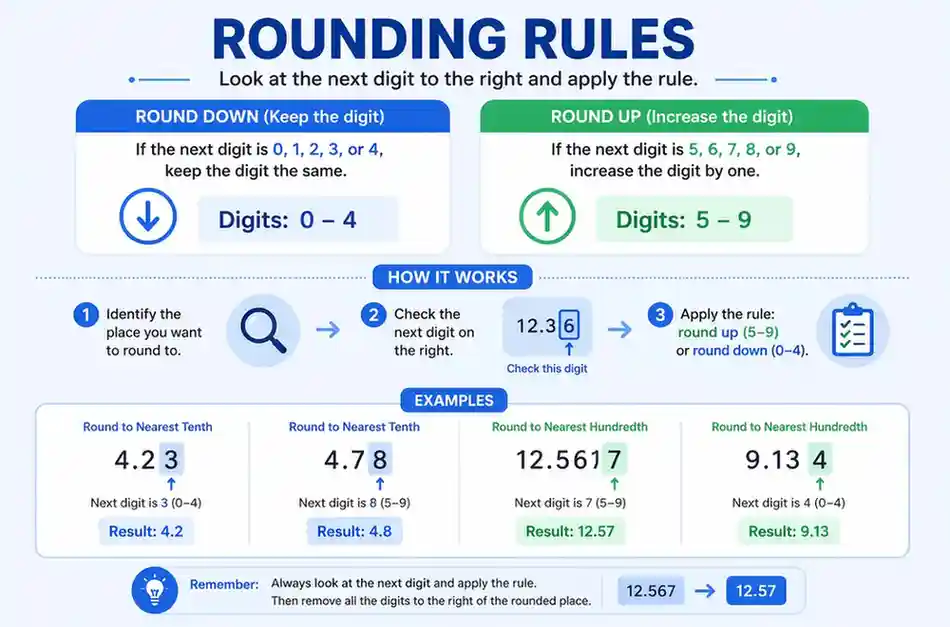
Rounding always depends on the next digit after your target place. This single step decides whether you round up or down.
Rounding Rules
- If the next digit is 5 or more, increase the value
- If the next digit is less than 5, keep it unchanged
- Remove all digits after the rounding place
Rounding Up and Rounding Down
- Rounding up increases the last kept digit by one
- Rounding down keeps the digit the same
- Only check the immediate next digit
Round to the Nearest Tenth Using a Rounding Calculator
Rounding to the nearest tenth focuses on one decimal place.
You check the hundredths digit to decide the result.
Step by Step Method
- Identify the tenths place in the number
- Look at the next digit, which is the hundredths place
- Apply the rounding rule and remove extra digits
Examples for Better Understanding
- 0.75 becomes 0.8 after rounding
- 1.05 becomes 1.1 after rounding
- 2.25 becomes 2.3 after rounding
- 4.08 becomes 4.1 after rounding
- 7.07 becomes 7.1 after rounding
If you want to explore more math tools, check this math calculators collection.
Round to the Nearest Hundredth
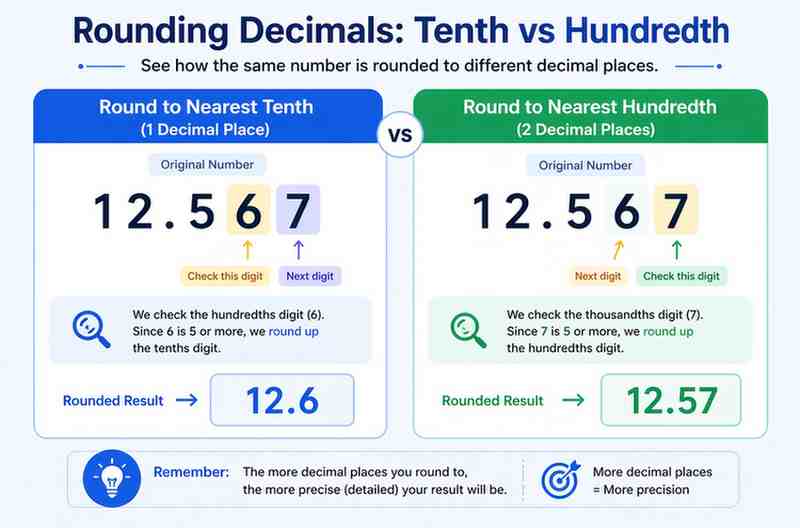
Rounding to the nearest hundredth keeps two decimal places. You check the third digit, which is the thousandths place.
Step by Step Method
- Identify the hundredths place
- Look at the next digit to the right
- Apply rounding rules carefully
Examples for Better Understanding
- 0.125 becomes 0.13 after rounding
- 1.866 becomes 1.87 after rounding
- 4.758 becomes 4.76 after rounding
- 7.884 becomes 7.88 after rounding
- 25.12 stays the same because no rounding is needed
Rounding to Different Decimal Places
You may need different levels of precision based on the task. Each level follows the same rounding logic with a different target digit.
Common Decimal Place Rounding
- Round to 1 decimal place means nearest tenth
- Round to 2 decimal places means nearest hundredth
- Round to 3 decimal places means nearest thousandth
- Round to 4 decimal places follows the same pattern
Examples
- 3.146 rounded to 2 decimal places becomes 3.15
- 5.3821 rounded to 3 decimal places becomes 5.382
- 7.999 rounded to 1 decimal place becomes 8.0
Use consistent decimal places when comparing multiple results. This keeps values aligned and easier to analyze.
Rounding Whole Numbers and Large Values
Rounding is not limited to decimals only.
You can round whole numbers to simplify large values.
This is common in budgeting, population data, and reporting.
Examples with Whole Numbers
- 75 rounded to nearest ten becomes 80
- 250 rounded to nearest hundred becomes 300
- 904 rounded to nearest hundred becomes 900
When to Use It
- Estimating large totals quickly
- Simplifying numbers in reports
- Reducing unnecessary detail in communication
For construction or measurement rounding cases, tools like construction calculators can help handle real-world values.
Rounding in Real Life Situations
Rounding appears in daily tasks more than most people notice. It helps present numbers in a clear and usable format.
Practical Use Cases
- Prices are rounded to nearest cent in shopping
- Measurements are rounded for quick field estimates
- Grades are rounded for reporting and averages
- Time estimates often use rounded values
Small rounding differences can affect totals in finance. So always apply consistent rules across calculations.
Rounding Decimals in Calculations
Many calculations produce long decimal results.
Rounding makes them easier to read and use.
Best Practices
- Round only the final answer when possible
- Avoid rounding during intermediate steps
- Keep decimal precision consistent across results
Example
If you calculate 12.456 × 3 = 37.368
Rounding early gives a different result than rounding at the end
Correct approach gives 37.37
Early rounding may give 37.35, which is inaccurate
Common Mistakes While Rounding Numbers
Small errors in rounding can change the final value. Most mistakes come from checking the wrong digit or place.
Mistakes to Avoid
- Looking at the wrong digit for rounding decisions
- Forgetting to remove extra decimal digits
- Rounding too early in long calculations
- Mixing different decimal precision in one result
Example Mistake
- 4.67 rounded to tenth should be 4.7
- Some write 4.6 by checking the wrong digit
Always follow place value strictly to avoid such errors.
Advanced Rounding Cases You Should Know
Some numbers do not behave like standard examples. These cases need extra attention while rounding.
Edge Case Examples
- 0.5 rounds up to 1 in whole number rounding
- 2.500 stays 2.5 when rounding to one decimal
- 9.995 rounded to two decimals becomes 10.00
Why These Matter
These cases often appear in finance and engineering. Incorrect handling can lead to inaccurate totals.
Rounding and Decimal Precision in Different Fields
Different fields require different rounding levels. Precision depends on how the result will be used.
Examples by Field
- Finance uses two decimal places for currency
- Engineering often uses three or more decimal places
- Science uses significant figures for accuracy
- Education focuses on rounding rules and examples
Always match rounding precision with the use case. Too much rounding reduces accuracy, too little adds confusion.
Examples for Better Understanding
Practice helps build confidence with rounding rules.
These examples cover common decimal rounding situations.
Nearest Tenth Practice
- 5.83 becomes 5.8
- 9.937 becomes 9.9
- 3.75 becomes 3.8
- 2.969 becomes 3.0
Nearest Hundredth Practice
- 222.222 becomes 222.22
- 37.62 stays 37.62
- 56.52 stays 56.52
- 13.045 becomes 13.05
If you also work with percentages, try this percentage and math tools to simplify similar calculations.
When to Use a Rounding Calculator
Manual rounding works for small and simple values. Complex or repeated tasks need a faster approach. A rounding calculator helps reduce human errors. It also saves time during large calculations.
Best Situations to Use It
- Long decimal calculations
- Repeated rounding tasks
- Financial or measurement accuracy
- Comparing multiple rounded values
FAQs About Rounding Numbers
Final Words
Rounding helps keep numbers simple without losing their real meaning. It works best when you follow place value and basic rules carefully.
Small mistakes in rounding can change results more than expected. So it is important to stay consistent in every calculation.
A rounding calculator makes this process faster and more reliable. It handles decimals, whole numbers, and precision without confusion.
Use it when accuracy matters or when calculations repeat often. With practice, rounding becomes quick, clear, and easy to apply.