

Square Root Calculator, Find Square Root, Simplified Form, Decimal Result
Enter a non-negative number to get the square root, decimal result, and simplified form when possible.
Square root of 0
Quick steps
A square root calculator helps you quickly find the root of any number. It shows both simplified form and decimal value for better understanding.
You can enter whole numbers or decimals and get instant results. This tool also checks perfect squares and shows clean output.
It saves time compared to manual calculation and reduces common mistakes.
What Is a Square Root
A square root is a number that multiplies by itself to give a value.
For example:
- 3 × 3 = 9
- So, √9 = 3
The symbol √ is called the square root sign. It represents the root of a number.
Every positive number has one main square root called the principal root.
Some key points:
- Perfect squares give whole number results
- Non perfect squares give decimal values
- Square roots are widely used in algebra and geometry
This basic idea helps you understand how the calculator works.
How to Use the Square Root Calculator
Enter Your Number
Enter any non-negative value in the input box.
Whole numbers and decimals both work well here.
Examples include:
- 25
- 50
- 144
- 0.25
- 2.5
Negative numbers are not part of real square root results.
Those belong to complex number math, not basic root calculation.
Select Decimal Precision
Choose the number of decimal places before calculating.
A lower value keeps the answer short and neat.
A higher value shows a more precise decimal approximation.
Common choices:
- 2 decimal places
- 4 decimal places
- 6 decimal places
This is useful when comparing values or checking homework answers.
View the Result
The result area should show the most useful outputs only.
These outputs matter most:
- Simplified form
- Decimal value
- Perfect square status
- Input value
For example:
- √144 = 12
- √50 = 5√2 ≈ 7.0711
That gives both the exact form and the rounded decimal.
Square Root Formula and Basic Concept
The square root of a number x is written as √x.
It asks one simple question, which number times itself gives x.
Example:
- √9 = 3
- because 3 × 3 = 9
Another way to write square root is exponent form.
It can be shown as x to the power of one half.
Examples:
- √16 = 16^(1/2)
- √25 = 25^(1/2)
Some important facts:
- Every positive number has one principal square root
- Zero also has a square root, which is 0
- Non perfect squares usually give irrational decimal values
This concept connects roots, exponents, factors, and radical expressions.
Simplifying Square Roots Step by Step
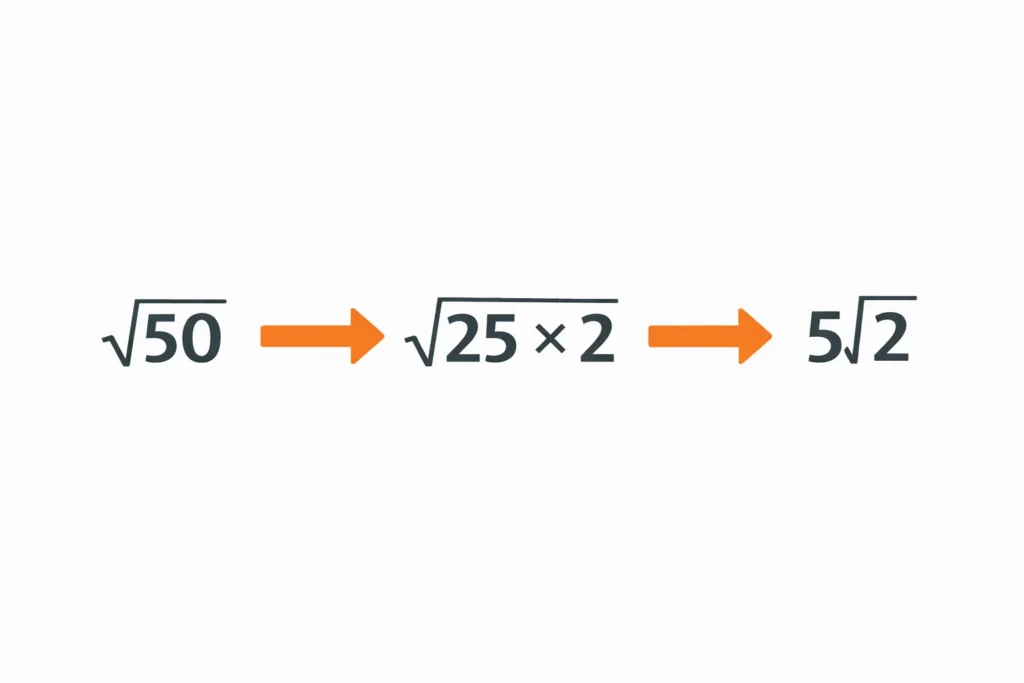
Find Perfect Square Factors
Start by breaking the number into factors.
Look for the largest perfect square inside that number.
Example:
- 50 = 25 × 2
- 72 = 36 × 2
- 48 = 16 × 3
This step makes simplification much easier.
Apply Square Root Rule
Use the radical rule for multiplication:
- √(a × b) = √a × √b
Now apply it:
- √50 = √(25 × 2)
- √50 = √25 × √2
The same pattern works for many other values.
Final Simplified Form
Solve the perfect square part first.
Example:
- √25 = 5
- so √50 = 5√2
Another example:
- √72 = √36 × √2
- √72 = 6√2
Another one:
- √48 = √16 × √3
- √48 = 4√3
Simplified radical form is often better than a long decimal.
It is cleaner for algebra, equations, and exact answers.
Perfect Square vs Non Perfect Square
A perfect square comes from multiplying a whole number by itself.
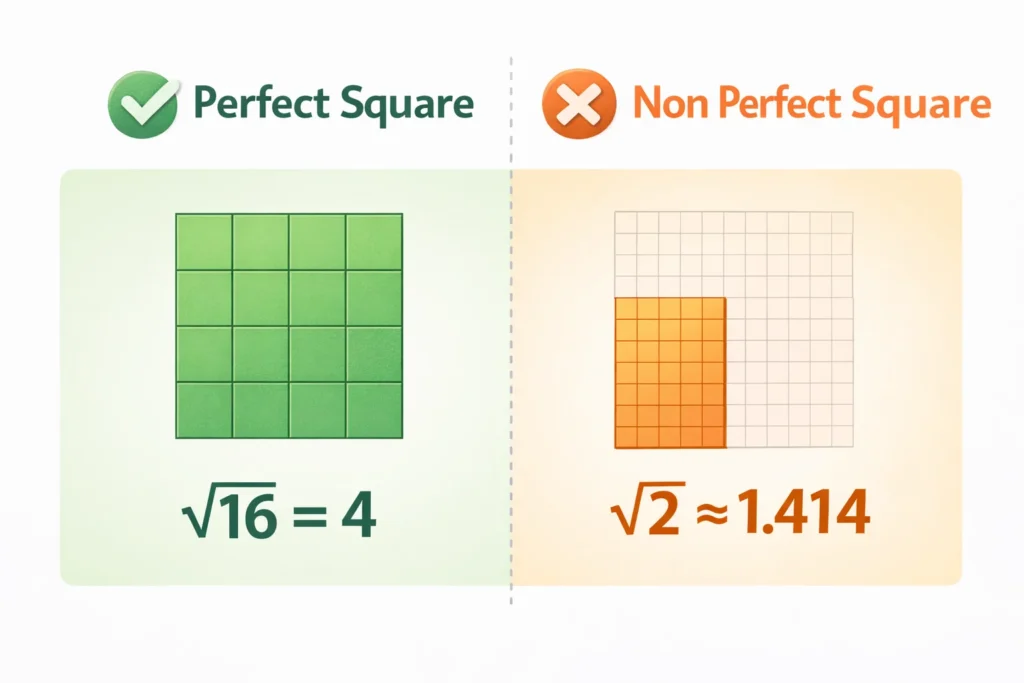
Examples:
- 1 = 1 × 1
- 4 = 2 × 2
- 9 = 3 × 3
- 16 = 4 × 4
- 25 = 5 × 5
Their roots are exact whole numbers:
- √1 = 1
- √4 = 2
- √9 = 3
- √16 = 4
- √25 = 5
A non perfect square does not work that way.
Its root is usually a decimal that does not end.
Examples:
- √2 ≈ 1.4142
- √3 ≈ 1.7321
- √5 ≈ 2.2361
Quick comparison:
- Perfect square, exact integer result
- Non perfect square, decimal approximation
This matters in school math, estimations, and simplified radical form. A perfect square may reduce to a whole number. A non perfect square may stay in radical form or decimal form.
Decimal Approximation of Square Roots
Many square roots are not whole numbers.
They produce decimal values that continue without ending.
These are called irrational numbers.
Examples:
- √2 ≈ 1.4142
- √3 ≈ 1.7321
- √10 ≈ 3.1623
The decimal result is rounded based on selected precision.
Common rounding levels:
- 2 decimal places for quick answers
- 4 decimal places for standard use
- 6 or more for higher accuracy
Decimal form is useful when:
- Comparing values
- Measuring lengths
- Working with real-world data
Simplified form is exact, but decimal form is easier to read.
Square Root of Negative Numbers
Square roots of negative numbers are not real values.
Example:
- √-1 does not exist in real numbers
In advanced math, this is written using imaginary numbers:
- √-1 = i
Other examples:
- √-4 = 2i
- √-9 = 3i
These belong to complex numbers, not basic arithmetic.
For standard calculations, only non-negative values are used.
Square Root Table for Common Numbers
These values are often used in calculations:
- √1 = 1
- √2 ≈ 1.414
- √3 ≈ 1.732
- √4 = 2
- √5 ≈ 2.236
- √9 = 3
- √16 = 4
- √25 = 5
- √36 = 6
- √49 = 7
- √64 = 8
- √81 = 9
- √100 = 10
Knowing these helps estimate square roots quickly.
Square Root of Common Numbers
Square Root of 2
√2 is not a perfect square.
It gives a decimal value that never ends.
Square Root of 50
50 can be simplified using factorization:
- 50 = 25 × 2
- √50 = 5√2
Decimal value is about 7.071.
Square Root of 144
144 is a perfect square.
- √144 = 12
This gives an exact whole number result.
Square Root Rules You Should Know
These rules help solve square roots faster:
- √(a × b) = √a × √b
- √(a ÷ b) = √a ÷ √b
- √(a²) = a for positive values
Examples:
- √(4 × 9) = √4 × √9 = 2 × 3 = 6
- √(16 ÷ 4) = √16 ÷ √4 = 4 ÷ 2 = 2
These rules are useful for simplification and solving equations.
Square Root Function and Graph
The square root function is written as y equals √x. It shows how the output changes when x increases.
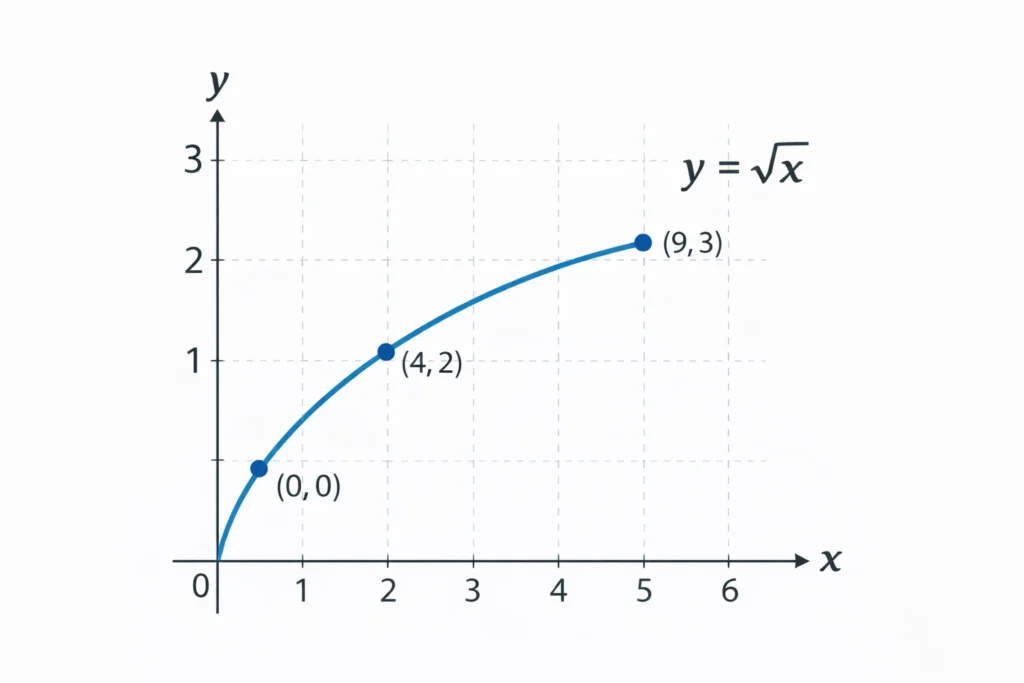
Key points:
- The graph starts at zero
- It only works for x greater than or equal to zero
- It increases slowly as x grows
Important properties:
- Domain, x ≥ 0
- Range, y ≥ 0
- The curve is not a straight line
Examples:
- If x = 0, y = 0
- If x = 4, y = 2
- If x = 9, y = 3
This function is common in algebra and real-world modeling.
Square Root on Calculator and Devices
Using a Scientific Calculator
Most scientific calculators have a √ button.
Steps:
- Press √
- Enter the number
- View the result instantly
Example:
- Press √ then 49 → result is 7
Typing Square Root Symbol
The square root symbol is √.
You can:
- Copy and paste the symbol
- Use keyboard shortcuts on some devices
This is useful in notes, assignments, and documents.
Square Root in Excel
Excel provides a built-in function for square roots.
Use this formula:
- =SQRT(25)
Result:
- 5
It works for both small and large values.
Common Mistakes When Calculating Square Roots
Avoid these common errors:
- Not simplifying square roots completely
- Treating negative inputs as real numbers
- Rounding decimal values too early
- Ignoring perfect square factors
Example mistake:
- √50 written as 7.07 only
- Correct form should also include 5√2
Checking both forms helps avoid confusion.
Why Simplified Form Matters
Simplified form gives exact values instead of rounded numbers.
Benefits include:
- Cleaner results in algebra problems
- Better comparison between values
- No loss of accuracy
Example:
- 5√2 is more exact than 7.071
This is important in exams and higher-level math.
Difference Between Square Root and Cube Root
Square root and cube root are different operations.
Square root:
- Finds a number multiplied by itself twice
Cube root:
- Finds a number multiplied three times
Examples:
- √9 = 3
- ∛27 = 3
They should not be confused in calculations.
FAQs About Square Root Calculator
Conclusion
A square root calculator makes it easy to find accurate results quickly.
It shows simplified form, decimal value, and number type together.
This helps you understand both exact and approximate answers clearly.