

Slope Calculator, Find Slope, Equation, Angle and Grade
9 calculation modes — slope, equation, angle, grade, intersection & more.
Line equation
Angle & grade
Derives the full line equation from a known point and slope.
Converts an inclination angle (−90° to +90°) to slope and builds the equation.
Perp slope (−1/m)
Both equations
Parallel lines share the same slope. Perpendicular slope = −1 ÷ m.
Finds where two lines cross. Shows parallel status if m₁ = m₂.
Accepts: y = mx + b · ax + by + c = 0 · ax + by = c
Enter grade % and horizontal distance to calculate the vertical rise.
Converts between decimal slope, % grade, angle degrees, and rise:run ratio.
📂 Click to upload a graph image
PNG, JPG, GIF · then click two points on the imageUpload an image, then click Point 1 and Point 2.
Pixel y increases downward. Math slope flips the sign automatically.
slope-calculator · precision math tool
Understanding slope is simple when you break it into steps. A good slope calculator helps you avoid manual errors and saves time. You can use it to find slope, angle, or percentage grade quickly. This guide explains how slope works and how to calculate it in real situations.
If you often solve math problems, explore this math calculators hub for related tools.
What Is Slope and Why It Matters in Real Life
Slope shows how steep a line is between two points. It tells how much something rises or falls.
In simple terms, slope compares vertical change with horizontal movement. This is called rise over run.
You will see slope used in many daily tasks:
- Road and driveway design
- Roof pitch calculation
- Data trends in charts
- Construction and drainage planning
A higher slope means a steeper line. A lower slope means a flatter surface. Slope also helps you understand how fast values change. This is useful in physics, finance, and engineering.
Slope Formula Explained with Simple Breakdown
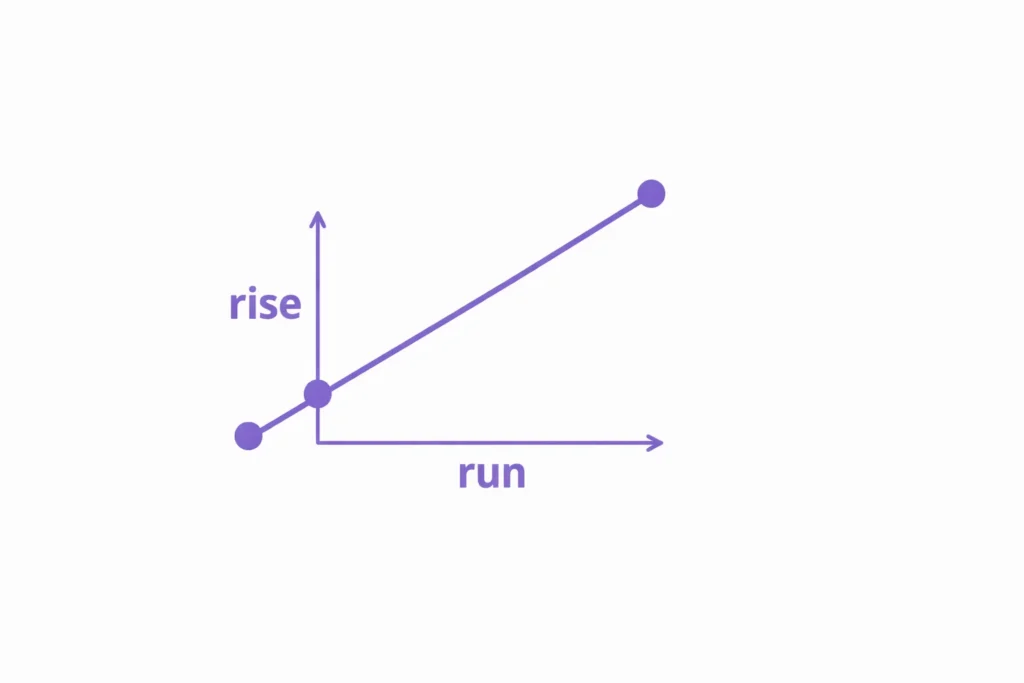
Standard slope formula and meaning
The slope formula is:
m = (y₂ − y₁) / (x₂ − x₁)
This formula calculates the rate of change between two points.
- y₂ − y₁ gives vertical change
- x₂ − x₁ gives horizontal change
The result is called slope, shown as m.
Understanding rise and run visually
Rise means how much the line moves up or down.
Run means how far the line moves left or right.
You can think of slope like climbing stairs:
- More rise means steeper steps
- More run means flatter steps
There are four main slope types:
- Positive slope, line goes up
- Negative slope, line goes down
- Zero slope, flat horizontal line
- Undefined slope, vertical line
How to Calculate Slope Step by Step
Using two points on a graph
Start with two points, for example (2, 3) and (6, 11).
Follow these steps:
- Subtract y values, 11 − 3 = 8
- Subtract x values, 6 − 2 = 4
- Divide, slope = 8 ÷ 4 = 2
So the slope is 2.
Calculating slope from a line equation
If the equation is y = 3x + 5, slope is already given.
The number before x is the slope. In this case, slope equals 3.
For standard form like 2x + y = 7:
- Convert to y = mx + b
- Result becomes y = −2x + 7
- Slope is −2
Types of Slope with Clear Examples
Slope direction tells you how a line behaves.
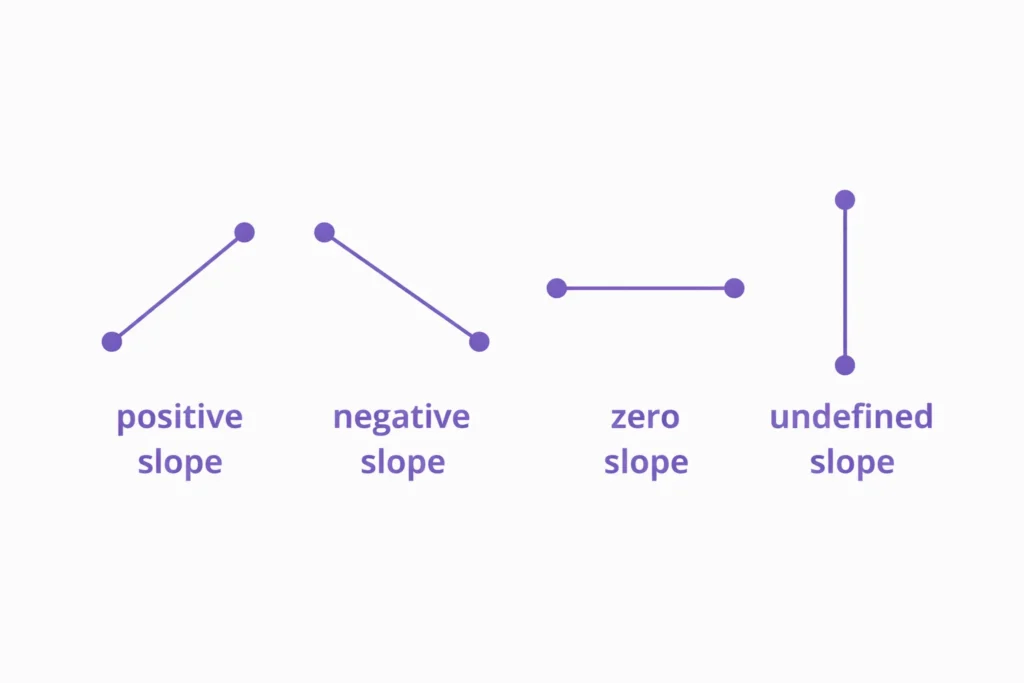
- Positive slope, example y = 2x
- Negative slope, example y = −3x
- Zero slope, example y = 5
- Undefined slope, example x = 4
Understanding these types helps you read graphs quickly.
You can also verify results using a slope calculator when working with complex values.
Slope Intercept Form and Line Equation Basics
Understanding y = mx + b form
This form is the most useful for graphing lines.
- m represents slope
- b represents y-intercept
The y-intercept is where the line crosses the vertical axis.
Finding y-intercept from known values
If you know slope and one point, you can find b.
Example with slope 2 and point (1, 4):
- Use b = y − mx
- b = 4 − (2 × 1) = 2
Final equation becomes y = 2x + 2.
Converting Between Slope, Angle, and Grade
Slope is not always shown as a fraction. In real use, it often appears as angle or percentage.
Slope to angle conversion
You can convert slope into an angle using this formula:
θ = arctan(m)
For example, if slope is 1:
- θ = arctan(1)
- Angle = 45 degrees
This helps in road design and roof calculations.
Slope to percentage grade
Percentage grade shows steepness in a more practical way.
Use this formula:
grade = |slope| × 100
Example:
- Slope = 0.25
- Grade = 0.25 × 100 = 25%
This format is common in construction and drainage planning.
Parallel and Perpendicular Slopes
Slope also helps compare different lines.
Parallel lines always have the same slope. They never meet.
Example:
- Line 1 slope = 2
- Line 2 slope = 2
- Both lines are parallel
Perpendicular lines meet at a right angle.
Their slopes are negative reciprocals.
Example:
- Line 1 slope = 2
- Line 2 slope = −1/2
These concepts are useful in geometry and design layouts.
Finding Intersection Point of Two Lines
Solving system of linear equations
To find where two lines meet, solve both equations together.
Example:
- y = 2x + 1
- y = −x + 7
Set them equal:
2x + 1 = −x + 7
Solve:
- 3x = 6
- x = 2
Put x back:
- y = 5
Intersection point is (2, 5).
Practical example of line intersection
Intersection shows where two paths cross.
This is useful in:
- Road planning
- Graph analysis
- Business trend comparisons
You can double check results using a slope calculator for accuracy.
Finding Slope from an Equation
Sometimes you do not need two points.
If equation is already given, slope is easy to find.
For slope intercept form:
- y = mx + b
- Slope is m
For standard form:
- Ax + By + C = 0
Convert to slope form:
- y = −(A/B)x − C/B
Now slope becomes −A/B.
This method saves time during exams or quick calculations.
Rise and Run from Percentage Grade
You can reverse the process and find rise or run.
Example:
- Grade = 20%
- Slope = 0.20
If run is 10 units:
- Rise = 0.20 × 10 = 2
This is useful in:
- Ramp design
- Roof pitch calculation
- Drainage systems
Distance Between Two Points and Its Relation to Slope
Slope shows direction, but distance shows length.
Use this formula:
d = √((x₂ − x₁)² + (y₂ − y₁)²)
Example:
- Points (1, 2) and (4, 6)
Steps:
- dx = 3, dy = 4
- Distance = √(9 + 16) = √25 = 5
This helps measure actual path length.
You can pair this with slope for better understanding.
Unit Conversion for Slope Calculations
Slope can be shown in different units.
Common conversions include:
- Fraction to percentage
- Percentage to angle
- Degrees to slope
Example:
- 30 degrees → slope = tan(30°) ≈ 0.577
These conversions are common in engineering work. If you deal with ratios often, try this ratio calculator for quick comparisons.
Graphing Slope on a Coordinate Plane
Plotting points and drawing line
Start by marking two points on the graph. Then connect them using a straight line. This gives a visual view of slope.
Understanding slope visually on graph
A steep line means higher slope value. A flat line means lower slope value. You can easily see rise and run on a graph. This helps in understanding problems faster.
Real World Applications of Slope
Slope is used in many practical tasks, not just math problems.
- Road and highway design uses slope for safe driving angles
- Roof pitch calculation helps with water drainage
- Construction planning uses slope for leveling surfaces
- Data graphs use slope to show trends and growth
For example, a steep driveway needs careful design to avoid safety issues. Engineers often rely on a slope calculator to check values quickly.
Common Mistakes When Calculating Slope
Small errors can lead to wrong results.
- Mixing x and y values in the formula
- Reversing subtraction order incorrectly
- Dividing by zero without checking vertical lines
- Ignoring negative signs in calculations
Always follow the same order when applying the formula. Double check your values before solving.
Advanced Slope Concepts for Deeper Understanding
Slope is also linked with more advanced topics.
- It represents rate of change in functions
- It connects with derivatives in calculus
- It helps analyze trends in regression lines
- It explains how values change over time
These ideas are useful in higher math and data analysis.
Practical Examples to Master Slope Calculations
Here are simple examples to build confidence.
- Two points example, (1,2) and (3,6), slope = 2
- Negative slope example, (2,5) and (4,1), slope = −2
- Equation example, y = 4x + 1, slope = 4
- Angle example, slope 1 gives 45 degrees
Practice with different values to improve accuracy.
When to Use Different Slope Calculation Methods
Different problems need different approaches.
- Use two point method for coordinate problems
- Use equation method for algebra questions
- Use angle conversion for engineering cases
- Use percentage grade for construction work
Choose the method based on given data.
Summary of Key Slope Formulas and Concepts
Slope calculations become easier with practice.
Key formulas to remember:
- m = (y₂ − y₁) / (x₂ − x₁)
- θ = arctan(m)
- Grade = |m| × 100
These formulas cover most real situations.
You can also use a slope calculator to save time and reduce mistakes.
FAQs About Slope and Slope Calculations
Conclusion
Slope is a simple concept once you understand rise and run clearly. It helps measure steepness, direction, and change between values.
You can calculate slope using points, equations, angles, or percentage grade. Each method works based on the data you have.
In real life, slope plays a key role in construction, road design, and data analysis. Even small mistakes can change results, so accuracy matters.
Using a slope calculator makes the process faster and more reliable. It helps you avoid manual errors and check results instantly.