

📐 Cubic Yard Calculator: How Many Cubic Yards Do I Need?
Rectangle · Circle · Triangle · Trapezoid · All units · Cost & Weight
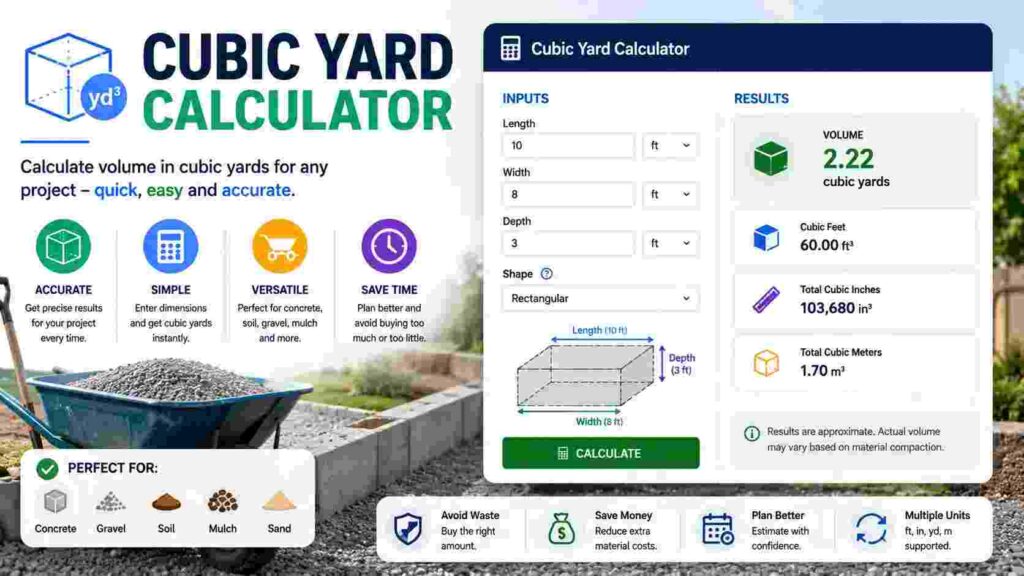
This cubic yard calculator handles four shapes in one tool. Enter your length, width, and depth. Pick your units. The result shows volume in cubic yards, cubic feet, cubic meters, and liters — all at once. Add a material and price to see estimated weight and total cost.
How to Calculate Cubic Yards
The formula is straightforward:
Volume (yd³) = Length (ft) × Width (ft) × Depth (ft) ÷ 27
Divide by 27 because one cubic yard equals 27 cubic feet (3 ft × 3 ft × 3 ft).
If your depth is in inches, convert it first. Divide the inch value by 12 to get feet.
Step-by-Step Example
You have a garden bed 10 feet long, 6 feet wide, and 4 inches deep.
- Convert depth: 4 ÷ 12 = 0.333 feet
- Multiply: 10 × 6 × 0.333 = 20 cubic feet
- Divide by 27: 20 ÷ 27 = 0.74 cubic yards
You need just under one cubic yard of topsoil for that bed.
The calculator above does all of this automatically. You select your units per field — no manual conversion needed.
What Is a Cubic Yard?
A cubic yard is a unit of volume equal to a cube measuring 3 feet on each side. That is 3 ft × 3 ft × 3 ft = 27 cubic feet.
Landscaping suppliers, fill dirt companies, and bulk material vendors all sell by the cubic yard. Knowing your volume before ordering prevents costly under-orders and expensive returns.
Quick size reference:
| Object | Approximate Size |
|---|---|
| 1 cubic yard | 3 ft × 3 ft × 3 ft cube |
| 1 cubic yard | ~27 cubic feet |
| 1 cubic yard | ~202 gallons |
| 1 cubic yard | ~46,656 cubic inches |
| Dump truck (standard) | 10–14 cubic yards |
| Pickup truck bed | 0.4–0.5 cubic yards |
| Standard wheelbarrow | ~0.02–0.04 cubic yards |
Square Feet to Cubic Yards
Many homeowners know their square footage but not their volume. The conversion is simple:
Cubic yards = (Square feet × Depth in inches) ÷ 324
Or: Cubic yards = (Square feet × Depth in feet) ÷ 27
Example: Mulch for a 500 Square Foot Bed
Depth: 3 inches Formula: (500 × 3) ÷ 324 = 4.63 cubic yards
Order 5 cubic yards to account for settling and uneven ground.
This is the most common calculation for garden beds, lawn dressing, and raised-bed projects. The cubic yard calculator’s rectangle tab handles it directly — enter area dimensions and depth.
Cubic Yards vs. Cubic Feet
These two units confuse most people because one yard equals 3 feet, but one cubic yard equals 27 cubic feet — not 3. Use this cubic yard calculator to check any conversion instantly.
That is because volume scales with the cube of the linear unit.
1 yard = 3 feet 1 cubic yard = 3 × 3 × 3 = 27 cubic feet
| Cubic Yards | Cubic Feet |
|---|---|
| 1 yd³ | 27 ft³ |
| 2 yd³ | 54 ft³ |
| 5 yd³ | 135 ft³ |
| 10 yd³ | 270 ft³ |
If a supplier charges by the cubic foot and you need cubic yards, divide by 27. If they charge by the cubic yard and you need cubic feet, multiply by 27.
How Much Does a Cubic Yard Weigh?
Weight depends on the material. Use these figures when estimating delivery load capacity.
| Material | Weight per Cubic Yard |
|---|---|
| Topsoil (dry) | ~1,800 lbs (~0.9 tons) |
| Fill dirt | ~2,700 lbs (~1.35 tons) |
| Sand (dry) | ~3,200 lbs (~1.6 tons) |
| Mulch / Wood chips | ~700 lbs (~0.35 tons) |
| Bark mulch | ~700 lbs (~0.35 tons) |
| Compost | ~1,200 lbs (~0.6 tons) |
| Limestone | ~2,970 lbs (~1.49 tons) |
Pickup trucks typically carry 0.5 cubic yards safely. A standard dump truck holds 10 to 14 cubic yards. A concrete truck holds 8 to 10 cubic yards.
Always check load capacity before ordering bulk delivery. One cubic yard of sand weighs more than 1.5 tons.
Material Depth Recommendations
Depth affects how much material you need more than area does. A difference of one inch doubles your order at shallow depths.
| Project | Recommended Depth |
|---|---|
| Lawn top dressing | 1–2 inches |
| Garden mulch | 2–3 inches |
| Raised bed fill | 8–12 inches |
| Pathway fill | 3–4 inches |
| Slope / berm fill | 6–12 inches |
| Drainage fill | 4–6 inches |
Use the depth preset buttons in the calculator to quickly try different depths and compare results. You can calculate cubic yards for each depth scenario in seconds.
How Many Cubic Yards Do I Need?
The right amount depends on your project, material, and tolerance for waste.
Topsoil for raised beds: Fill depth matters most. To calculate cubic yards for a 4×8 foot raised bed at 12 inches deep, you need about 1.2 cubic yards. Add 10 to 15 percent for compaction.
Mulch for garden beds: Most landscapers use 3 inches of mulch. Calculate cubic yards for a 200 square foot bed: you need about 1.9 cubic yards. One cubic yard of mulch covers roughly 100 square feet at 3 inches.
Sand for leveling: A thin layer over a large area adds up fast. At 1 inch deep over 500 square feet, you need about 1.5 cubic yards of sand.
Fill dirt for low spots: Uneven ground often needs more material than expected. Measure the average depth across the low area, not just the deepest point.
Always add 10 percent to your calculated volume. Materials settle, spread unevenly, and compact over time.
Tons to Cubic Yards Conversion
Suppliers sometimes quote prices by the ton rather than the cubic yard. Converting between them requires knowing the material density.
Cubic yards = Tons ÷ Weight per cubic yard (in tons)
| Material | Tons per Cubic Yard |
|---|---|
| Fill dirt | ~1.35 tons |
| Sand | ~1.6 tons |
| Topsoil | ~0.9 tons |
| Mulch | ~0.35 tons |
| Limestone | ~1.49 tons |
Example: You need 3 cubic yards of sand. At 1.6 tons per cubic yard, that is 4.8 tons. If your supplier charges per ton, multiply the ton price by 4.8 for total material cost.
The cubic yard calculator shows tons automatically when you select a material type.
Frequently Asked Questions
Related Calculators
Browse all tools in the Construction Calculator collection for more project estimators.
- Gravel Calculator — Volume, weight, and cost for gravel and crushed stone projects
- Board Foot Calculator — Lumber volume in board feet for woodworking projects
- Square Footage Calculator — Area in square feet for rooms and surfaces
- Asphalt Calculator — Estimate asphalt tonnage for paving projects
Conclusion
Knowing your volume before you order saves time, money, and extra trips to the supplier. This cubic yard calculator supports four shapes — rectangle, circle, triangle, and trapezoid — and converts measurements in any unit combination. It also shows weight estimates by material and total cost when you enter a price.
Add 10 percent to your final number to account for compaction, uneven ground, and settling. Measure depth at multiple points if the surface is not level.
Results are estimates. Always confirm measurements with your supplier before ordering. Material densities vary by moisture content, grade, and source.