

PTO Calculator, How PTO Accrual, Balance, and Payout Work
Estimate how much paid time off you have earned so far in your current accrual year.
Your PTO estimate
Paid time off is not always simple to track. Many employees rely on a PTO calculator to understand their earned time, remaining balance, and future availability. This explains how PTO works in real scenarios, not just theory. You will learn how accrual rate, pay period, and work schedule affect your leave balance.
Most companies combine vacation time, sick leave, and holidays into one PTO system. This makes it easier to manage leave, but harder to calculate manually. That is why understanding PTO accrual and balance logic is important for both employees and HR teams.
Here is what you need to track PTO correctly:
- Annual PTO allowance set by your employer
- Accrual frequency, weekly, biweekly, or monthly
- Start date of your accrual year
- PTO already used
- Carryover balance from previous year
- Hours per work day for conversions
A simple mistake in any of these inputs can change your final PTO balance. That is why many people use tools instead of guessing.
This focuses on practical calculation methods. You will see how to calculate accrued PTO, remaining balance, and payout step by step using real examples.
To manage your schedule better, you can also explore more work and time calculators that help track different types of time-based data.
What PTO Means and How Paid Time Off Works in Real Jobs
Paid time off is a single leave balance that combines different types of leave. Most companies include vacation time, sick days, and paid holidays under one system. This makes tracking easier for employers but requires clear understanding from employees.
PTO works based on a defined policy set by the employer. This policy controls how leave is earned, used, and carried forward. The structure can vary across industries, roles, and contract types.
In most cases, PTO is not given all at once. It builds over time through an accrual process. This means you earn a portion of your total leave gradually during the year.
Key components of a PTO system include:
- Accrual rate based on time or hours worked
- Pay period structure such as weekly or biweekly cycles
- Work schedule including hours per day and working days
- Carryover rules for unused leave
- Maximum limits or caps on total PTO balance
Employees need to track how much PTO they have earned versus how much they have used. This helps avoid negative balances and ensures proper leave planning.
For HR teams, PTO is more than a benefit. It affects staffing, workload distribution, and employee satisfaction. A clear PTO structure helps reduce confusion and improves planning across teams.
Understanding how PTO works in real job conditions is the first step before moving into actual calculation methods.
How PTO Accrual Actually Works in Different Company Policies
PTO accrual is not the same across all companies. Each employer defines how leave is earned based on internal policy and payroll structure. Understanding this helps you calculate PTO correctly without relying only on estimates.
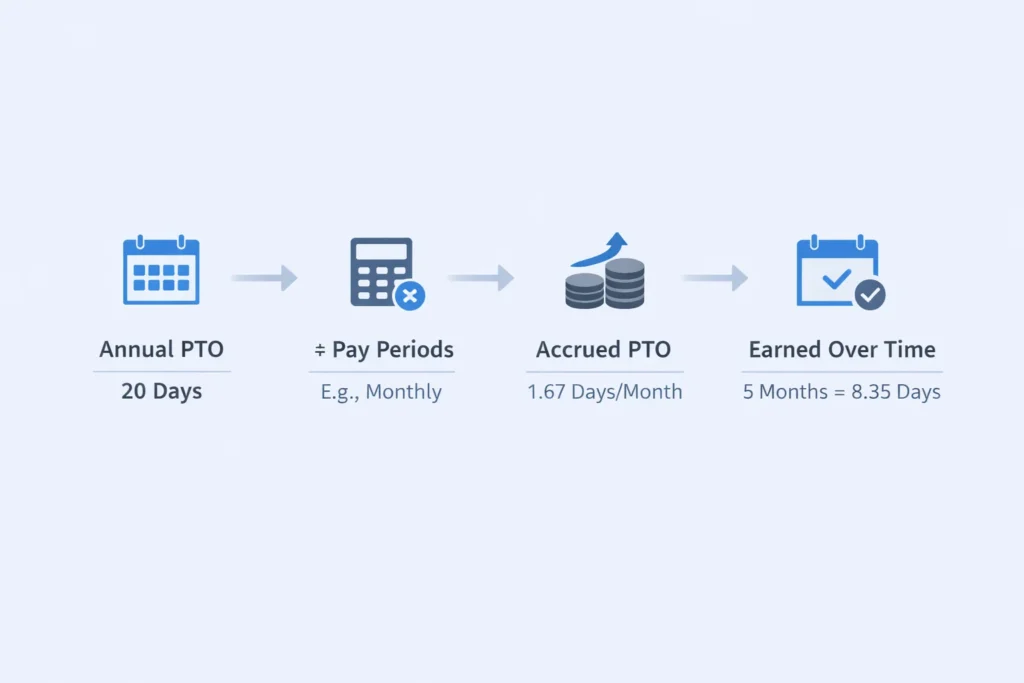
Most systems follow one of two models, incremental accrual or upfront allocation. Both methods affect how your PTO balance grows over time.
Annual PTO Allowance and Accrual Basics
Every employee starts with a defined yearly PTO allowance. This can be 10 days, 15 days, or a fixed number of hours.
Instead of receiving all leave at once, most companies spread it across the year. This creates a steady accrual pattern based on time worked.
For example:
- 24 days per year becomes 2 days per month
- 120 hours per year becomes 10 hours per month
This structure ensures employees earn PTO gradually rather than instantly.
Accrual Frequency, Weekly, Biweekly, Monthly, and Yearly
Accrual frequency depends on the company’s pay period. This directly impacts how often PTO is added to your balance.
Common accrual setups include:
- Weekly accrual for hourly employees
- Biweekly accrual aligned with payroll cycles
- Monthly accrual for salaried employees
- Yearly allocation in some fixed policy setups
Biweekly and semimonthly structures are often confusing. The difference affects how much PTO is added each cycle.
Upfront PTO vs Incremental Accrual Models
Some companies use an upfront model. In this case, the full PTO balance is available at the start of the year.
Other companies use incremental accrual. PTO builds slowly based on time worked or pay periods completed.
Key differences:
- Upfront PTO allows early use but may require payback if you leave early
- Incremental accrual prevents negative balances but limits early usage
Both models impact how you track earned PTO and remaining balance. Understanding your company’s accrual method is critical before calculating PTO manually or using any tool.
How to Calculate PTO Accrual Step by Step Using Simple Logic
Once you understand your accrual method, calculation becomes straightforward. You only need a few inputs and a clear formula to estimate earned PTO.
Basic PTO Accrual Formula Explained Clearly
The core formula is simple and works in most cases.
- PTO accrued = Annual allowance × (time worked ÷ total year time)
This means your earned PTO depends on how much of the year has passed.
Example:
- 24 days per year
- 6 months completed
- Earned PTO = 24 × (6 ÷ 12) = 12 days
This method works well for monthly and yearly accrual setups.
Accrued PTO Based on Hours Worked
Some companies use hourly accrual instead of fixed periods. This is common for hourly employees and part time roles.
The formula becomes:
- PTO per hour = Total annual PTO ÷ total working hours in a year
- Accrued PTO = PTO per hour × hours worked
Example:
- 80 hours PTO per year
- 2000 working hours per year
- PTO per hour = 0.04 hours
- If you worked 500 hours, earned PTO = 20 hours
This method gives more accurate tracking for variable schedules.
If you want a clearer view of your daily and weekly schedule, you can calculate your working hours to align your PTO planning with actual work time.
Prorated PTO Calculation for New Employees
New employees rarely get full PTO for the year. Their entitlement is adjusted based on joining date.
Prorated PTO formula:
- Prorated PTO = Annual allowance × (remaining time ÷ total year)
Example:
- 20 days per year
- Joined after 3 months
- Remaining time = 9 months
- Earned PTO = 20 × (9 ÷ 12) = 15 days
This ensures fair distribution of leave based on actual working period.
Understanding these formulas helps you verify results from any PTO calculator and avoid incorrect estimates.
How to Calculate PTO Balance and Remaining Time Accurately
Accrual alone is not enough. You also need to track how much PTO is left after usage. This is where most errors happen.
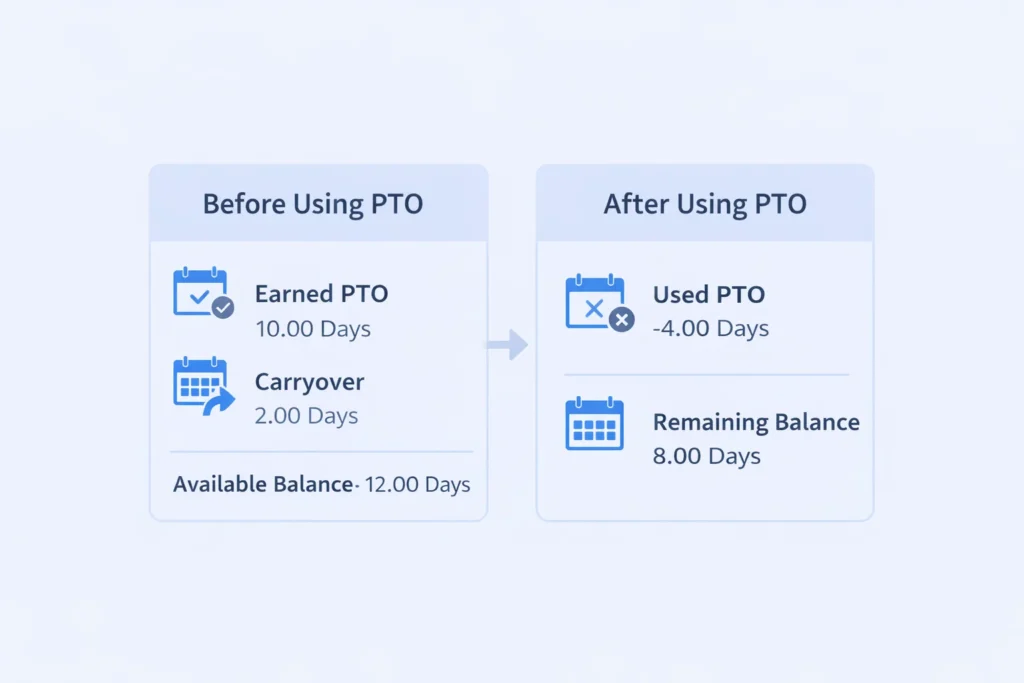
PTO Balance Formula and Key Inputs
The basic balance formula is simple and works in most cases.
- PTO balance = Accrued PTO + carryover − used PTO
Each part plays a different role:
- Accrued PTO is what you earned so far
- Carryover is unused leave from the previous cycle
- Used PTO is what you already took
If any value is missing, the final balance becomes inaccurate.
PTO Used and Remaining Balance Calculation
PTO used directly reduces your available balance. This is why regular updates are important.
Example:
- Accrued PTO = 12 days
- Carryover = 3 days
- Used PTO = 5 days
Remaining PTO:
- 12 + 3 − 5 = 10 days
This number helps you plan future leave without exceeding limits.
Carryover Rules and PTO Caps
Carryover rules depend on company policy. Some employers allow unused PTO to move forward. Others reset balances at the end of the year.
Common rules include:
- Full carryover with no limit
- Limited carryover up to a fixed number of days
- No carryover, balance resets to zero
PTO caps also matter. A cap limits how much PTO you can accumulate. Once you hit the limit, accrual stops until you use some leave.
Ignoring carryover and caps often leads to wrong calculations. Always check your company policy before estimating your balance. Accurate tracking of earned, used, and carried forward PTO ensures your remaining balance reflects reality.
PTO Hours vs Days Conversion and Why It Matters
Many companies track PTO in different units. Some use days, while others use hours. This creates confusion when calculating leave balance or planning time off.
Understanding how to convert between hours and days keeps your calculations accurate.
The most common conversion is based on work schedule:
- 1 day = 8 working hours in standard setups
- 5 days = 40 working hours per week
However, this can change depending on your job. Some roles use 7.5 hours or 10 hours per day.
Key conversion formulas:
- Days to hours = Days × hours per work day
- Hours to days = Hours ÷ hours per work day
Example:
- 5 days PTO with 8 hours per day
- 5 × 8 = 40 hours
Another example:
- 32 hours PTO
- 32 ÷ 8 = 4 days
Using the wrong conversion leads to incorrect PTO balance. This is common when switching between payroll systems or HR tools.
Always confirm your company’s standard hours per day before converting. This ensures your PTO tracking stays consistent across reports and calculations.
Clear unit conversion also helps when comparing PTO policies across companies or planning leave in advance.
How PTO Payout Works When Leaving a Job
PTO payout becomes important when you leave a company or end a contract. In many cases, unused paid time off is converted into money. The exact rules depend on employer policy and local regulations.
PTO Payout Calculation Basics
The payout calculation is based on your remaining PTO balance and pay rate.
- PTO payout = Remaining PTO hours × hourly rate
If you are salaried, your salary is converted into an hourly rate first.
Example:
- Remaining PTO = 40 hours
- Hourly rate = $25
- Payout = 40 × 25 = $1000
This gives a gross payout before any deductions.
Taxes and Policy Differences in PTO Payout
PTO payout is usually treated as regular income. This means taxes and deductions apply based on payroll rules.
Important points to consider:
- Some employers include PTO payout in final paycheck
- Tax rates may vary depending on jurisdiction
- Certain companies do not allow payout for unused PTO
Company policy plays a major role here. Some organizations have strict rules about forfeiture or payout eligibility.
Before estimating payout, always check:
- Your employment contract
- Company HR policy
- Local labor laws
Understanding payout rules helps avoid surprises and gives a clear picture of your final compensation.
PTO Accrual by Employee Type, Hourly, Salaried, and Part Time
PTO accrual is not applied the same way for every employee. The method changes based on job type, contract structure, and working hours.
Understanding your category helps you calculate earned time more accurately.
Hourly Employees and PTO Accrual
Hourly employees usually follow a direct accrual model. PTO builds based on hours worked instead of fixed time periods.
Typical setup:
- PTO accrual per hour worked
- Linked to total working hours in a year
- Flexible for shift-based schedules
Example:
- 0.04 hours PTO per hour worked
- 500 hours worked
- Earned PTO = 20 hours
This method gives precise tracking for variable work patterns.
Salaried Employees and Fixed Accrual Schedules
Salaried employees often follow a structured accrual plan. PTO is added at regular intervals based on pay cycles.
Common patterns include:
- Monthly accrual based on annual allowance
- Biweekly accrual aligned with payroll
- Fixed days granted at the start of the year
This setup is easier to track but less flexible compared to hourly accrual.
Part Time Employees and Prorated PTO
Part time employees receive adjusted PTO based on reduced working hours. This is known as prorated PTO.
Key factors:
- Fewer working hours per week
- Reduced annual PTO allowance
- Same accrual logic applied proportionally
Example:
- Full time PTO = 20 days
- Part time schedule = 50 percent
- Adjusted PTO = 10 days
This ensures fairness while reflecting actual work contribution.
Each employee type follows a different accrual structure. Using the correct method ensures accurate PTO balance and prevents calculation errors.
Real PTO Calculation Examples for Practical Understanding
Examples make PTO calculations easier to understand. They show how formulas work in real situations and help avoid common mistakes.
Example for Annual PTO Accrual Calculation
This example uses a standard monthly accrual model.
- Annual PTO allowance = 24 days
- Accrual period = monthly
- Months worked = 6
Calculation:
- 24 ÷ 12 = 2 days per month
- 2 × 6 = 12 days earned
This shows how PTO builds steadily over time.
Example for PTO Balance and Remaining Days
This example focuses on total balance after usage.
- Accrued PTO = 12 days
- Carryover = 3 days
- Used PTO = 5 days
Calculation:
- 12 + 3 − 5 = 10 days remaining
This helps you understand how much leave is still available.
Example for PTO Accrual Per Pay Period
This example uses a biweekly payroll structure.
- Annual PTO = 80 hours
- Pay periods = 26 per year
Calculation:
- 80 ÷ 26 ≈ 3.08 hours per period
If you completed 10 pay periods:
- 3.08 × 10 ≈ 30.8 hours earned
This method is common in payroll-based systems.
These examples show how different accrual methods affect your final PTO balance. Applying the right formula based on your company setup ensures accurate results.
Common PTO Calculation Mistakes That Cause Wrong Results
Small mistakes can change your PTO balance significantly. Most errors come from missing inputs or using the wrong method.
Here are the most common issues to avoid:
- Ignoring carryover balance from the previous year
- Mixing hours and days without proper conversion
- Using the wrong accrual rate for your pay period
- Not updating PTO used after taking leave
- Assuming full yearly PTO before completing the accrual period
One major mistake is treating upfront PTO and accrued PTO the same way. These models work differently and lead to different results.
Another common issue is rounding too early. Small rounding errors across multiple pay periods can affect the final balance.
To avoid errors:
- Always confirm your accrual frequency
- Track PTO usage regularly
- Use consistent units, either hours or days
- Check company policy for caps and carryover rules
Accurate PTO tracking depends on correct inputs and consistent calculation methods. Even a small oversight can lead to incorrect planning.
Advanced PTO Planning for Better Leave Management
Basic calculation shows your current balance. Advanced planning helps you decide when to use your time off without creating gaps.
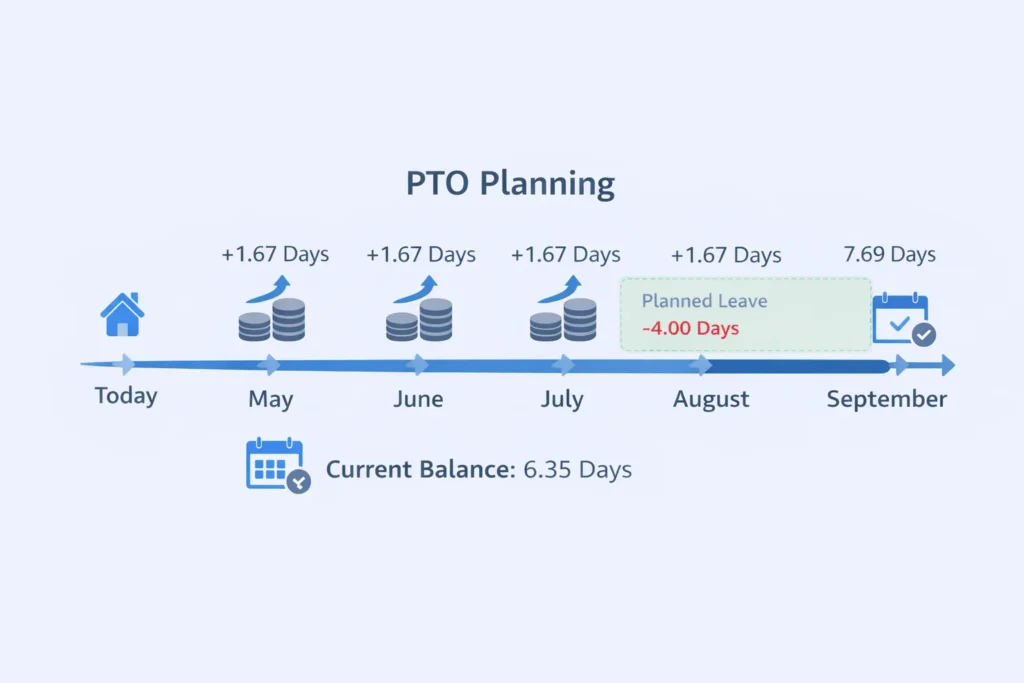
Forecasting Future PTO Balance
You can estimate future PTO based on your current accrual rate. This helps answer questions about upcoming leave.
Key approach:
- Use your current accrual rate per period
- Project earned PTO for future months
- Subtract planned leave in advance
Example:
- Current balance = 8 days
- Monthly accrual = 2 days
- Planned leave after 2 months = 5 days
Future balance:
- 8 + (2 × 2) − 5 = 7 days
This method helps avoid negative balances.
Planning PTO Around Workload and Team Coverage
PTO is not only about personal time. It also affects team operations and project timelines.
Good planning includes:
- Checking workload before booking leave
- Avoiding peak business periods
- Coordinating with team members to maintain coverage
For managers, PTO planning helps reduce burnout and maintain productivity. For employees, it ensures smoother leave without last-minute issues.
Using a PTO calculator with future estimation helps align your leave with both personal plans and work responsibilities.
PTO Policies That Change How Calculations Work
PTO calculations are not universal. Company policies define how leave is earned, used, and carried forward. Ignoring these rules leads to incorrect estimates.
Most organizations follow internal HR policies that adjust standard formulas.
Key policy factors include:
- Accrual rules based on pay period or hours worked
- Carryover limits for unused PTO at year end
- Maximum caps on total PTO balance
- Waiting periods before new employees can use PTO
- Reset dates for new accrual cycles
Some companies allow unlimited carryover, while others enforce strict limits. In certain cases, unused PTO may expire if not used within a defined period.
Another important factor is negative balance policy. Some employers allow employees to take PTO in advance, while others restrict usage to earned time only.
Payout rules also vary. Not every company converts unused PTO into cash when employment ends.
Before making any calculation, always review:
- Your employment contract
- HR handbook or PTO policy document
- Payroll structure and accrual frequency
Accurate PTO tracking depends on aligning calculations with company rules, not just general formulas.
How to Use a PTO Calculator for Fast and Accurate Results
A PTO calculator helps you avoid manual errors and saves time. It combines accrual rate, dates, and usage into one clear result.
To get accurate results, you need to enter the right inputs.
Basic steps:
- Enter your annual PTO allowance in days or hours
- Select your accrual year start date and current date
- Add any carryover balance from the previous cycle
- Enter PTO already used
- Set hours per work day for correct conversion
Once these values are entered, the tool calculates:
- Earned PTO based on elapsed time
- Remaining PTO after usage
- Progress of your accrual year
For best results:
- Use exact dates instead of estimates
- Keep your PTO usage updated regularly
- Match units correctly, hours or days
- Follow your company’s accrual policy
A well-used PTO calculator gives a quick snapshot of your leave position. It helps you plan time off without risking negative balance or policy issues.
Frequently Asked Questions
Conclusion
Understanding how PTO works helps you manage your time off without confusion. A PTO calculator simplifies this process by combining accrual, usage, and policy factors into one clear result.
Accurate inputs lead to accurate outputs. Always track your earned PTO, update used time, and follow your company’s accrual rules.
With the right approach, you can plan leave confidently, avoid balance issues, and make better decisions about your paid time off.