

Surface Area Calculator
Calculate the surface area of common 3D shapes with quick inputs and clear results.
Total outer surface of a perfect ball
Surface area can feel tricky when shapes get more complex. This surface area calculator guide helps you understand real calculations, not just theory. You will learn how to measure outer areas of common 3D shapes step by step. The focus stays on practical use, formulas, and everyday applications.
Most people need surface area for painting, wrapping, or construction work. Small mistakes in dimensions can lead to wrong material estimates. That is why clear methods and correct formulas matter from the start.
You can explore more tools like this in our math calculators collection to solve related geometry and algebra problems easily.
What surface area means in real situations
Surface area is the total outer area of a solid object. It measures how much space covers the outside surface. This value is always expressed in square units like cm², m², or ft². It differs from volume, which measures internal space.
You will often deal with two types:
- Total surface area, which includes all outer faces
- Lateral surface area, which excludes top and bottom faces
For example, a painted wall uses surface area, not volume. A water tank needs both, depending on the task. Understanding this difference helps avoid wrong calculations in real projects.
Basic shapes and their surface area formulas
Surface area of a cube and square-based shapes
A cube has six equal square faces.
Formula:
SA = 6a²
Here, a is the edge length.
Each face area is a², then multiply by six.
This works for boxes where all sides are equal.
For a square pyramid:
Formula:
SA = a² + 2al
Here, a is base edge, l is slant height.
Surface area of a rectangular prism or cuboid
A rectangular prism has three different dimensions.
Formula:
SA = 2(lw + lh + wh)
Here:
- l = length
- w = width
- h = height
This formula adds all six faces correctly.
Used in rooms, cartons, and storage calculations.
Surface area of a cylinder and circular solids
A cylinder has two circular bases and one curved surface.
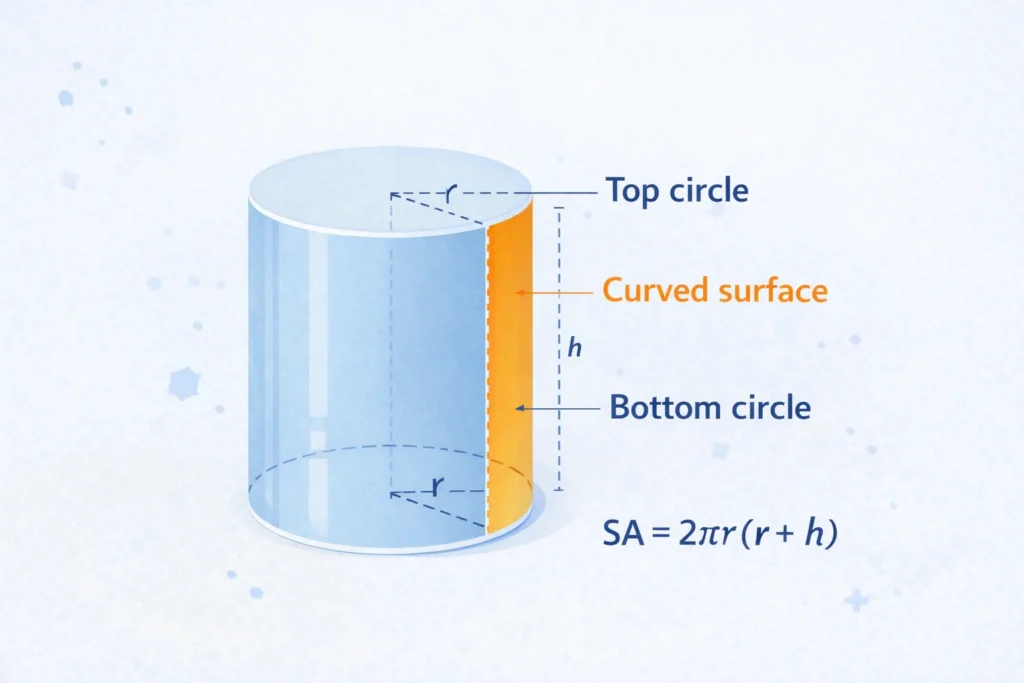
Total surface area formula:
SA = 2πr(r + h)
Lateral surface area formula:
SA = 2πrh
Here:
- r = radius
- h = height
Use lateral formula when top and bottom are not included.
Surface area of a sphere and hemisphere
A sphere has only one curved surface.
Formula:
SA = 4πr²
For a hemisphere:
Total surface area:
SA = 3πr²
Curved surface only:
SA = 2πr²
Always confirm if the flat base is included.
Surface area of cones and pyramids
A cone uses slant height, not vertical height.
Formula:
SA = πr(r + l)
Here:
- r = radius
- l = slant height
Slant height formula:
l = √(r² + h²)
For pyramids:
Formula:
SA = base area + lateral area
Square pyramid:
SA = a² + 2al
Surface area of prisms and complex solids
A prism has two bases and side faces.
Formula:
SA = Ph + 2B
Here:
- P = perimeter of base
- h = height
- B = base area
For triangular prism:
- Find triangle area first
- Then add lateral faces
For complex shapes:
- Break into smaller shapes
- Calculate each separately
- Add all surface areas
How to calculate surface area step by step
Start by identifying the correct shape before using any formula. Each shape needs different dimensions like radius, height, or length.
Follow these steps for accurate results:
- Write down all given dimensions clearly
- Convert units into the same system before calculation
- Choose the correct surface area formula
- Calculate base areas and side areas separately
- Add all parts to get the total surface area
Always double check your final unit. Surface area must be in square units like cm² or m². If working with circular shapes, confirm radius instead of diameter. A small mistake here can double your result incorrectly.
For multi-part shapes, break them into simple solids first.
Then calculate each part and add the results together.
Surface area formulas you should remember
These formulas cover most common shapes used in daily problems.
Cube:
SA = 6a²
Rectangular prism:
SA = 2(lw + lh + wh)
Cylinder:
SA = 2πr(r + h)
Sphere:
SA = 4πr²
Cone:
SA = πr(r + l)
Triangular prism:
SA = Ph + 2B
These formulas save time when solving repeated problems. Memorizing them helps avoid confusion during quick calculations. If you also work with volume, use a volume calculator to compare results.
Examples of surface area calculation
Surface area is used in many daily tasks, not just math problems. It helps estimate materials, costs, and coverage accurately.
Painting walls and rooms
When painting a room, you need wall surface area, not volume. Measure height and width of each wall, then add them together.
Exclude doors and windows if they are not painted. This prevents overestimating paint quantity.
Wrapping boxes and packaging materials
For packaging, calculate surface area of a rectangular prism. This gives the exact paper or plastic needed to cover the box.
It helps reduce waste and improves packing efficiency. Common in shipping, storage, and product packaging.
Pipes, tanks, and industrial coating
Cylinders are used for pipes, tanks, and containers. Use lateral surface area when coating only the outer side.
Include top and bottom only if fully covered. This is useful for insulation and protective coatings.
Swimming pool and construction planning
Pools often use rectangular or complex shapes. Calculate surface area to estimate tiles or waterproof layers.
For irregular pools, break into smaller shapes first. Then add all areas for a final estimate.
Dome structures and curved surfaces
Spheres and hemispheres appear in domes and storage tanks. Use curved surface formulas for accurate measurements.
These calculations help in roofing, design, and architecture. Always confirm whether the base is included or excluded.
Common mistakes in surface area calculation
Small errors can lead to large differences in final results. Most mistakes happen during setup, not calculation.
Mixing different units
Using cm and meters together gives incorrect results. Always convert all values into one unit before starting.
Using diameter instead of radius
Many formulas require radius, not diameter. Divide diameter by two before applying formulas.
Ignoring hidden or extra surfaces
Some shapes include surfaces that are not visible. Others require excluding base or top areas.
Confusing lateral and total surface area
Lateral surface excludes top and bottom surfaces. Total surface includes every outer face.
Missing slant height in cones and pyramids
Slant height is required for correct calculations. Using vertical height instead leads to wrong answers.
Edge cases and special calculations
Some problems do not follow standard shape rules.
These cases need careful handling and correct breakdown.
Open and closed shapes
Open shapes do not include one or more surfaces.
Closed shapes include all outer faces completely.
Hollow objects and pipes
Pipes and tubes have inner and outer surfaces.
Both must be included if coating or insulation is needed.
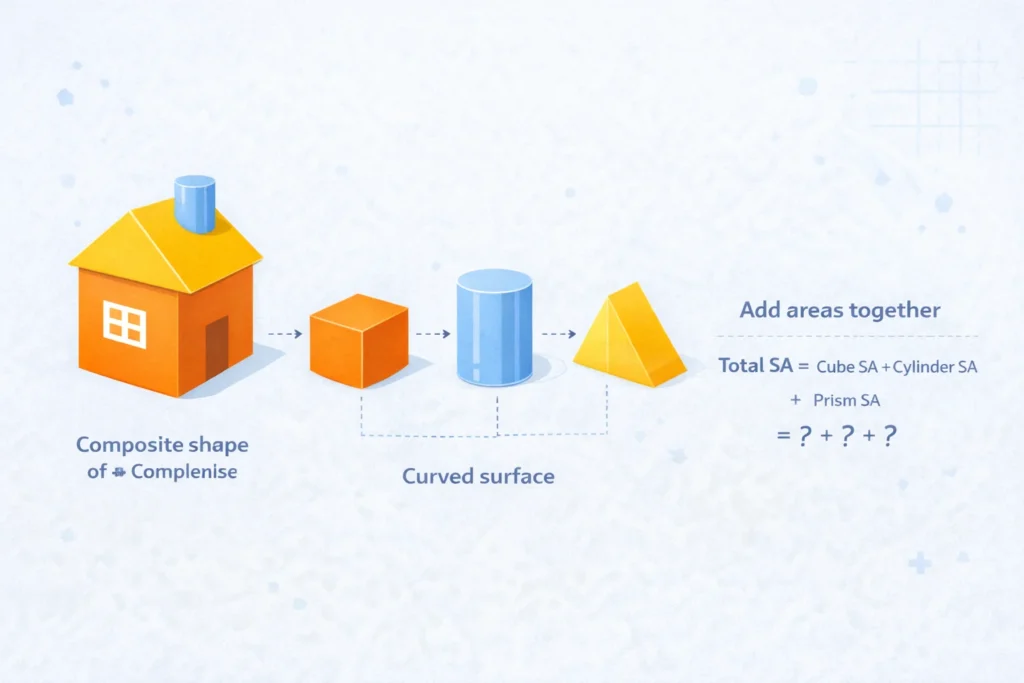
Composite shapes
Many real objects combine multiple geometric solids. Break them into smaller shapes, then calculate separately.
Irregular shapes
Irregular objects cannot use one single formula.
Approximate them using known shapes like cylinders or prisms.
Surface area to volume ratio
This ratio compares outer area to internal volume. It is useful in biology, chemistry, and heat transfer.
Advanced surface area concepts for deeper understanding
Surface area becomes more useful when you apply it beyond basic formulas. These concepts help in planning, analysis, and real-world problem solving.
Surface area to volume ratio
This ratio shows how much surface surrounds a given volume. It is written as surface area divided by volume.
Smaller objects usually have a higher ratio than larger ones. This affects heat loss, cooling, and chemical reactions.
For example, small particles react faster due to larger exposed area. This concept is widely used in biology and engineering fields.
Lateral vs total surface area differences
Lateral surface area includes only side faces of a shape. It excludes top and bottom surfaces completely.
Total surface area includes every outer face of the object. Choosing the correct one depends on your use case.
For example, painting a wall uses lateral area only. Coating a tank requires total surface area calculation.
Surface area of composite and 3D figures
Many real objects are not simple geometric shapes. They combine cubes, cylinders, cones, and prisms together.
Break the object into smaller known shapes first. Calculate each part separately using the correct formulas.
Then add all values to get the final surface area. This method avoids confusion and improves accuracy.
This approach is useful in construction, product design, and modeling. It also helps when working with complex exam problems.
Using a surface area calculator for faster results
Manual calculation works, but it takes time for complex shapes. A surface area calculator helps solve these problems quickly and accurately. Select the shape you want to calculate first. Common options include cube, cylinder, sphere, cone, and prism.
Enter the required dimensions like radius, height, or length. Make sure all values use the same unit before calculating. The tool applies the correct formula automatically. It shows total surface area and sometimes a detailed breakdown.
Use it when dealing with multiple shapes or large projects. It reduces errors and saves time during planning.
If you are working with triangular shapes, you can also use a triangle calculator to find base values before surface calculations.
FAQs about surface area calculations
Conclusion
Understanding formulas and correct steps makes calculations much easier.
A surface area calculator helps speed up work and reduce mistakes.
Use it for shapes like cubes, cylinders, prisms, and spheres.
Always check inputs and units before trusting the final result.