

Volume Calculator: Calculate Volume of Any Shape Instantly
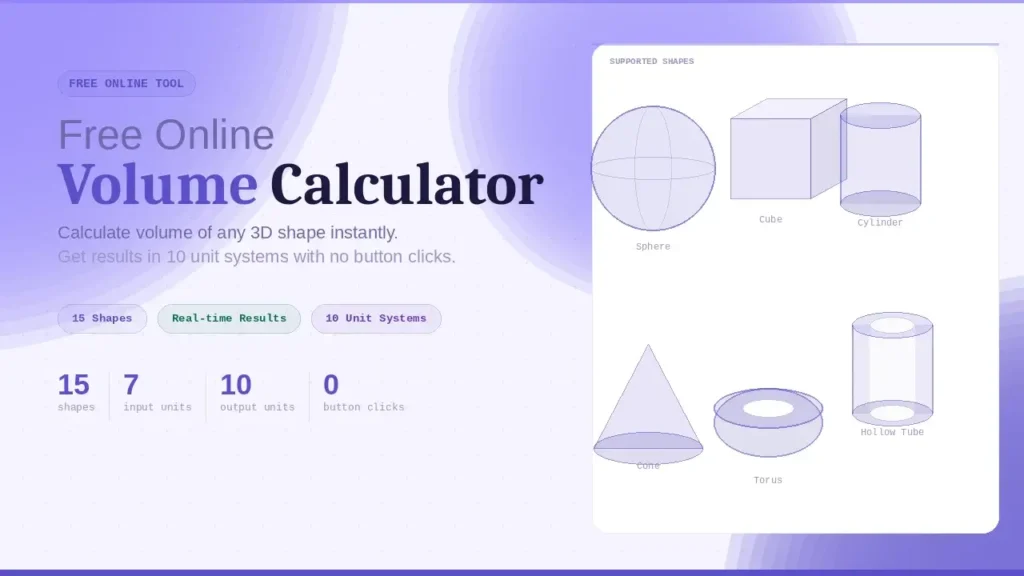
Calculate the volume of any 3D shape instantly. Enter your dimensions and get accurate results.
Enter dimensions on the left
to see live results here
You can also find related tools and formulas inside our Math Calculators Hub where different math problems are solved in one place.
A good volume calculator helps you measure space inside common 3D shapes without confusion. It is useful for tanks, boxes, pools, pipes, concrete forms, and storage planning. When you know the right formula and the right dimensions, you get more accurate results and avoid waste.
This guide focuses on practical calculation, not textbook theory. You will learn the main volume formulas, how to choose the correct shape, how to convert cubic units, and where people often make mistakes. You will also see real examples that make the math easier to apply.
What Volume Means and Why It Matters in Real Calculations
Most people use a volume calculator when they need quick and reliable measurements. It helps avoid guesswork in real tasks. You often need volume when working with water tanks, containers, or construction materials.
Volume measures the space inside a three dimensional object. It tells you how much something can hold or store. This becomes useful in daily work like filling a tank or planning materials.
You will see volume used in many situations:
- Estimating water storage in tanks or pools
- Measuring concrete for slabs or foundations
- Calculating soil or gravel for landscaping
- Finding capacity of boxes and containers
In simple terms, volume connects math with real work. It helps you plan better and avoid costly mistakes.
Another key point is choosing the right shape before calculating. A wrong shape leads to wrong results. For example, a cylinder and a box need different formulas.
Common Units Used in Volume Calculation
Volume is measured in cubic units. These units show length, width, and height together. Choosing the right unit helps keep your results accurate and useful.
The most common cubic units include:
- Cubic meter (m³), used in construction and large projects
- Cubic feet (ft³), common in US measurements
- Cubic inches (in³), used for small objects
- Cubic centimeters (cm³), used in precise calculations
For liquids, volume is often shown in liters or gallons. These units are easier to understand in real use.
Here are key conversions you should know:
- 1 cubic meter equals 1000 liters
- 1 cubic foot equals about 28.32 liters
- 1 liter equals 1000 cubic centimeters
Using the wrong unit can create big errors. For example, mixing feet with meters will give incorrect results. Always keep units consistent before applying any formula.
In practical work, you may switch between units. A tank may be measured in cubic meters, but water is filled in liters or gallons.
If you work with area tools like a Square Footage Calculator, remember that area uses square units. Volume uses cubic units, which include depth. Understanding units makes calculations easier and avoids confusion in real projects.
Basic Volume Formulas for Common Shapes
These formulas cover most everyday calculations. Use them when working with simple shapes like boxes, tanks, or round containers.
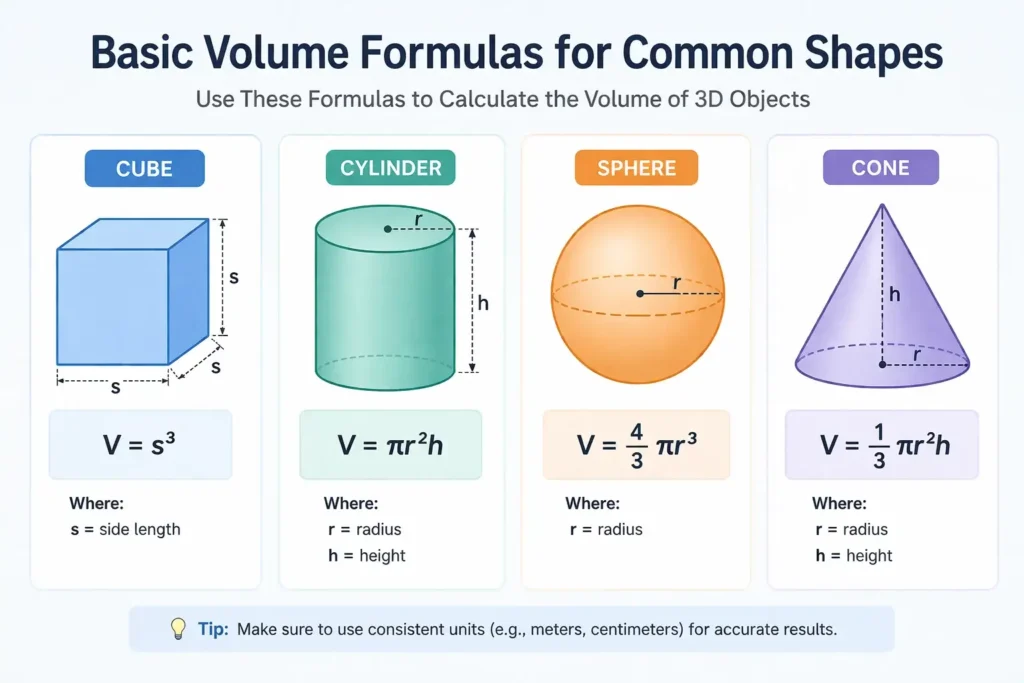
Cube Volume Formula
A cube has equal sides. You only need one measurement.
- Volume = side × side × side
- Example, side = 5 cm
- Result = 5 × 5 × 5 = 125 cm³
This works for small boxes or equal-sized storage units.
Rectangular Prism Volume Formula
This shape covers most real objects like rooms and containers.
- Volume = length × width × height
- Example, 4 m × 3 m × 2 m
- Result = 24 m³
Use this for rooms, tanks, or packaging boxes.
Cylinder Volume Formula
A cylinder is used for round containers like pipes or tanks.
- Volume = π × radius² × height
- Example, radius = 2 m, height = 5 m
- Result = 3.14 × 4 × 5 = 62.8 m³
Always square the radius before multiplying.
Sphere Volume Formula
A sphere is a fully round object like a ball.
- Volume = 4/3 × π × radius³
- Example, radius = 3 cm
- Result ≈ 113.1 cm³
This is common in storage tanks with rounded shapes.
Cone Volume Formula
A cone has a pointed top and circular base.
- Volume = 1/3 × π × radius² × height
- Example, radius = 3 m, height = 6 m
- Result ≈ 56.5 m³
This is useful for funnels or tapered containers.
These basic formulas solve most problems. If you already calculate ratios using a Ratio Calculator, you will notice volume follows a similar step-by-step pattern.
Advanced Volume Formulas for Less Common Shapes
These formulas help when objects are not simple boxes or cylinders. You will see these shapes in real projects like tanks, domes, or pipes.
Hemisphere Volume Formula
A hemisphere is half of a sphere.
- Volume = 2/3 × π × radius³
- Example, radius = 4 m
- Result ≈ 134.0 m³
This works for dome tanks or rounded roofs.
Triangular Prism Volume Formula
This shape is used in angled structures and wedges.
- Volume = 1/2 × base × height × length
- Example, base = 4 m, height = 3 m, length = 6 m
- Result = 36 m³
It is common in roof sections and ramps.
Square Pyramid Volume Formula
Used in design and structural shapes.
- Volume = 1/3 × base² × height
- Example, base = 5 m, height = 9 m
- Result = 75 m³
Always square the base before multiplying.
Ellipsoid Volume Formula
An ellipsoid looks like a stretched sphere.
- Volume = 4/3 × π × a × b × c
- Example, a = 3 m, b = 2 m, c = 1 m
- Result ≈ 25.1 m³
This is useful for irregular rounded objects.
Capsule Volume Formula
A capsule combines a cylinder with two half spheres.
- Volume = cylinder + sphere
- Example, radius = 2 m, length = 5 m
- Result includes both parts together
Used in tanks with rounded ends.
Conical Frustum Volume Formula
This is a cut cone with two circular ends.
- Volume = 1/3 × π × h × (R² + Rr + r²)
- Example, R = 4 m, r = 2 m, h = 6 m
- Result ≈ 175.9 m³
Used in containers that taper.
Hollow Cylinder Volume Formula
Used for pipes and tubes.
- Volume = π × h × (R² − r²)
- Example, outer radius = 5 cm, inner radius = 3 cm, height = 10 cm
- Result ≈ 502.6 cm³
Make sure inner radius is smaller than outer radius.
These advanced shapes solve real problems that basic formulas cannot handle. Many tools skip these, but they are common in construction and storage work.
How to Calculate Volume Step by Step
Getting the right result depends on a simple and clear process. Follow these steps to avoid common errors and save time.
Identify the Correct Shape First
Start by matching your object with a known shape.
A box uses a prism formula, while a tank uses a cylinder formula.
If the shape looks complex, break it into smaller simple shapes.
This helps you apply the correct formula to each part.
Measure Dimensions Accurately
Take measurements carefully before starting any calculation.
Use a ruler, tape, or tool based on the object size.
Make sure all values use the same unit system.
Do not mix meters with inches in one calculation.
Apply the Correct Formula
Use the formula that matches your selected shape.
Follow the order of operations step by step.
Square or cube values where needed, do not skip these steps.
Small mistakes here can change the final result.
Convert Units if Needed
After calculating, convert the result into useful units.
You may need liters, gallons, or cubic meters.
For example, convert cubic meters to liters for liquid storage.
This makes the result easier to use in real work.
If you also calculate time-based tasks, tools like a Time Duration Calculator help in planning. Combining time and volume improves project accuracy.
Following these steps keeps your calculation simple and reliable.
Examples of Volume Calculation
These examples show how volume works in actual tasks. They help you apply formulas without confusion.
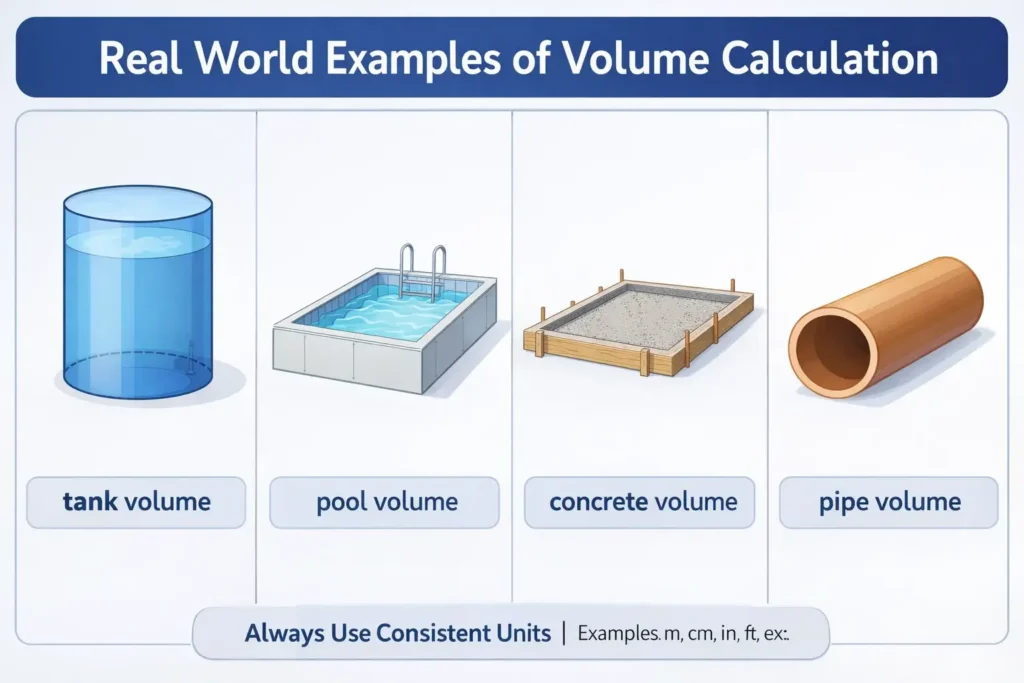
Calculating Tank Volume
Most tanks use the cylinder formula.
You need radius and height to get the total capacity.
- Example, radius = 2 m, height = 5 m
- Volume = π × 2² × 5 = 62.8 m³
Convert this into liters if needed.
62.8 m³ equals 62,800 liters.
This helps plan water storage or fuel capacity.
Calculating Pool Volume
Pools can be rectangular or round.
Choose the correct shape before calculating.
- Rectangular pool example, 10 m × 5 m × 2 m
- Volume = 100 m³
For round pools, use the cylinder formula instead.
This is useful for filling water and adding chemicals.
Calculating Concrete Volume
Concrete work usually uses rectangular prism formulas. Measure length, width, and depth carefully.
- Example, slab = 6 m × 4 m × 0.15 m
- Volume = 3.6 m³
This helps estimate how much concrete to order.
You can connect this with your Concrete Calculator for more detailed planning.
Calculating Soil or Gravel Volume
Landscaping uses area multiplied by depth.
- Example, area = 20 m², depth = 0.2 m
- Volume = 4 m³
This helps avoid overbuying soil or gravel.
Calculating Pipe Volume
Pipes use the hollow cylinder formula.
You need outer radius, inner radius, and length.
- Example, outer = 5 cm, inner = 3 cm, height = 10 cm
- Volume ≈ 502.6 cm³
This is useful for flow and storage calculations.
Real examples make volume easier to understand. They also help reduce mistakes in planning and estimation.
Converting Volume Between Units
After calculation, you often need to convert results into useful units. Raw cubic values are not always practical for real work.
Start with basic conversions:
- 1 cubic meter equals 1000 liters
- 1 cubic foot equals about 7.48 gallons
- 1 cubic inch equals about 0.016 liters
These conversions help you move between measurement systems.
For example, a tank may be measured in cubic meters.
But water is usually filled in liters or gallons.
Always convert after completing the main calculation.
Do not mix units during the formula step.
Here is a simple approach:
- Calculate volume in one consistent unit
- Convert the final result into required units
- Round only at the end for accuracy
This method avoids confusion and keeps results precise. Proper conversion makes your result usable in real situations.
Common Mistakes in Volume Calculation
Many errors come from small steps that seem harmless. Fixing these can improve accuracy without changing your process. One common mistake is choosing the wrong shape. A tank may look like a box but behaves like a cylinder.
Another issue is mixing units during calculation. Using meters and centimeters together gives wrong results. People also forget to square or cube values. Radius must be squared, and some values must be cubed.
Here are frequent mistakes to avoid:
- Using diameter instead of radius in formulas
- Skipping unit conversion before final result
- Ignoring hollow spaces in pipes or containers
- Rounding values too early during calculation
These errors can change results by a large margin.
Always double check each step before finalizing. Accuracy depends on both formula and correct input values.
Tips for Accurate Volume Estimation
Accurate results depend on careful input and simple checks.
These tips help reduce errors in real calculations.
Start by measuring all dimensions more than once.
Small differences can change the final volume result.
Break complex shapes into smaller parts when needed.
Add or subtract volumes to get the final value.
Use consistent units from start to end.
Switch units only after completing the calculation.
Helpful tips to follow:
- Always use radius, not diameter, in circle formulas
- Keep decimal values precise until the final step
- Double check shape selection before applying formulas
- Use simple shapes to approximate irregular objects
If you estimate large projects, combine area and depth correctly. For example, area from a Square Footage Calculator helps calculate volume for soil or concrete. These small habits improve accuracy and save time on corrections.
When to Use Different Volume Formulas
Choosing the right formula depends on the object shape. Using the wrong formula leads to incorrect results. Use simple formulas for regular shapes. Boxes, cubes, and cylinders cover most daily calculations.
Use advanced formulas for irregular or combined shapes. These include frustums, capsules, and hollow structures.
Here is a quick guide:
- Use cube or prism formulas for rooms and containers
- Use cylinder formula for tanks, pipes, and round storage
- Use sphere or hemisphere for domes and rounded ends
- Use hollow cylinder for pipes with empty inner space
- Use frustum for tapered containers or cut cones
Sometimes objects are not perfect shapes. In that case, split them into smaller known shapes. For example, a tank with rounded ends uses two formulas.Combine cylinder and sphere parts to get total volume.
Volume vs Area vs Capacity
These terms are often mixed, but they serve different purposes. Understanding them prevents mistakes in real calculations.
Volume measures the space inside a three dimensional object. It includes length, width, and height together.
Area measures surface size only. It works for flat spaces like floors, walls, and land.
Capacity shows how much liquid or material an object can hold. It is usually expressed in liters or gallons.
Here is a simple comparison:
- Volume uses cubic units like m³ or ft³
- Area uses square units like m² or ft²
- Capacity uses liquid units like liters or gallons
For example, a tank has both area and volume. Area shows surface size, but volume shows total storage. Keeping these differences clear helps avoid wrong results.
Quick Reference of Volume Formulas
Keep these formulas handy for fast calculations.
They cover most shapes used in daily tasks and projects.
- Cube = side³
- Rectangular prism = length × width × height
- Cylinder = π × radius² × height
- Sphere = 4/3 × π × radius³
- Cone = 1/3 × π × radius² × height
- Hemisphere = 2/3 × π × radius³
- Triangular prism = 1/2 × base × height × length
- Square pyramid = 1/3 × base² × height
- Ellipsoid = 4/3 × π × a × b × c
- Conical frustum = 1/3 × π × height × (R² + Rr + r²)
- Hollow cylinder = π × height × (R² − r²)
Use these formulas with correct measurements and units. Always check whether the shape is solid or hollow before calculating. For quick checks, many people rely on a volume calculator. But knowing these formulas helps you verify results easily.
Final Thoughts on Using a Volume Calculator
A volume calculator makes calculations faster and more reliable. It reduces manual errors and saves time in real projects. Still, understanding formulas gives you more control. You can verify results and handle complex shapes with confidence.
Use the right shape, correct units, and proper measurements. These steps ensure accurate and useful results every time. With practice, volume calculation becomes simple and practical.